


From Manual Inspection to AI
Carcass quality assessment is a critical stage in poultry processing, influencing product value, food safety, processing efficiency, and economic losses from downgrading. Conventional inspection depends heavily on trained personnel who visually evaluate carcasses as they move through high-speed processing lines. However, the increasing speed and scale of modern poultry production can make it difficult to maintain consistent inspection standards.
Artificial intelligence (AI) and computer vision are emerging as tools for more objective and continuous carcass assessment. These technologies can analyze carcass images, detect abnormalities, and provide standardized information to support quality-control decisions. Rather than eliminating human expertise, AI can complement inspectors by providing continuous monitoring across processing lines (1,2).
How AI Detects Carcass Defects
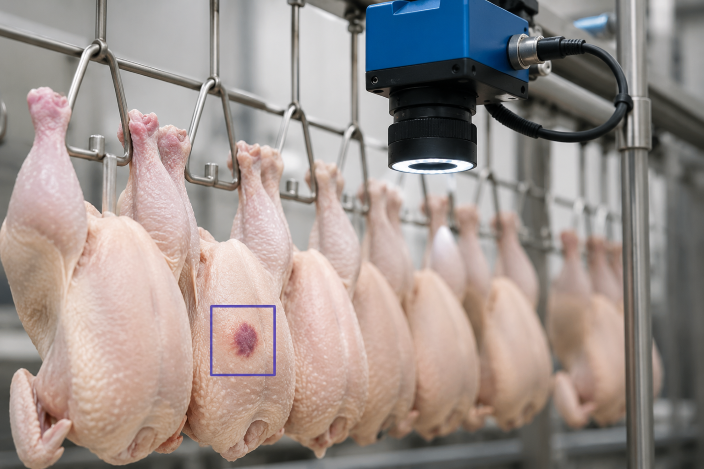
AI-powered grading systems generally combine cameras, image-processing technologies, and machine-learning algorithms. Cameras capture carcass images at specific points along the processing line, while computer-vision systems analyze characteristics such as shape, surface appearance, and visible abnormalities.
Deep-learning models can be trained using large datasets of annotated carcass images. Depending on the model, AI can locate defects, identify affected areas, segment abnormalities from surrounding tissue, and classify different defect types.
One important development is CarcassFormer, an end-to-end Transformer-based framework designed specifically for poultry carcass defect assessment. The researchers developed the model using 7,321 carcass images collected from a pilot processing plant. The system was designed to simultaneously detect, segment, and classify carcass defects, demonstrating the potential of advanced AI architectures for automated poultry inspection (1).
Identifying Problems Along the Processing Line
AI inspection can potentially do more than determine whether a carcass meets quality requirements. It can also help identify patterns of defects associated with different stages of production and processing.
Carcass defects may originate from production conditions, transportation, handling, or processing equipment. The CarcassFormer research considered defects associated with production and transportation and examined abnormalities potentially linked to equipment involved in stunning, scalding, and picking (1).
This creates an opportunity for processors to use inspection data as an early-warning system. For example, a sudden increase in a particular defect could indicate a developing equipment or process problem. Linking defect information with processing parameters could help quality-control teams identify problems earlier and investigate their causes.
Real-Time Quality Control
Processing speed is a major challenge for conventional inspection. Modern poultry plants operate at high throughput, making it difficult for manual inspectors to examine every carcass with the same level of attention.
Previous USDA research demonstrated the feasibility of machine-vision inspection under commercial processing conditions. A multispectral imaging system was evaluated on a processing line operating at approximately 140 birds per minute and was able to distinguish wholesome carcasses from systemically diseased carcasses during online inspection (2).
Modern AI systems can extend this concept by applying deep-learning algorithms to continuous image streams. Integrating automated inspection directly into processing lines could allow carcasses to be assessed continuously rather than relying only on intermittent manual sampling.
Training Data: A Critical Challenge
The performance of an AI grading system depends strongly on the quality, quantity, and diversity of its training data. Poultry processing environments introduce challenges such as changing illumination, carcass orientation, movement, overlapping birds, and natural variation between carcasses.
Creating and manually labeling thousands of real processing-line images can also require considerable time and resources. Researchers are therefore investigating synthetic data as a way to supplement real-world datasets.
A 2025 study found that photorealistic synthetic chicken carcass images could enhance segmentation performance when combined with relatively small real-world datasets. This approach could potentially reduce the amount of manual annotation needed to develop computer-vision models (3).
Toward Smarter Poultry Processing
The next generation of carcass grading could move beyond simple defect detection. AI systems could combine visual inspection with processing-line data to create continuous quality-monitoring platforms.
Such systems could help processors:
- Detect carcass defects automatically
- Monitor changes in defect frequency
- Identify potential processing-equipment problems
- Improve consistency in quality assessment
- Reduce unnecessary downgrading and product waste
- Generate data for process optimization
Nevertheless, commercial implementation requires extensive validation. AI models must remain reliable despite changes in processing speed, lighting, carcass characteristics, and equipment configurations. Human oversight will also remain essential, particularly for regulatory decisions and complex cases that cannot be reliably assessed through imaging alone.
The Future of Carcass Quality Control
AI-powered carcass grading represents a significant step toward data-driven poultry processing. By combining high-speed imaging with machine learning, processors can potentially achieve more consistent inspection while gaining valuable information about where and why quality problems occur.
The technology is still developing, but its ability to inspect carcasses continuously, identify defects objectively, and provide actionable processing data could make AI an increasingly important component of future poultry quality-control systems.
Sources
(1) Tran, M., Truong, S., Fernandes, A. F. A., Kidd, M. T., & Le, N. (2024). CarcassFormer: An end-to-end transformer-based framework for simultaneous localization, segmentation and classification of poultry carcass defect. Poultry Science.
(2) Yang, J., Chao, K., & Kim, M. S. USDA Agricultural Research Service. Machine vision system for online inspection of freshly slaughtered chickens.
(3) Feng, Y., Pallerla, C., Lin, X., Sohrabipour, P., Crandall, P., Shou, W., She, Y., & Wang, D. (2025). Synthetic Data Augmentation for Enhanced Chicken Carcass Instance Segmentation.