


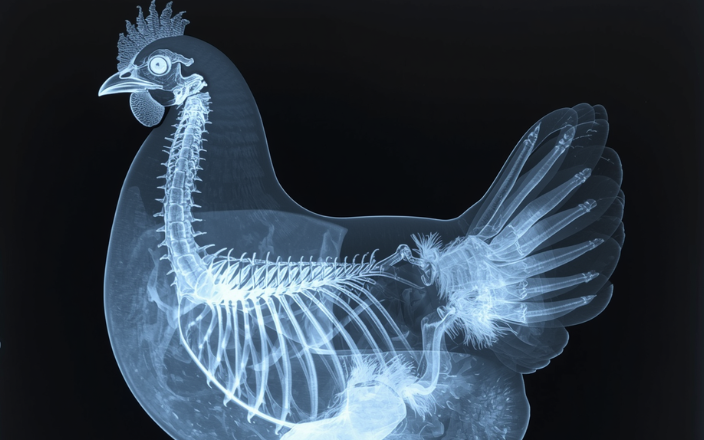
The Challenge of Fragile Bones
Laying hens face a persistent welfare issue: bone fragility. As hens produce eggs, calcium is diverted from their skeletons to form shells, leaving bones brittle and prone to fractures. This not only affects animal welfare but also reduces productivity and farm profitability. Traditional methods of monitoring bone strength—such as manual inspections or post‑mortem analysis—are slow, invasive, and often fail to provide timely insights for preventive action.
Enter Artificial Intelligence and X-ray Imaging
Recent advances in artificial intelligence (AI) combined with X-ray technology are offering a breakthrough solution. AI algorithms can analyze X-ray scans of hens’ bones in real time, detecting subtle changes in density and structure that human eyes might miss. By processing thousands of images quickly, AI can identify early warning signs of osteoporosis or bone weakness before fractures occur. This approach transforms bone health monitoring from reactive to proactive.
How It Works
- X-ray capture: Non-invasive imaging provides detailed views of skeletal structures.
- AI analysis: Machine learning models trained on large datasets recognize patterns linked to bone strength.
- Predictive insights: Farmers receive alerts about hens at risk, enabling targeted interventions.
- Continuous improvement: As more data is collected, algorithms refine their accuracy, making predictions increasingly reliable.
Benefits for Poultry Farming
The integration of AI-driven X-ray diagnostics could reshape poultry management in several ways:
- Enhanced welfare: Early detection reduces painful fractures and improves hens’ quality of life.
- Higher productivity: Healthier hens sustain egg production longer, boosting farm efficiency.
- Cost savings: Preventing bone damage lowers veterinary expenses and reduces losses from premature culling.
- Data-driven decisions: Farmers gain actionable insights to adjust nutrition, housing, or breeding strategies.
Implications for Research and Industry
Beyond immediate farm applications, this technology has broader implications. Researchers can use AI X-rays to study genetic factors influencing bone strength, guiding selective breeding programs. Feed companies may tailor diets to optimize calcium absorption based on real-time skeletal data. Ultimately, the poultry industry could move toward precision livestock farming, where every hen’s health is monitored continuously and interventions are personalized.
Looking Ahead
AI-powered X-ray diagnostics represent a promising step toward solving one of the poultry sector’s most pressing welfare challenges. By combining cutting-edge imaging with machine learning, farmers can fast‑track stronger bones in laying hens, ensuring healthier flocks and more sustainable egg production. As adoption grows, this innovation may become a cornerstone of modern poultry management—where technology safeguards both productivity and animal well-being.
Sources: Available upon request