


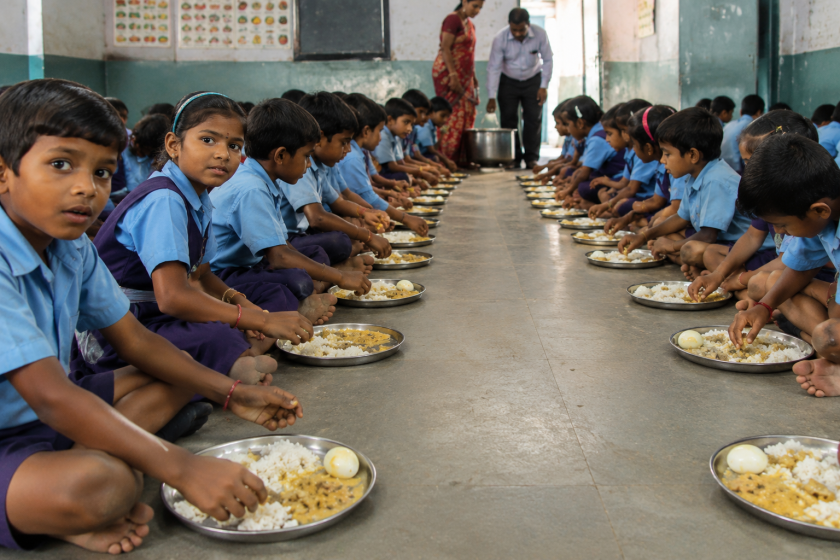
Institutional egg demand in eastern India is about to shrink, and the cause is not disease, feed cost or a price crash. It is a kitchen handover. West Bengal has put its mid-day meal program in the hands of the International Society for Krishna Consciousness, a strictly vegetarian operator, and the egg is the first casualty of that contract change.
For India’s organized layer industry, school feeding schemes have never been a side issue. They are one of the few demand channels with the scale to move national consumption figures, and the sector’s growth over the past two decades has tracked closely with how aggressively states have built eggs into school menus. Bengal’s decision runs the opposite direction, and it is worth asking what it actually removes from the demand side of the ledger, and what it signals about a contracting model the industry may see again elsewhere.
The volume Bengal is taking off the table
Under the outgoing arrangement, Bengal’s government and aided schools served a boiled egg once a week, alongside rice, dal and potato curry on other days. That is a modest frequency by the standards of states like Tamil Nadu, which built its program around three eggs a week, but Bengal’s school-going population is large enough that even a once-weekly egg represents a meaningful, government-anchored volume for the eastern layer belt and the traders who supply it.
That volume is now being replaced, not supplemented, with paneer, rajma, soybean preparations and other pulses. ISKCON’s Kolkata spokesperson, Radharaman Das, has confirmed the menu change and said the organization has empaneled dietitians to design replacement menus that meet the scheme’s protein targets without eggs, meat or fish, all of which fall outside ISKCON’s kitchens by policy.
The state has paired the switch with more money, not less: Finance Minister Swapan Dasgupta told the assembly the per-student material cost for primary meals would rise from around USD 0.07 to around USD 0.11, a roughly 47% increase, which officials frame as the cost of richer vegetarian substitutes rather than a budget cut dressed up as policy. For egg suppliers, the relevant fact is not the higher spend; it is where that spend is now going.

Why mid-day meals matter this much to the egg trade
Tamil Nadu remains the industry’s reference case for why this channel matters. The state introduced a boiled egg into its mid-day meal in 1989, expanded to three eggs a week by 2007, and saw primary-school dropout rates fall alongside it. Industry analysis built on that result has argued that if even eight or nine additional states matched Tamil Nadu’s frequency, institutional demand alone could absorb more than a billion additional eggs annually, a volume large enough to factor into layer flock expansion planning at the farm level, not just retail pricing.
Andhra Pradesh, Telangana and Odisha have moved in that direction, though frequency and district-level rollout vary. Bengal was never going to be the next Tamil Nadu on egg frequency, but a once-weekly egg sustained across the state’s school network was still real, recurring, government-funded demand. Losing it does not crash any single market, but it does subtract a known, stable buyer from a regional supply chain that has otherwise been running on steady NECC-benchmarked pricing and minimal disease disruption this year.
The nutrition case the industry has long made
The egg sector’s standard argument for these schemes is not sentimental, it is nutritional, and on that front the science has not moved against eggs. The Centre’s own Department of Animal Husbandry, Dairying and Fisheries describes the egg as a high-density source of complete protein supplying essential amino acids, vitamins and minerals in one inexpensive, shelf-stable unit.
India’s National Institute of Nutrition goes further, classifying it as a complete food for children.
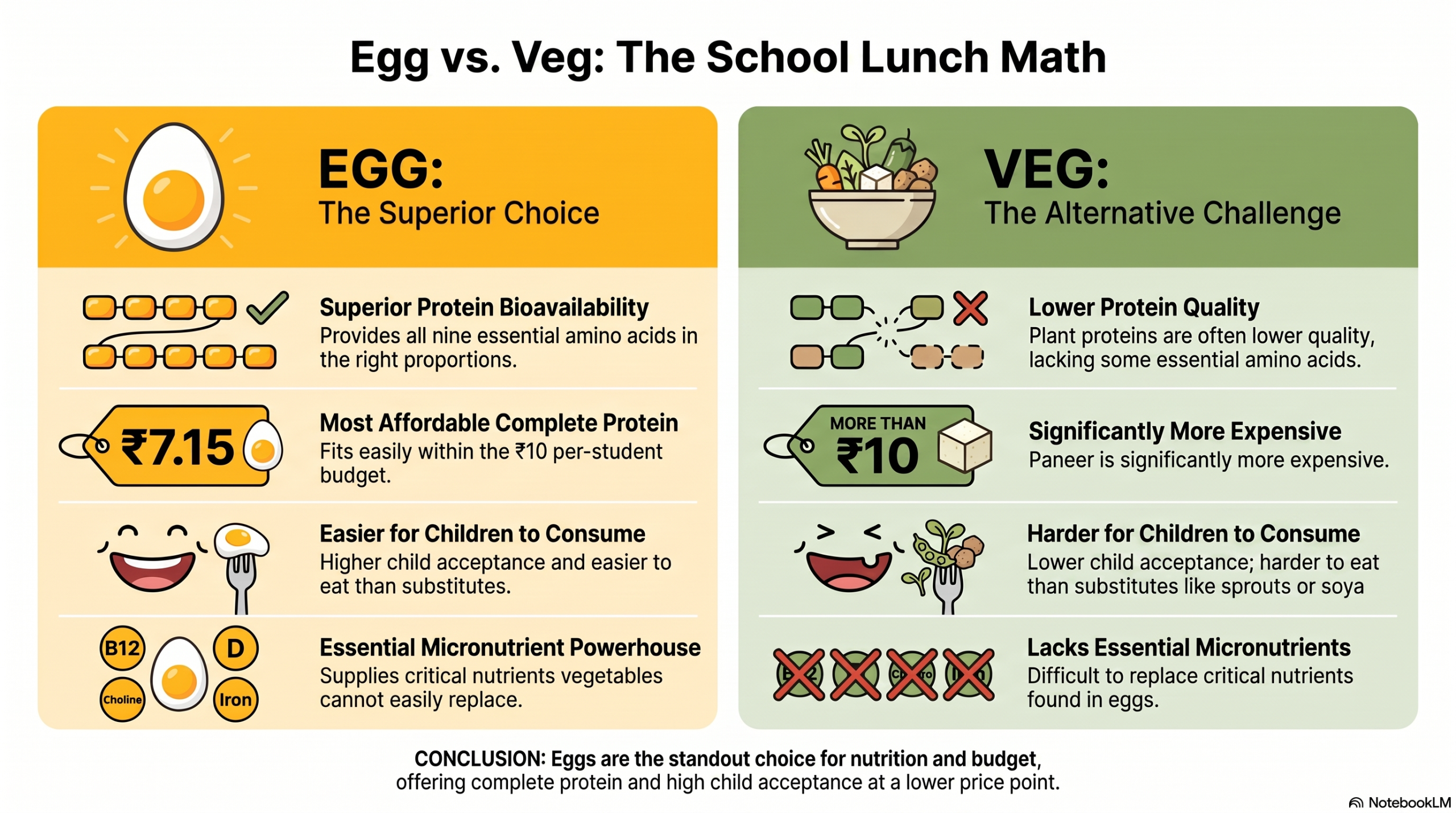
Pulses and soya register as protein on paper but are not a clean substitute. Plant proteins typically run lower on certain essential amino acids and do not supply the bioavailable vitamin B12, vitamin D and choline an egg does, nutrients that matter most for children already at risk of stunting or being underweight. Paneer narrows that gap on protein quality without closing it on micronutrients. It is the argument the industry has made in Karnataka and elsewhere for years, and it applies here with the same force.
There is a behavioral angle too, one that bears directly on whether substitute menus actually deliver the protein they are designed to. Kolkata teachers have told reporters that attendance noticeably rises on egg days, and that it is genuinely uncertain whether children used to eggs will eat rajma or soya chunks with the same willingness. If they do not, the calorie-and-protein math behind the new menu stops translating into nutrition delivered, regardless of what the spec sheet says.
Egg versus veg meal: The nutrient and cost comparison
Stripped of politics, the comparison the scheme actually has to satisfy is a nutrition and budget one. PM POSHAN’s own norm requires a minimum of 450 calories and 8 to 12 grams of protein per meal, and both eggs and the new vegetarian substitutes are being asked to hit that bar within the same per-student spend. Here is how the two options line up, ingredient for ingredient.
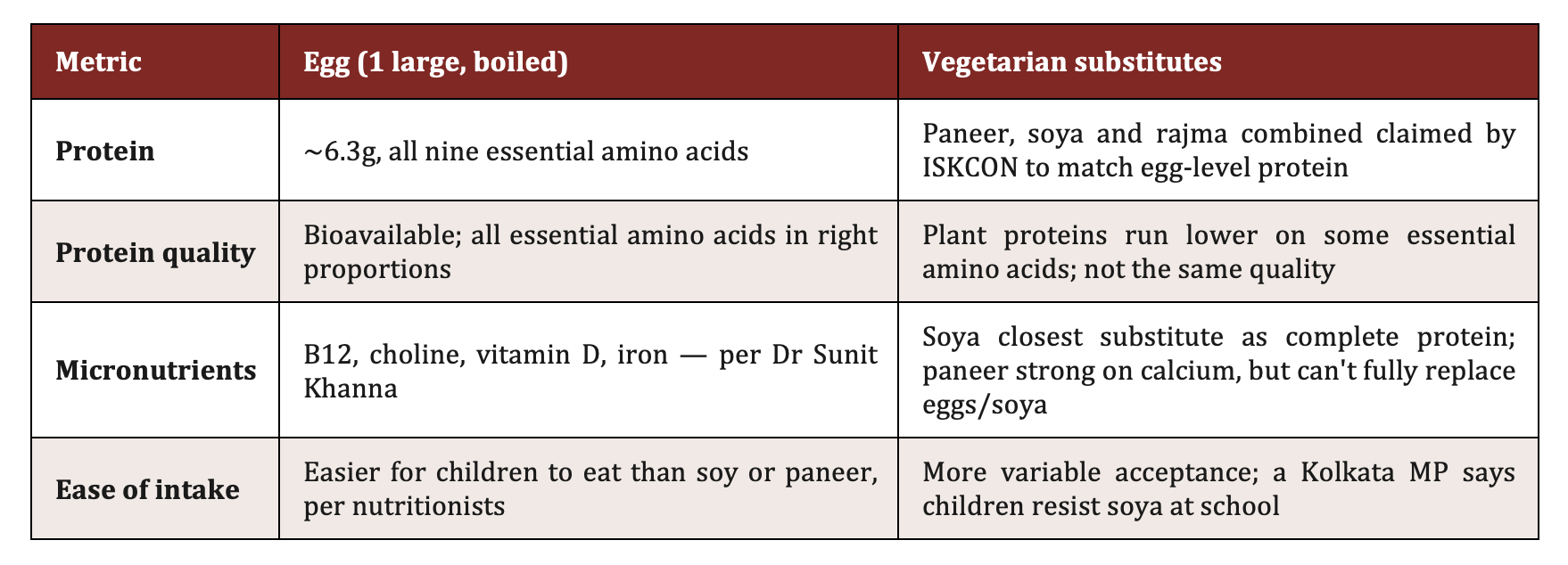
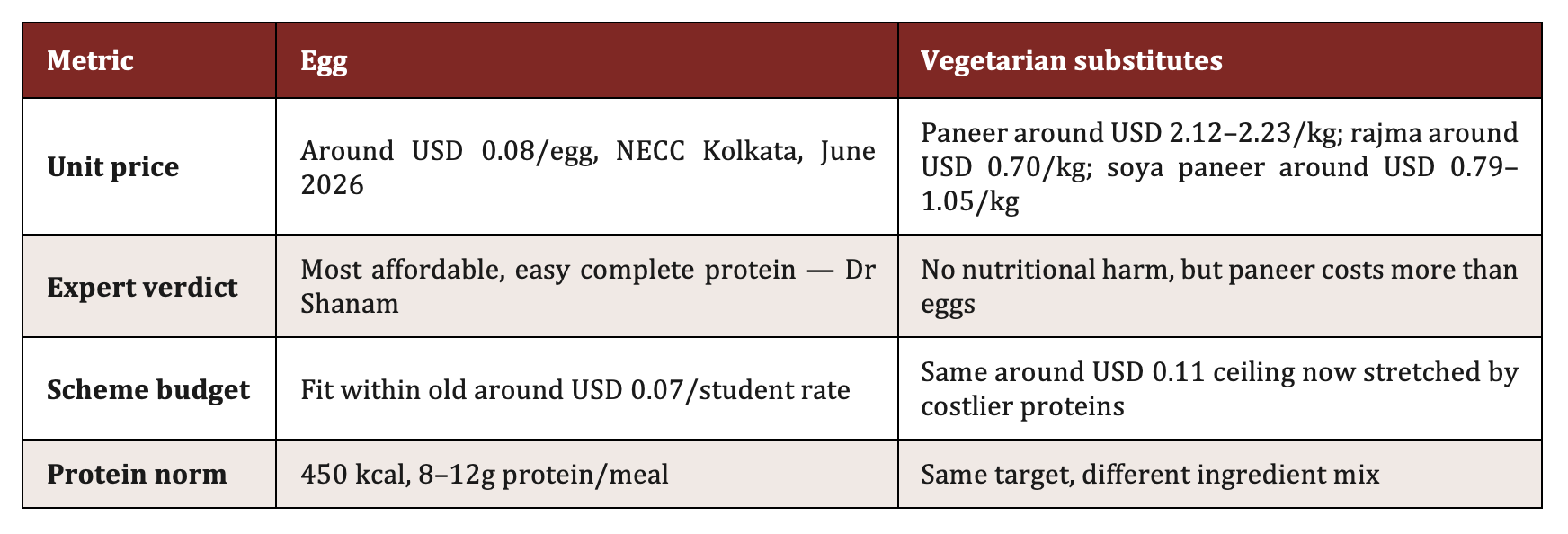


The bottom-line nutritionists keep returning to: the substitute has to be nutritionally equivalent, built on adequate soya, paneer, pulses and dairy, because every child is owed a balanced meal that supports healthy growth. But paneer costs more than eggs, and eggs remain easier for children to eat than sprouts, soy or paneer, which keeps the egg the standout option on a tight per-student budget, even before the political debate enters the picture. Worth flagging for trade readers: ISKCON’s Radharaman Das has since said no final menu has actually been confirmed, so the substitute lineup above is provisional, not locked in.
Politics, briefly, and the part that does not move markets
Opposition politicians have framed the switch as cultural rather than nutritional. Trinamool Congress MP Mahua Moitra told reporters Bengali children have shown little appetite for soya dishes in school settings and challenged officials to justify the change if nutrition, not vegetarianism, is genuinely the goal. “If the reason is not cultural and the reason is not to promote vegetarianism, give me one good reason,” she said.
ISKCON’s response is one of equivalence: that paneer, soya, pulses and dairy collectively meet the scheme’s protein targets, and that vegetarian eating is not foreign to Bengali food culture. Worth noting for trade readers: there is no national mandate either way. PM POSHAN, the Centre’s school-feeding scheme, sets calorie and protein targets, not ingredients, and leaves states free to meet them however they choose. The political fight is real, but it is a state-level argument over discretion the Centre already grants, not a rule change with national implications.
What to watch
Three things are worth tracking from a trade perspective:
- First, whether the contractor model used in Bengal, handing meal delivery to a vegetarian religious body rather than a state-run kitchen, gets replicated in other states currently retendering their school-meal contracts; that is the channel through which this kind of demand loss could compound well beyond Bengal’s borders.
- Second, whether attendance and nutrition indicators in Bengal’s schools move over the coming terms, the same metric Tamil Nadu used to build its case for eggs in the first place, and the one Bengal’s critics are now betting will eventually make the case against removing them.
- Third, whether producer associations or state poultry federations issue a formal response; none had done so at time of writing, though the industry has organized pushback in comparable disputes before, including in Karnataka, where producer and civil-society groups lobbied directly for eggs to be restored to school menus.