


Rethinking the sustainability equation
Alternative poultry production systems are gaining global attention as the industry responds to increasing expectations for animal welfare, environmental responsibility, and transparent food production. Free-range, organic, and other higher-welfare systems are often presented as more sustainable alternatives to conventional production. However, their performance depends on several interconnected factors.
Providing outdoor access does not automatically make a poultry system more sustainable. Producers must consider animal health, feed efficiency, environmental impacts, and economic viability together to determine whether a production model delivers measurable benefits.
Animal welfare: Opportunities and challenges
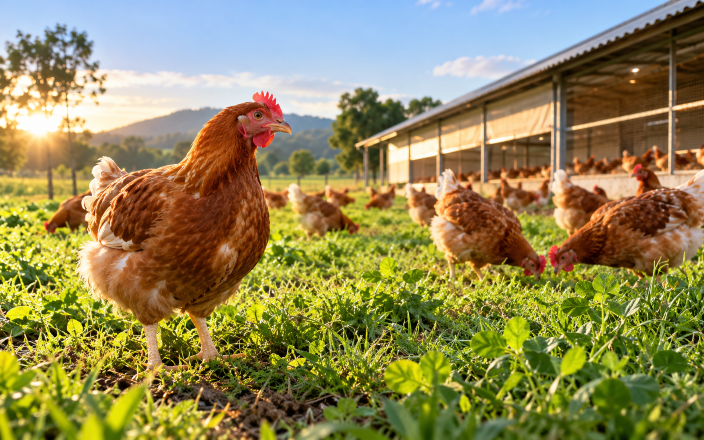
Outdoor-access systems allow chickens to express natural behaviors, including foraging, scratching, dust bathing, and exploring their surroundings. These opportunities can contribute to improved behavioral welfare when outdoor areas are appropriately designed and managed.
However, outdoor access also introduces challenges. Weather extremes, predators, parasites, and uneven use of available space can affect flock health and performance. Some birds may spend little time outdoors, even when access is provided, making range design and management particularly important.
The review by Campbell and colleagues examined differences between outdoor-access and conventional broiler production, highlighting the importance of evaluating welfare, food safety, and meat quality rather than relying exclusively on production-system labels (1).
The objective should be to improve measurable welfare outcomes, not simply to provide access to an outdoor area. Appropriate genetics, stocking density, litter quality, vegetation, shelter, and health monitoring all contribute to achieving this goal.
Feed efficiency remains a critical factor
One of the most important considerations when comparing poultry production systems is the environmental footprint associated with feed production and utilization.
Feed ingredients require land, water, energy, and transportation. Consequently, differences in feed conversion ratio can substantially influence the resources required to produce a kilogram of poultry meat.
Research examining environmental impacts across broiler production systems has highlighted the importance of feed efficiency and other production variables when interpreting sustainability results (2).
In alternative systems, slower-growing broilers or longer production cycles may increase cumulative feed consumption per bird. Depending on performance, diet composition, and production conditions, this can increase resource requirements per kilogram of meat produced.
Nevertheless, these outcomes are not inevitable. Improving feed conversion, reducing feed wastage, and sourcing ingredients responsibly can help limit environmental impacts without compromising animal welfare.
Managing environmental impacts beyond the poultry house
Alternative systems must also address manure management, nutrient losses, energy consumption, and the environmental condition of outdoor areas.
Repeated use of the same range can concentrate nutrients around poultry-house entrances and feeding locations. Without appropriate management, this may contribute to soil degradation, nutrient accumulation, and potential contamination of nearby water resources.
Rotating outdoor areas, maintaining vegetation, distributing resources strategically, and managing manure according to nutrient requirements can help reduce these risks.
Inside the poultry house, ventilation, litter management, and temperature control remain essential for maintaining suitable environmental conditions. These measures are particularly important when birds have access to outdoor areas but spend substantial time indoors during unfavorable weather.
Measuring sustainability through practical indicators
Producers should evaluate alternative systems using a combination of indicators rather than relying on marketing claims or production labels.
Three areas deserve particular attention:
| Animal welfare: Monitor mortality, mobility, footpad condition, injuries, and behavioral opportunities. | Environmental performance: Assess feed conversion, energy consumption, feed sourcing, manure management, and outdoor-range condition. | Economic viability: Consider additional labor, land requirements, infrastructure, veterinary expenses, and potential market premiums. |
Comparisons should use consistent functional units, such as environmental impact per kilogram of meat produced, while also reporting welfare outcomes and relevant production characteristics. This approach helps avoid misleading conclusions when systems differ in slaughter age, growth rate, or final body weight.
The future of alternative poultry production
The future of alternative poultry production will depend on combining credible welfare improvements with efficient resource use and sound farm economics.
No single production model will deliver the same results under every climate, market, or management system. The priority is to identify the practices that produce measurable welfare benefits while maintaining flock health, environmental responsibility, and long-term farm viability.
References
(1) Campbell, Y. L., Walker, L. L., Bartz, B. M., Eckberg, J. O., & Pullin, A. N. (2025). Outdoor access versus conventional broiler chicken production: Updated review of animal welfare, food safety, and meat quality. Poultry Science, 104(4), 104906.
(2) Kyriazakis, I., Dokou, S., Taylor, J., Giannenas, I., & Murphy, E. (2025). A meta-analysis of the sources of variation in the environmental impacts of different broiler production systems. British Poultry Science, 66(2), 193–205.