


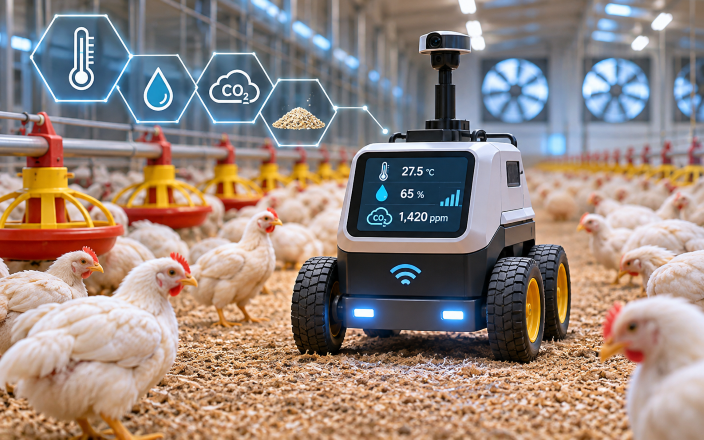
Mobile robotics and smart sensing are emerging as new tools for monitoring broiler-house conditions, offering producers a more detailed picture of the environment experienced by birds.
Beyond Conventional Poultry-House Sensors
Broiler-house equipment is evolving beyond traditional ventilation, feeding and climate-control systems. A growing research trend is the integration of mobile robots and intelligent sensors capable of collecting environmental data directly at bird level.
A study published in Results in Engineering in December 2025 introduced RobôFrango, a mobile biosensor robot developed to monitor environmental conditions inside commercial broiler houses. Unlike conventional fixed sensors, the robot moves through the poultry house, collecting real-time information about temperature, humidity, carbon dioxide and litter conditions (1).
Why Mobile Monitoring Matters
The research identified important differences between measurements collected by the mobile robot and those obtained from conventional fixed sensors. For example, relative humidity measured by the robot exceeded 65%, compared with readings below 60% from fixed monitoring equipment. Carbon dioxide concentrations were also substantially higher at bird level.
These findings suggest that conventional sensor positioning may not always reflect the actual environmental conditions experienced by broilers.
The robot achieved 77.5% accuracy in semi-autonomous navigation, demonstrating the potential of mobile equipment to identify environmental variations that might otherwise remain undetected.
Smart Equipment and More Precise Management
This development reflects a wider movement towards precision livestock farming. A 2025 review published in Animals highlights the growing application of technologies such as computer vision, infrared thermography, RFID and sound analysis in broiler production (2).
For producers, integrating mobile monitoring with existing ventilation and climate-control equipment could support earlier identification of environmental problems, more targeted interventions and improved management decisions.
The next step will be translating these research prototypes into reliable, commercially scalable equipment that works alongside existing poultry-house systems.