Broiler Heat Management in Tropical Climates: The Combi-Tunnel Solution
Introduction
Achieving optimal broiler performance in tropical climates presents significant challenges due to fluctuating temperatures and high humidity.
While observed outcomes like broilers reaching market weight of 1.7-1.9 kg despite temperature swinging from 23°C to 35°C and a dew point of 17°C can seem successful, they raise crucial questions about the sustainability and consistency of performance in such unpredictable conditions. This article delves into the critical aspects of broiler heat loss, analyzes a real-world case study from Nepal, and explains why advanced ventilation systems like Combi-Tunnel are essential for consistent, efficient, and healthy growth in challenging environments.
- My personal observations from a field visit to a broiler poultry farm in Nepal during the summer of 2025 revealed significant temperature fluctuations, yet the birds maintained an impressive average market weight of 1.7-1.9 kg.
- This seemingly successful outcome prompted a deeper analysis into why Combi-Tunnel Ventilation Systems are particularly effective in such tropical microclimates.
- It also led me to critically analyze how such temperature and humidity swings impact flock health and performance, reinforcing the belief that a Combi-Tunnel Ventilation System offers the most adaptive solution for these dynamic conditions.
Understanding How Broilers Lose Body Heat
Broilers continuously generate internal heat through their metabolism. A fully grown bird, for instance, produces about 13 BTU/lb/hr of internal heat. This internally generated heat must be dissipated efficiently to prevent the birds from overheating and suffering from heat stress.
They primarily rely on two fundamental mechanisms to lose body heat:

Sensible Heat Loss: This type of heat loss occurs when heat is transferred directly from the bird’s body to the cooler surrounding air.
- This process largely happens through the bird’s skin and comb.
Sensible heat loss is most effective when the surrounding air is cooler than the bird’s body temperature and is moving, indicating the crucial role of effective ventilation in facilitating this process.
Latent Heat Loss: This mechanism involves the loss of heat through evaporation. For broilers, this primarily occurs during panting, where moisture evaporates from their respiratory tracts, carrying heat away from the body. This method of heat dissipation is most effective when the surrounding air is dry, meaning it has low humidity, allowing for greater evaporative cooling.
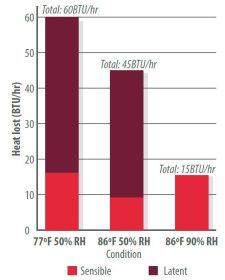

Understanding the interplay between these two mechanisms under varying environmental conditions is vital. For example, consider a 5-lb broiler under different climate conditions:
- At 77°F and 50% Relative Humidity (RH), a bird loses a total of 60 BTU, with 16 BTU via sensible heat and a dominant 44 BTU via latent heat.
- At 86°F and 50% RH, total heat loss drops to 45 BTU, comprising 9 BTU sensible and 36 BTU latent, still predominantly latent.
However, at 86°F and 90% RH, the situation changes dramatically. The bird can only lose a mere 15 BTU, entirely through sensible means, as latent cooling becomes completely ineffective (0 BTU). This highlights a crucial insight: in high humidity, latent cooling fails, and birds cannot shed enough heat, significantly risking heat stress. This inability to dissipate heat effectively can lead to severe physiological stress and reduced performance.
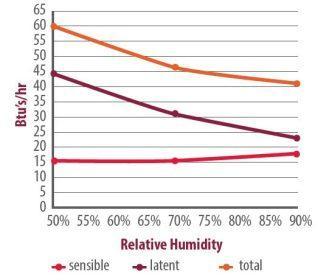
The Figure 1 illustrates the critical impact of relative humidity on a bird’s cooling ability. As humidity increases, birds progressively lose less heat through evaporation (latent heat). While they may attempt to compensate with a minimal increase in sensible heat loss, this is often insufficient, leading to a significant drop in their total cooling ability. This phenomenon underscores why high humidity is so detrimental to broiler comfort and health, even if temperatures are not excessively high.
The importance of air movement in heat dissipation cannot be overstated. The graph demonstrates how increasing air speed can dramatically shift the dominant heat loss mechanism, thereby reducing a bird’s reliance on humidity-sensitive latent cooling.
- At an air speed of 100 ft/min, a bird loses 28% of heat through sensible means and a significant 72% through latent means (panting).
- However, when the air speed increases to 600 ft/min, the balance shifts: 52% of heat is lost sensibly, and 48% is lost latently.
This key insight shows that higher air speed shifts heat loss from panting (latent) to air cooling (sensible), thereby reducing the bird’s dependency on humidity-sensitive latent cooling. This is particularly vital in humid tropical environments where evaporative cooling is often compromised.


Nepal Case Study: The Challenges of Heat Stress
During a recent poultry farming project in Nepal’s lowland region, broilers housed in environmentally controlled houses exhibited clear signs of heat stress, such as:
- Panting, poor feed intake, and reduced growth, even though cooling systems like evaporative cooling pads were in use.
This observation prompted a deeper analysis into the underlying causes of heat stress in this challenging tropical environment.
The critical issues identified in this specific scenario were:
- The cooling pads, while lowering temperature, inadvertently increased humidity inside the poultry house. This created an environment where the air was already saturated with moisture.
- Consequently, the birds were unable to effectively evaporate moisture from their bodies, meaning their crucial latent cooling mechanism was blocked.
- Furthermore, the air speed within the houses was too low to adequately support sensible cooling, which would have been necessary to compensate for the failing latent heat loss.
- This combination created a perfect storm for heat stress.
A detailed look at broiler house environmental parameters from a similar environmentally controlled house provides context for the scale and complexity of the operation:
- A substantial bird population of 22,000 broilers at 28 days old.
- Housed in a large structure with dimensions of 400 ft × 36 ft × 7.5 ft, equating to a total volume of approximately 3,058 m³.
- The indoor target temperature for the house was set at 24°C.
These foundational parameters are crucial for various technical calculations, including the estimation of water vapor load inside the house, determining the minimum air exchange needed to remove excess moisture, and evaluating the overall performance of the ventilation system under variable humidity conditions. Such calculations are vital for optimizing environmental control strategies.
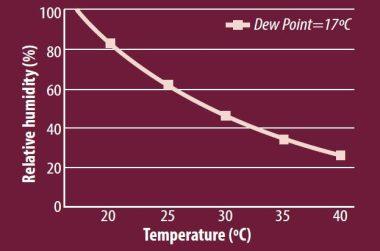

Beyond basic temperature and humidity, monitoring the dew point temperature is crucial for effective environmental management. The dew point temperature is the point at which relative humidity reaches 100%.
- From this, it’s possible to estimate the expected relative humidity at various temperatures within the poultry house, guiding the selection of the appropriate ventilation system mode.
- For optimal bird comfort and health, the goal is to consistently maintain the relative humidity (RH) between 40% and 60% in the poultry house.
- When the dew point temperature is below 10°C, managing relative humidity within this ideal range becomes significantly more feasible, indicating better conditions for evaporative cooling and overall bird comfort.
- In this case it was 17°C was difficult to manage humidity at requested temperature of 24°C .
Lessons Learned for Tropical Poultry Management
The Nepal case study provides vital lessons for effective poultry management in humid, tropical regions, particularly when designing and operating environmentally controlled houses:
- Monitor both temperature and humidity diligently: Relying solely on temperature can be misleading in humid environments. Both parameters must be tracked continuously to get a complete picture of the birds’ comfort levels. In this case the temperature was in the range of 35°C to 23°C.
- The ventilation system was operating in all mode i.e. minimum to tunnel mode in 24 hours. Mostly from 2am to 8 am it was in minimum ventilation mode. As the dew point was 17°C, calculated relative humidity at requested temperature 24°C was 65% but because of wet litter it was more than 65%. With high humidity, the air exchange rate during minimum ventilation stage was quite high. It was more than 110000 cfm according to humidity removal rate (water consumption of the flock per day was 5500+ litters).
- When we compare this air exchange rate, the side fan requirement is much higher. Usually we design fan capacity for minimum ventilation is equal to the 3 minutes for whole house air exchange. Here it was more than the assumed one.
- So, in tropical region with high humidity and high temperature the required maximum air capacity for minimum ventilation mode is much higher and need extra fans to coup than another region.
- Utilize air speed to enhance sensible cooling: In situations where, latent cooling is compromised by high humidity, increasing air speed becomes critical. Proper airflow can significantly improve sensible heat loss, compensating for reduced evaporative cooling and helping to mitigate heat stress in the tunnel ventilation mode.
- Avoid overusing cooling pads in environments already prone to high humidity: While cooling pads are effective at reducing air temperature, their operation adds moisture to the air. In already humid climates, this can push the relative humidity too high, making it impossible for birds to cool themselves through panting. A careful balance or alternative cooling strategies might be needed.
- Aim to maintain relative humidity (RH) below 70% for effective bird cooling: Keeping the RH below this threshold is essential for allowing birds to effectively use their latent cooling mechanism.
- Exceeding 70% RH severely impairs evaporative heat loss, leading to increased heat stress even at moderate temperatures.

What Defines a High-Performing Broiler House?
In modern poultry farming, success is no longer measured by birds’ weight alone. It’s about achieving consistent, efficient, and healthy growth through optimized environmental control. Several key performance indicators (KPIs) help benchmark how well an environmentally controlled (EC) broiler house is functioning, reflecting its overall efficiency and profitability:
- Hourly temperature alignment with set points: This KPI reveals the climate control system’s ability to maintain environmental stability within the broiler house. Even minor deviations from the set temperature can negatively impact bird comfort, reduce feed intake, and slow down growth rates, emphasizing the need for precise control.
- Balanced air speed and humidity: This is the hallmark of a truly reliable and effective ventilation system. Proper airflow, combined with controlled humidity levels, is critical for reducing heat stress, controlling harmful ammonia levels, and maintaining dry litter. All these factors are essential for promoting optimal flock health and preventing respiratory issues or footpad lesions.
- Energy consumption per kg of live bird: In an era of rising energy costs and environmental awareness, this is a critical sustainability metric. Efficient environmental control systems deliver optimal performance with lower energy inputs, thereby maximizing profitability while simultaneously reducing the operation’s environmental impact.
These metrics are not just numbers; they are, in essence, the pulse of a broiler operation, providing a comprehensive overview of its health and efficiency. Strategic ventilation, particularly advanced systems like Combi-Tunnel Ventilation, directly influence these KPIs. They are especially crucial when facing the challenges posed by fluctuating conditions prevalent in tropical climates, ensuring that the farm remains productive and profitable.
Conclusion
- This case study from Nepal, combined with a detailed understanding of broiler heat loss mechanisms, underscores the paramount importance of precise environmental control in poultry farming, especially in humid tropical regions.
- Farmers must delicately balance ventilation strategies with humidity control to ensure bird comfort and optimize performance.
- The physiological principles of sensible and latent heat loss, particularly their vulnerabilities in high- humidity conditions, dictate the need for robust ventilation solutions.
- Combi-Tunnel Ventilation Systems offer an adaptive and effective solution for dynamically managing environments characterized by temperature and humidity swings.
- In India and Southeast Asia, most broiler farms still rely on pure tunnel ventilation systems. However, during the rainy season, the minimum ventilation mode often leads to excessively high air exchange rates.
- Because these houses generally lack side inlets and side fans, the result is an unintended chilling effect that stresses the flock and worsens feed conversion ratio (FCR).
- I observed this firsthand during a recent visit to Nepal, where such a pure tunnel house clearly demonstrated these challenges.
- By providing the flexibility to shift between different ventilation modes, these systems can optimize air speed and air exchange rate in minimum ventilation mode with side inlets to enhance sensible cooling when latent cooling is compromised, directly influencing critical KPIs.
- Ultimately, implementing such advanced ventilation technologies is crucial for promoting sustainable, consistent, and high-performing broiler operations in challenging tropical climates.