


Rethinking lighting beyond visibility
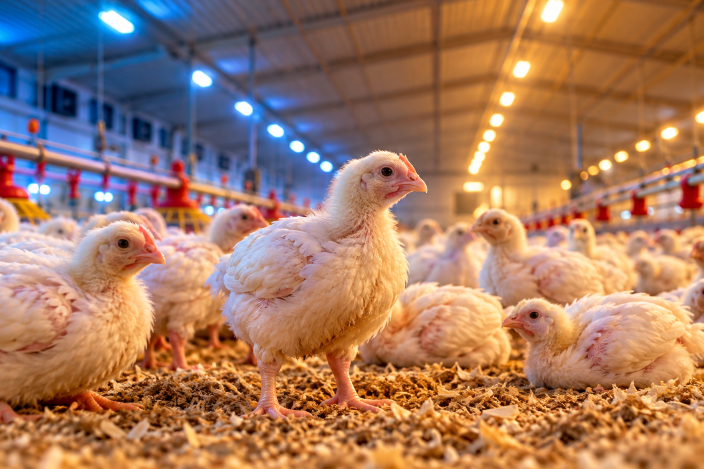
Lighting is an essential component of broiler management, influencing behavior, physiological responses, and production performance. However, conventional poultry-house lighting programs may not fully account for chickens’ visual biology. Recent 2026 research suggests that adapting light spectrum, intensity, and daily transitions to broilers’ needs could improve selected welfare indicators.
Full-spectrum lighting and physiological stress
A study published on October 9, 2026, in the International Journal of Poultry Science investigated tetrachromatic, full-spectrum LED lighting designed to reflect chickens’ visual sensitivity (1).
Researchers compared conventional white LED lighting with a full-spectrum system in 60 broiler chicks over 30 days. Birds exposed to the experimental lighting had higher final body weights, lower corticosterone concentrations, and changes in antioxidant indicators consistent with improved oxidative balance.
Corticosterone is commonly used as an indicator of physiological stress in poultry. However, the small sample size and short experimental period mean that these findings should be considered preliminary, rather than proof of benefits under commercial production conditions.
Dynamic lighting and leg health
Additional evidence comes from a study published in Animals on October 6, 2026 (2). Researchers evaluated integrated dynamic LED lighting programs in two experiments involving 960 broilers each.
The first experiment compared conventional white lighting with a blue-emphasis program that gradually reduced light intensity and extended the dark period. Birds under dynamic lighting showed improved growth performance, lower stress indicators, and reduced physical asymmetry.
In the second experiment, researchers added gradual red-light transitions at dawn and dusk. This additional transition improved tibial breaking strength and reduced stress indicators without compromising growth performance.
These findings are particularly relevant because skeletal health, fear responses, and stress are important components of broiler welfare. Nevertheless, the experimental results require validation across commercial farms, breeds, housing systems, and lighting schedules.
Implications for poultry producers
Programmable LED systems could give producers greater control over the birds’ light environment while supporting welfare-oriented management. Potential benefits include more gradual transitions between light and darkness and lighting programs that consider both behavioral and physiological responses.
Before changing farm protocols, producers should evaluate the effects of any lighting program on activity, resting behavior, gait, skeletal health, and flock performance. Lighting must also provide adequate conditions for birds to access feed and water and perform normal behaviors.
Lighting should be considered a management tool for poultry welfare, not simply a means of illuminating the house. Emerging research supports further investigation into chicken-specific lighting, but commercial recommendations should be based on replicated trials and comprehensive welfare assessments.
References
(1) Hernanda, A. S., Tansil, J. E., Xie, J. H. M., Liem, A., Palupi, T. D. W., & Novianti, A. N. (2026). Effects of Tetrachromatic Full-Spectrum LED Lighting on Growth Performance, Physiological Stress and Antioxidant Levels in Broiler Chickens: Implications for Welfare and Sustainable Poultry Production. International Journal of Poultry Science.
(2) Watson, P. B., Jiral, E., Grimes, M., & Archer, G. S. (2026). The Effect of Broiler-Targeted Lighting Programs on Productivity, Health, and Welfare. Animals, 16(19), 3127.