


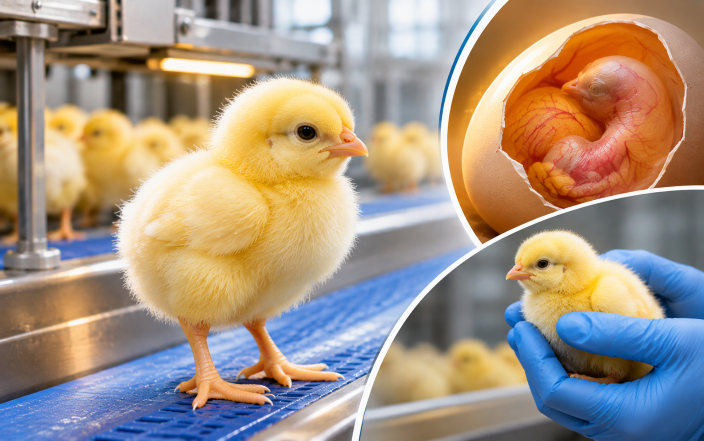
The Hidden Welfare Challenges of Chick Processing
Chick welfare is receiving renewed scientific attention as poultry production systems become increasingly automated. While traditional welfare programs focus on nutrition, hydration, temperature and transportation, the mechanical handling of newly hatched chicks is emerging as another important area for improvement.
Commercial hatcheries process thousands of chicks per hour through a series of operations, including sorting, vaccination, sexing and other procedures. Although automation improves processing efficiency, the equipment and holding systems used during these operations can expose chicks to physical pressure, disorientation, fear and injuries.
Recent scientific research is providing new insights into how these procedures affect newly hatched birds and how welfare assessments could become more precise.
Could Chicks Experience Stress Before Hatching?
An important development in poultry welfare research concerns the neurological development of chick embryos.
A systematic review published in Frontiers in Veterinary Science in October 2025 examined scientific evidence regarding when chick embryos develop the capacity to experience pain and suffering.
The researchers concluded that the capacity to experience pain, distress or other prolonged negative welfare states may begin around embryonic day 18, approximately three days before hatching, and potentially earlier (1).
This finding raises important questions about how hatchery operations should be designed. Welfare considerations may need to extend beyond the moment chicks emerge from their shells, taking into account their developmental stage during late incubation.
The review also highlights the importance of examining the entire hatchery process, particularly mechanical operations and handling procedures that may expose chicks to avoidable physical harm.
Processing Equipment Under Scientific Investigation
A particularly relevant development appeared in Poultry Science in 2026, where researchers investigated how different chick-holding devices influence welfare during hatchery processing.
The study, conducted by Jhetam and colleagues, compared three holding-device configurations used during chick processing. Researchers assessed several welfare indicators, including heart rate, body temperature, fear responses, disorientation, bruising and inflammatory biomarkers.
The results demonstrated that equipment design can influence chick welfare, even during routine hatchery operations.
Chicks processed using the original holding-device configuration showed greater disorientation and fear responses, alongside lower surface body temperatures. Researchers also identified differences in bruising and inflammatory responses between equipment configurations.
Importantly, the modified Hatchling Support System, incorporating improved head space and body support, produced better welfare outcomes (2).
Another significant contribution was the identification of potential stress and inflammatory biomarkers in chick down feathers, offering a promising non-invasive approach to welfare monitoring.
Turning Research into Practical Hatchery Improvements
These findings suggest that hatchery welfare assessments should examine not only the final condition of chicks but also their experience throughout individual processing stages.
Several practical considerations deserve attention:
🐣Equipment design: Holding devices should accommodate differences in chick size and provide appropriate head and body support.
🐣Mechanical safety: Conveyor belts, transfer points and processing equipment should be regularly inspected to minimize falls, trapping and injuries.
🐣Handling procedures: Staff training and appropriate handling techniques can help reduce unnecessary physical stress.
🐣Welfare monitoring: Physical indicators, behavioral observations and emerging biomarkers can help identify problems associated with specific processing operations.
🐣Continuous evaluation: Hatcheries should assess equipment performance and welfare outcomes across different chick strains and sizes.
Moving Towards a More Comprehensive Welfare Approach
The growing body of research suggests that chick welfare cannot be evaluated solely through mortality rates or physical appearance at delivery.
The design of hatchery equipment, the handling of newly hatched birds and even the developmental stage of embryos should form part of a broader welfare strategy.
For poultry producers, the challenge is to combine processing efficiency with systems that minimize avoidable stress, injury and suffering. As scientific assessment methods advance, hatcheries have an opportunity to make welfare monitoring more objective and integrate it into everyday operational management.
References
(1) Mace, J. L., & Knight, A. (2025). Development of the capacity to suffer in embryos and chicks: A systematic review of relevant studies. Frontiers in Veterinary Science, 12, 1698528.
(2) Jhetam, S., et al. (2026). Different chick processing holding devices reveal welfare and stress effects via novel down-feather biomarkers. Poultry Science, 105(5), 106595.