


Political pressure builds over fast-growing chickens
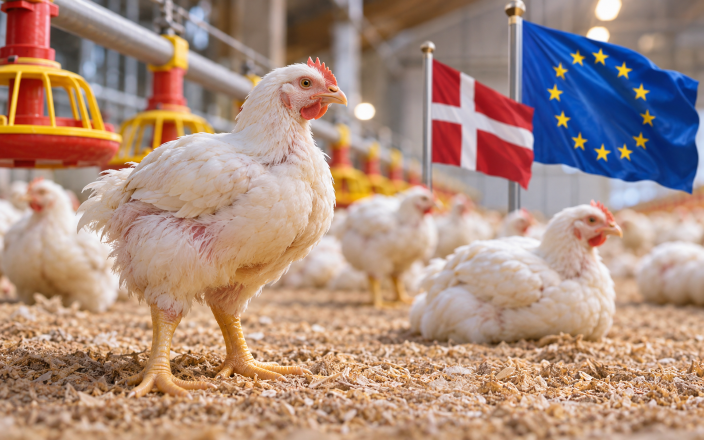
Denmark is intensifying the debate over broiler welfare, with calls for restrictions on fast-growing chicken breeds gaining momentum following renewed public scrutiny of intensive poultry production.
On November 3, 2026, reports revealed that Denmark is pursuing a possible national ban on fast-growing Ross 308 chickens, while also encouraging the European Union to consider wider restrictions. The debate follows a television investigation into poultry production practices and concerns about the welfare consequences of rapid growth .
The proposal has not yet become law. Danish authorities are examining its legal and economic implications, while industry representatives warn that national restrictions could increase reliance on imported chicken meat.
Scientific evidence strengthens welfare concerns
The discussion reflects findings from scientific research examining the relationship between growth rate and animal welfare.
A 2024 review published in Frontiers in Animal Science, analyzing 63 scientific papers, found that slower-growing commercial broiler strains generally performed better in several welfare indicators. Compared with slower-growing strains, fast-growing birds showed higher mortality risk, poorer walking ability and more contact dermatitis (1).
Another review published in Animals in November 2024 found that rapid growth was associated with increased leg disorders, cardiovascular problems, reduced activity and greater susceptibility to heat stress (2).
Implications for the European poultry industry
The debate extends beyond Denmark. The European Commission is expected to present a targeted revision of animal welfare legislation covering broilers and laying hens by the end of 2026. The proposed changes are expected to address practical welfare indicators and equivalent requirements for imported products (3).
For poultry producers, the growing pressure on fast-growing genetics could have significant implications for breeding strategies, production costs, feed efficiency and international trade. The challenge will be balancing animal welfare improvements with affordability and the competitiveness of European poultry production.
References
1. Nicol, C. J., Abeyesinghe, S. M., & Chang, Y. M. (2024). An analysis of the welfare of fast-growing and slower-growing strains of broiler chicken. Frontiers in Animal Science, 5.
2. Riber, A. B., & Wurtz, K. E. (2024). Impact of Growth Rate on the Welfare of Broilers. Animals, 14(22), 3330.
3. European Commission. (2026). Revision of EU animal-welfare legislation.