


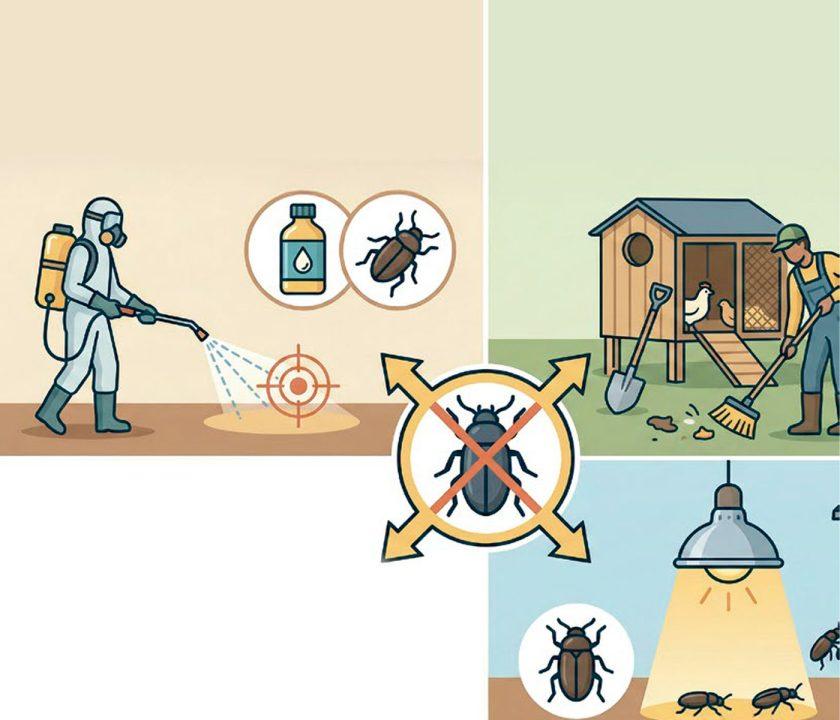
Alphitobious diaperinus known as lesser mealworm, darkling beetle, or Panzer is one of the most important insect pests of poultry facilities and grain storage facilities worldwide. It is recognized as a vector of numerous diseases, and their colonies damage insulation materials of poultry houses. Then, infestations of these insects can compromise structural integrity and thermal efficiency of these facilities. Eventually, A. diaperinus can cause allergic reactions in humans who come into frequent contact with these insects. These beetles can migrate and when litter is spread near residential areas they can become a nuisance for neighbors.
- The heavy application of chemical insecticides used to control this pest has led to resistance, and environmental contamination that may lead to residue problems in poultry products.
- Consequently, an integrated pest management strategy is necessary to control A. diaperinus.
- Multiple eco-friendly control methods have been tested.
- These methods include use of entomopathogenic fungi, bacteria, plant extracts, pheromones, and diatomaceous earth. Some of these methods will be discussed in this article.
Biology of Alphitobius diaperinus
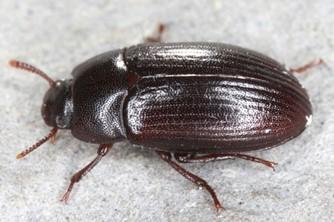
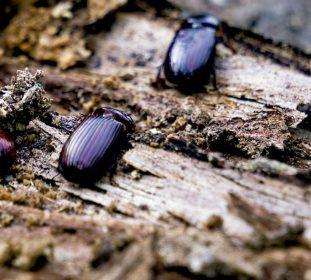
The Alphitobius diaperinus seems to have originated in sub-Saharan Africa and has spread worldwide. Adults are roughly oval in shape, 6 mm long, and shiny black in color. Larvae develop six to 11 instars, reaching a length of up to 11 mm in the last instar. Their preferred habitat is under litter, and they are primarily nocturnal, active at dusk.

Alphitobius diaperinus as a disease vector
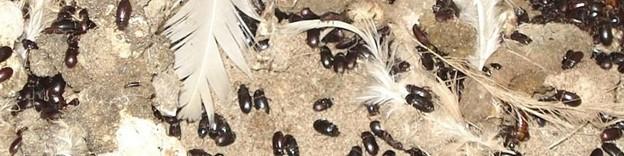
Darkling beetles can be intermediary hosts for Raillietina cesticillus, a poultry tapeworm, and Histomonas meleagridis, a protozoan parasite for turkeys. They can also transmit and serve as reservoirs for Salmonella typhimurium, and fungi like Aspergillus flavus. They are ingested by birds and transmit the pathogenic agents including antibiotic-resistant bacteria directly and can also perpetuate multiple bacteria, fungi, and parasites in a poultry facility across multiple flocks.
The A. diaperinus infestations can tunnel through multiple construction materials and damage polystyrene, polyurethane, and fiberglass. They can proliferate faster on wooden surfaces than in concrete.

Chemical control
Multiple pesticides have been used to control A. diaperinus. In Table 1 we provide a comprehensive, but no exhaustive list of categories and products used for lesser mealworm control. The list includes the indicated concentration of the product used. These chemical classes include pyrethroids, organophosphates, neonicotinoids, insect growth regulators like pyriproxyfen, macrocyclic lactone, neonicotinoid, and borates.

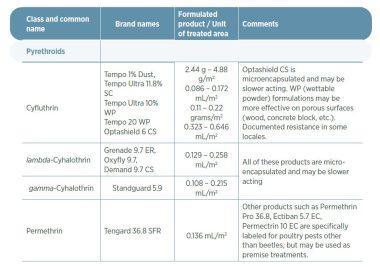
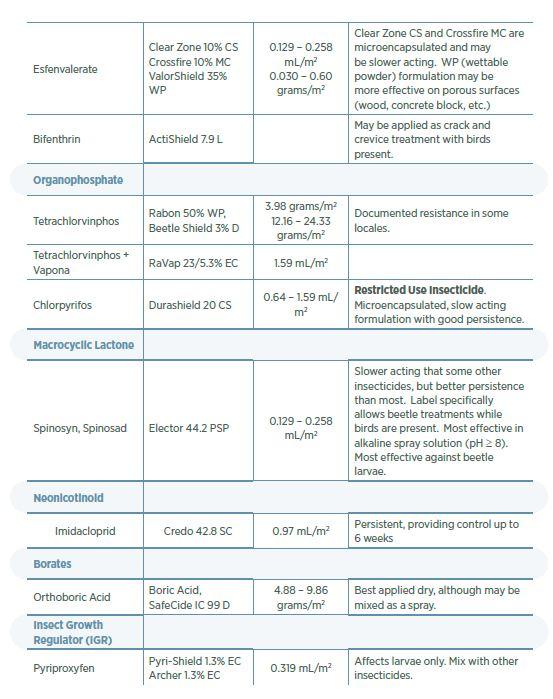

These products may have around 37 recognized modes of action (MOAs). However, only five products are commonly used in poultry operations. Producers often rotate products without understanding MOA differences, leading to resistance buildup. The lack of education on MOA and over-reliance on ineffective treatments has led to a cycle of poor results and increased costs.
- Multiple reports indicate lesser mealworm beetles have developed resistance to imidacloprid, with resistance levels exceeding 3000-fold , while lower resistance was observed against bifenthrin and spinosad.
- The cyfluthrin resistance ratios reaching up to 29-fold in larvae and 9.5-fold in adults.
- Resistance to tetrachlorvinphos is even higher, some individual can survive exposure to doses 1000 times higher than those required to kill susceptible strains.
- The insecticide resistance levels of A. diaperinus vary significantly among geographical regions depending on the most common chemical products used in each region.
- However, there is no area of the world where darkling beetle’s resistance to chemical products is already present.
Chemical pesticides also impose a risk for accumulation in poultry meat and eggs because poultry ingest insects that probably were in contact with the chemicals, survive, but still carry the product or its metabolites in their bodies. Some pesticide metabolites can be detected in poultry droppings for at least 30 days after a treatment. Pesticide metabolites can accumulate in the skin and yolk and can be transformed into more toxic metabolites.
Integrated pest management strategies
Effective control of Alphitobius diaperinus requires more than chemical treatments. Monitoring beetle populations using strategically placed traps allows producers to assess infestation levels and treatment efficacy.
- One monitoring method frequently used is the tube trap which is a 250 mm PVC pipe of 38 mm diameter with a hole drilled on each end to stake the pipe to the floor to prevent movement by birds.
- Corrugated cardboard is rolled up and placed inside the pipe.
- A few traps will be staked to the litter floor for about one week then removed.
- The corrugated cardboard is removed from the PVC, and adults, larvae and pupae are counted.
The integrated pest management strategies should combine biological, cultural, mechanical, and chemical tools to manage pests sustainably. These include sanitation practices, litter management, structural repairs, and rotation of chemical classes based on mode of action. Education on pest biology and resistance management is essential to empower producers to make informed decisions and reduce reliance on ineffective chemical interventions.
Biological control strategies
The use of entomopathogenic microorganisms (fungi, bacteria and nematodes) to control insects has been explored in the past decades.
- Entomopathogenic fungi from the genera Beauveria, Isaria, Lecanicillium, Metarhizium, Paecilomyces have been evaluated.
- These fungi can invade the insect through the cuticle, consequently, only need to be sprayed to infect adults and larvae.
- Once in the environment they can sporulate infecting other beetles.
- Metarhizium anisopliae have the highest efficacy to control larvae and in lower degree adults.
- Beauveria bassiana also is 100% effective in controlling larvae.
Fungi can be used in combination with sublethal concentrations of insecticides with great success. The application of fungi is more effective when house temperatures are between 22 and 26 oC. Temperatures near 32 oC reduce virulence of fungi, indicating that they can’t be used during the first week of a flock.
Entomopathogenic bacteria can be also used to control darkling beetles, but results of their application have been less successful than fungi. The toxins produced by bacteria are the ones that attack the insect. But it requires that A. diaperinus ingest these toxins. One of the species most used is the Bacillus thuringiensis. This bacterium produces a toxin labeled Cry3Bb that affects A. diaperinus.
Effective nematodes to control A. diaperinus are Heterorhabditis bacteriophora, Steinernema carpocapsae, and Steinernema feltiae. Larvae are more susceptible to nematodes than adult beetles because they move frequently through the litter. Nematodes can be used in combination with other products.
Plant essential oils and extracts to control A. diaperinus
The bioactive compounds of plants against insects are terpenes, phenols, and aldehydes among others. There are several plants known to have insecticidal, repellent, and antimicrobial effects.
- Among these plants, clove (Sysygium aromaticum) and oregano (Origanum vulgare) have shown positive momentaneous repellent effects for A. diaperinus.
- Thyme (Thymus vulgaris), neem (Azadirachta indica), Myrcia oblongata, and Cunila angustifolia have larvicidal effects and repellent properties.
- Combinations of plants including Citronella oil and Mentha species have been evaluated to achieve over 80% lethality for A. diaperinus.

Pheromones
Pheromones from darkling beetles can be used to attract them to specific areas and combined with biological agents enhance their control. The lesser mealworm releases six-component aggregation pheromones:
- (R)-limonene
- (E)-ocimene
- 2-nonanone
- (S)-linalool
- (R)-daucene, and
- (E,E)-α-farnesene
These compounds can attract A. diaperinus in all stages of development to be captured in traps. One of the main challenges to apply pheromones is to reach a slow release of the product to maintain its activity.
Diatomaceous earth
This non-toxic powder composed of fossilized remains of diatoms, a type of hard-shelled algae, can cause damage to the exoskeleton of insects and beetles cannot develop resistance.
- When applied at a concentration of 280 g/m2 under feeders and near walls and pillars of the poultry house, they were highly effective.
- The application of this product can be effective for up to eight months, but it is better to avoid areas that are more prone to moisture.
In conclusion, the control of A. diaperinus still relies on chemical products and insect growth regulators. An integrated pest management strategy that includes sanitation practices, litter management, structural repairs, and rotation of chemical classes based on mode of action is necessary. The control strategy may include biological control, use of plant extracts and essential oils, pheromones, and diatomaceous earth. More research and education are necessary to succeed in Alphitobius diaperinus control.
PDF