


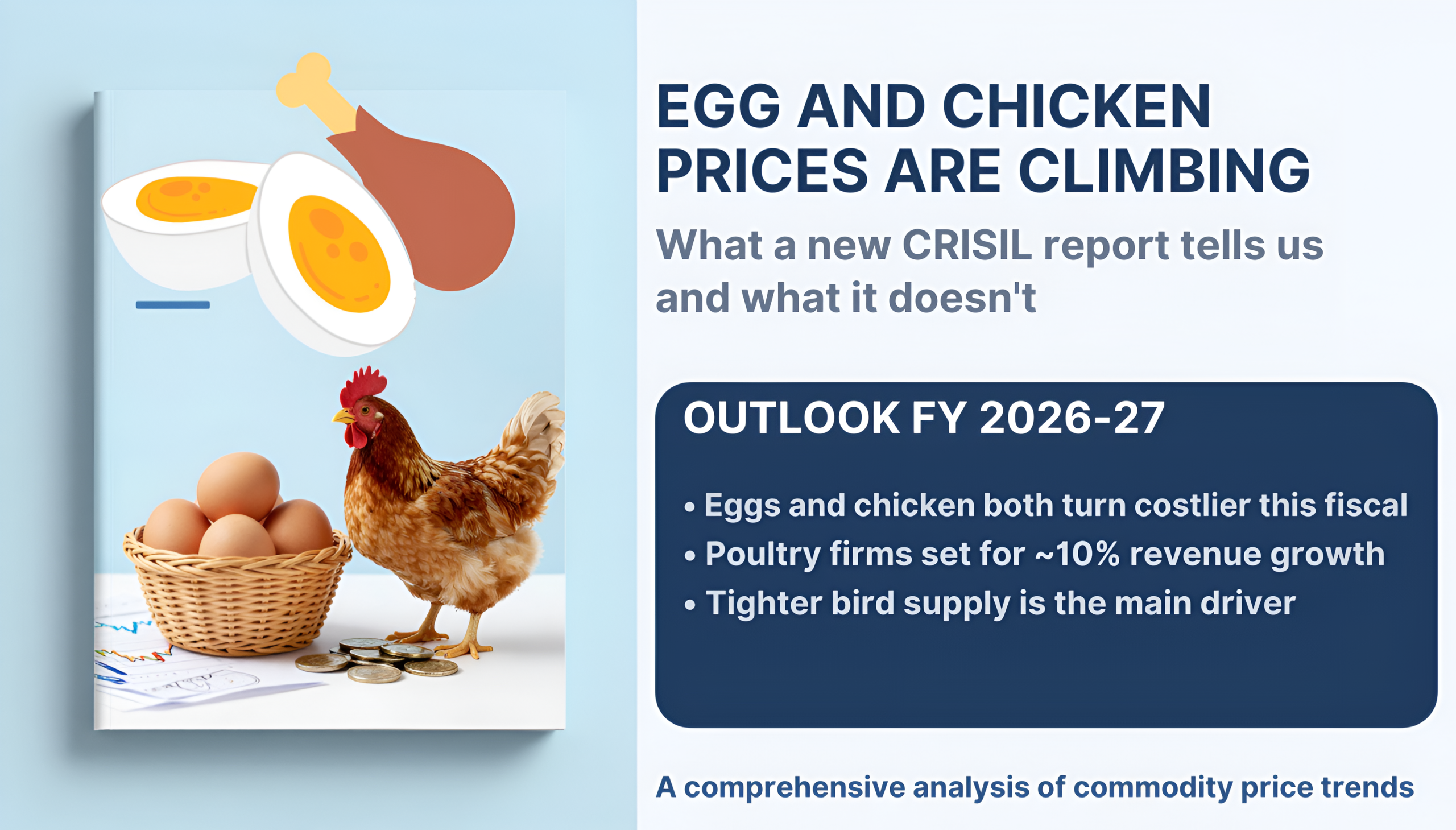
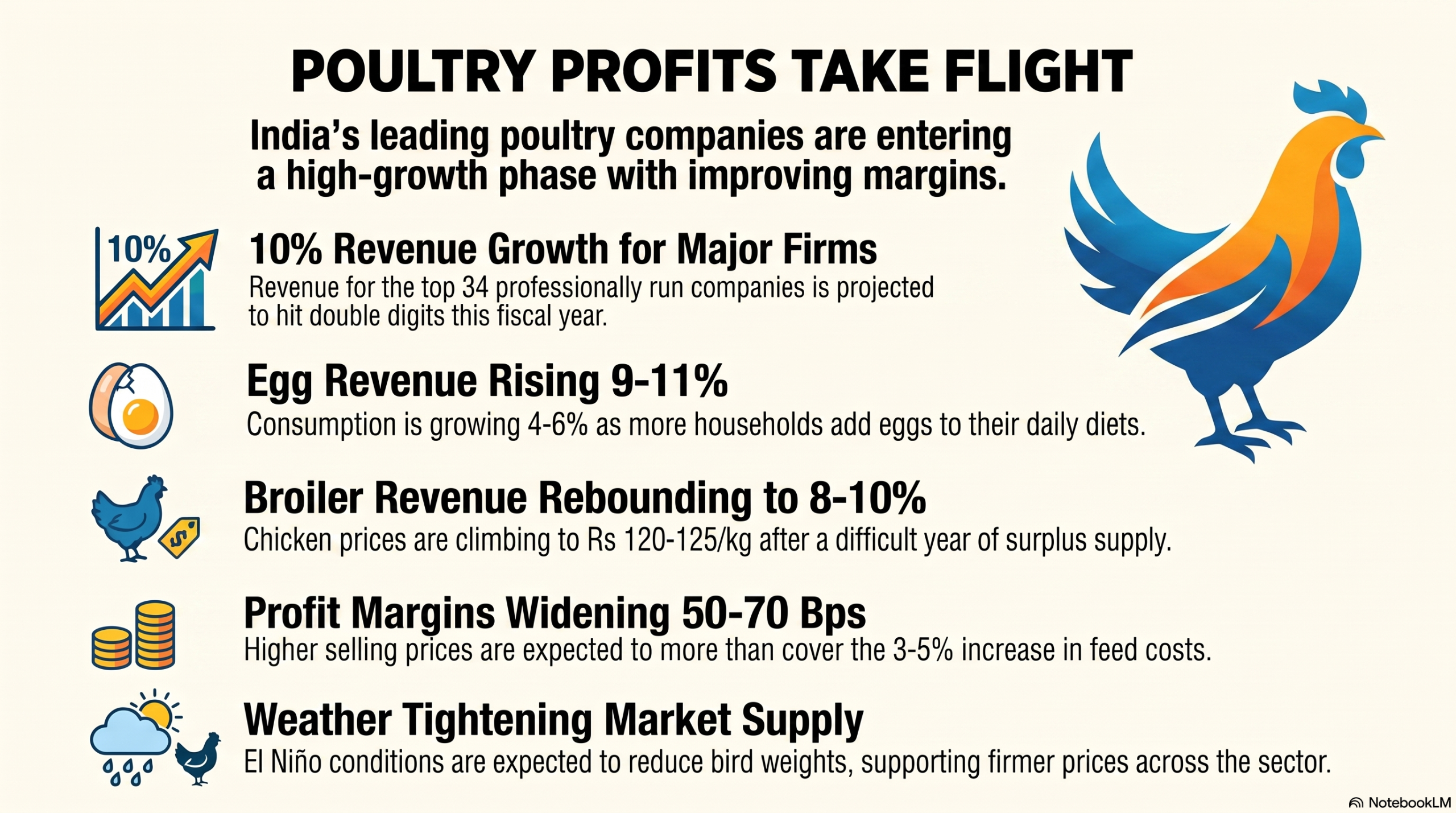
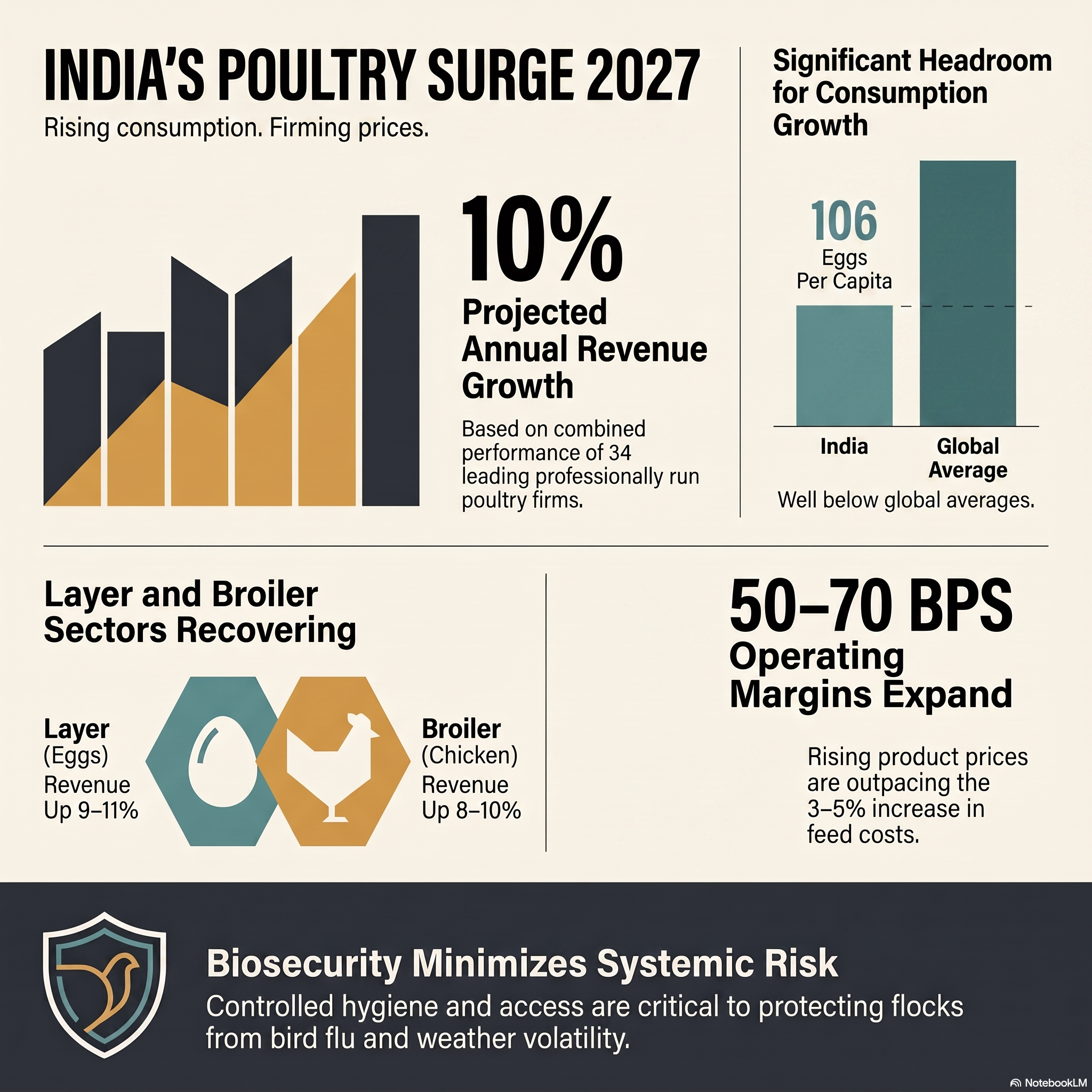
If you have noticed egg and chicken prices creeping up at the market lately, you are not imagining things. A new report from CRISIL Ratings says India’s large, professionally run poultry companies are heading into a strong year, with revenues expected to rise by around 10% in the 2026-27 financial year.
That figure has been travelling fast through industry circles, but it covers a narrower slice of the business than the headline suggests.

It’s about company revenue, not the whole industry
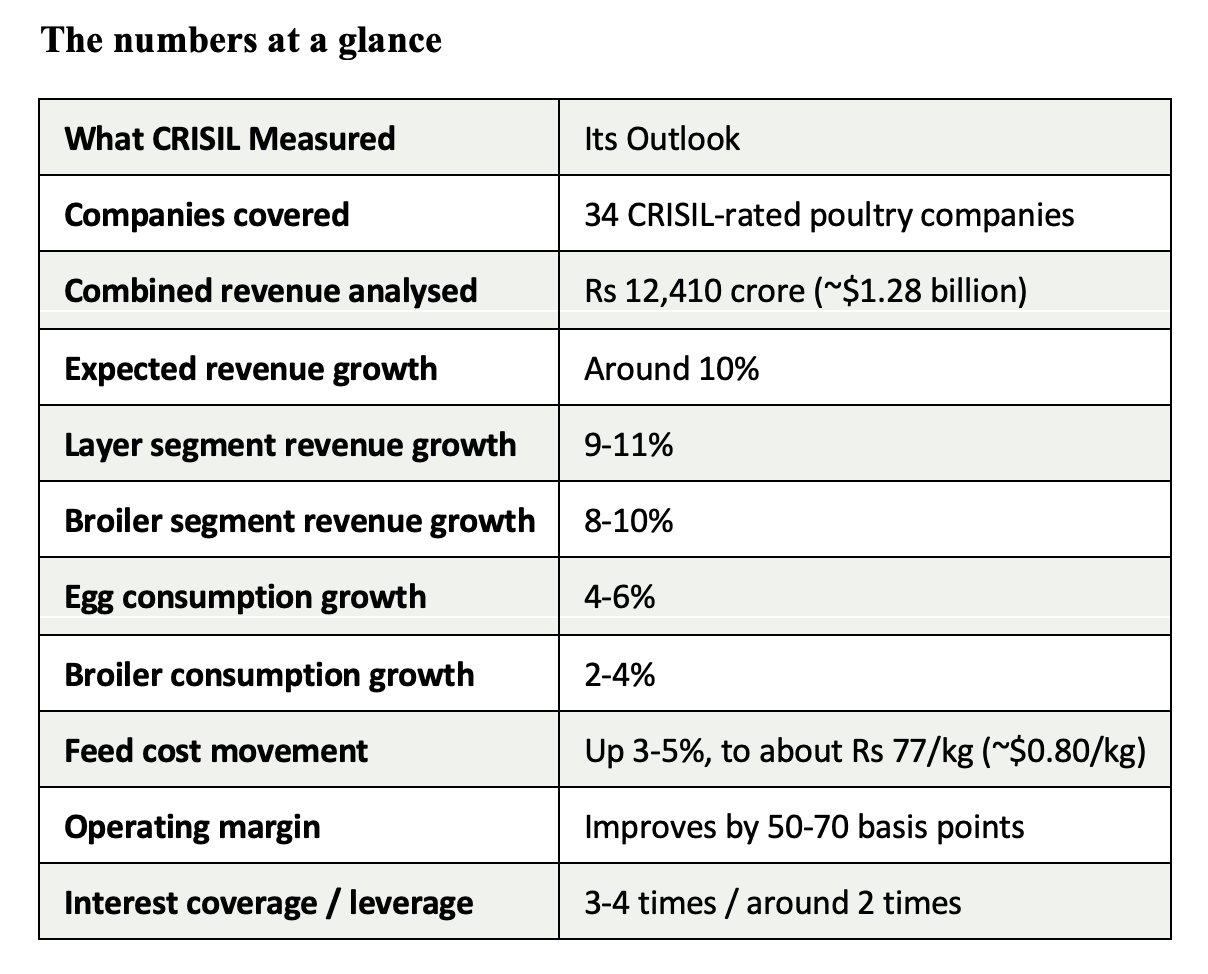
CRISIL studied 34 poultry companies that it rates, which together earned about USD 1.28 billion last year. When the agency talks about 10% growth, it means the combined sales of these particular companies, not the output of every poultry farm and backyard flock in the country.
Picture a school with a thousand students. Checking the report cards of the top thirty tells you something real about how the strongest students are doing, but it says nothing about the other 970. That is roughly the gap here: CRISIL’s 34 companies are among the best-organized players in a sector still dominated by small and mid-sized farms, so their 10% is not a stand-in for the industry’s growth rate, which CRISIL does not put a number on in this report.

Why eggs are set to cost a little more
Eggs remain the biggest part of the business, making up close to 60% of the value CRISIL tracked. The agency expects egg consumption to rise 4-6% this year, with prices settling about USD 0.058-0.060 per egg. Together, that should lift layer segment revenue by 9 to 11%, an improvement on the 9% recorded last year.
There is a bigger story behind these numbers. India’s per capita egg consumption stands at roughly 106 eggs a year, well short of the global average. Rather than a weakness, that gap points to plenty of headroom for demand to keep growing as more households add eggs to their diets.

Chicken prices are climbing too
The broiler, or meat chicken, business had a difficult previous year, when revenue growth slowed to just 5%. CRISIL expects a recovery to 8-10% this year, with bird prices projected to rise to about USD 1.24-1.29 per kilogram, up from about USD 1.19-1.24 last year.
Weather played a large part in last year’s dip. A shorter summer and an early monsoon led to a surplus of birds, which pushed prices down sharply and discouraged farmers from placing new birds toward the end of the year. Jayashree Nandakumar, Director at CRISIL, has pointed out that expected El Nino conditions could now reduce bird weights, tightening supply and supporting firmer prices through this fiscal year.
Rising demand is adding to the momentum too. More households in rural India are eating chicken regularly, while city consumers are increasingly drawn to protein-rich diets, quick-service restaurants and ready-to-cook chicken products.
What it costs to raise a bird
Feed is where most of the money goes, typically 60-65% of the total cost of raising poultry. Corn and soybean meal make up most of that feed bill, in roughly a two-to-one ratio. Rishi Hari, Associate Director at CRISIL Ratings, has noted that corn prices are likely to rise moderately because of El Nino-related weather worries, while soybean meal supplies should hold steady enough to keep those prices in check.
A smaller line item is also getting pricier. Imported feed additives, mainly vitamins, make up roughly a tenth of feed costs, and shipping disruption linked to the conflict in West Asia is expected to push those costs up. Add it all together and CRISIL projects feed costs rising 3-5% this year, taking the average to around USD 0.80 per kilogram.
The companies still come out ahead on paper. CRISIL expects operating margins, the slice of revenue left after covering costs, to widen by 50 to 70 basis points, or roughly half a percentage point, because the higher prices poultry companies charge should more than cover the higher prices they pay for feed.

What could still go wrong
A lot rides on things staying calm. Bird flu can wipe out a flock within days, and it remains the sector’s biggest single threat. Long stretches of extreme heat hurt bird health directly and can also damage the corn crop that feeds them.
A sudden spike in corn prices, or fresh trouble getting imported ingredients into the country, would eat straight into the margin gains CRISIL is projecting. Farms with solid biosecurity, meaning the everyday hygiene and access controls that keep disease out, tend to weather these shocks better than the rest.
There is also a quieter financial story here. Most poultry companies expanded their capacity after the pandemic and are not short of room to grow, so they are not under pressure to borrow heavily for new farms or processing plants.
Combined with steady cash coming in, that should keep their finances on an even keel. In practical terms, CRISIL expects these companies to earn roughly 3 to 4 times their annual interest bill in operating profit, and to owe around twice their annual earnings in total debt, both comfortable levels by industry standards.
The bigger picture
Strip away the headline number and what CRISIL is really describing is a business recovering its footing. Last year’s price crash, brought on by an unusually mild summer that left the country with too many birds, is working its way out of the system, and the companies that stayed disciplined through that stretch are now positioned to benefit from tighter supply and steadier demand.
For a farmer deciding how many chicks to place next month, or a retailer pricing a tray of eggs, the practical read is this: the increase in prices this year has an identifiable cause in weather and bird placement patterns, not speculation, which makes it easier to plan around than a random spike would be.
Source: CRISIL Ratings, ‘Fowl Play to Roost: Double-Digit Revenue Growth for Poultry This Fiscal’, press release, July 23, 2026. US dollar figures are converted at the mid-market rate of about Rs 96.6 per dollar on July 23, 2026, the date of the CRISIL report.