


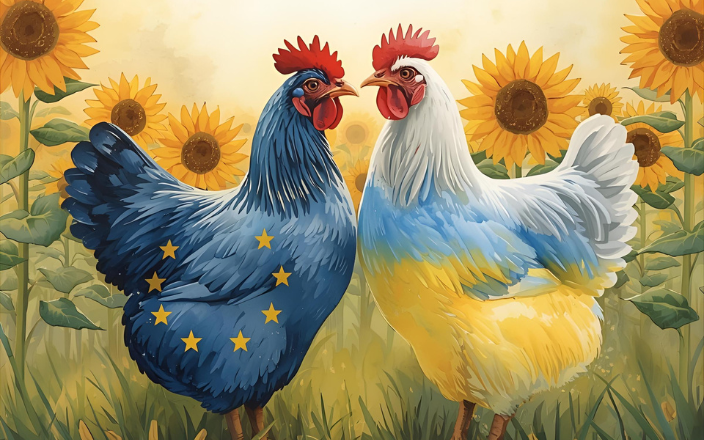
In a significant move to deepen trade ties, the European Union and Ukraine have agreed to expand poultry and egg import quotas under a revised framework of their Deep and Comprehensive Free Trade Area (DCFTA). The new agreement, which came into effect in late October 2025, marks a major shift in agricultural trade between the two parties.
- Under the updated terms, Ukraine’s annual poultry export quota to the EU has increased by one-third—from 90,000 to 120,000 tonnes.
- Additionally, the quota for egg exports has tripled, rising from 6,000 to 18,000 tonnes.
- In return, Ukraine will allow duty-free imports of up to 120,000 tonnes of poultry meat from the EU, a substantial jump from the previous 20,000-tonne limit.
The European Council emphasized that while market access for sensitive products such as poultry, eggs, sugar, wheat, maize, and honey remains “limited and gradual,” the removal of customs duties is expected to foster economic stability and strengthen Ukraine’s integration with the EU. Denmark’s Foreign Affairs Minister Lars Løkke Rasmussen hailed the agreement as a win-win for both sides.
- However, the deal has sparked controversy among several EU member states.
- Poland, Hungary, Slovakia, Bulgaria, and Romania have voiced concerns over the potential destabilization of local agricultural markets.
- Hungarian officials criticized the agreement for lacking adequate safeguards to protect domestic farmers from a surge in Ukrainian imports.
Despite the opposition, Ukraine’s poultry exports to the EU have been on the rise. Between January and August 2025, Ukraine exported poultry worth \$716 million—an increase of 13% compared to the same period in 2024. The EU accounted for 28.2% of these exports, with the Netherlands leading as the top importer, followed by Saudi Arabia, the UK, and Slovakia.
To support Ukraine’s poultry sector, the European Bank for Reconstruction and Development (EBRD) has backed a \$12.26 million loan to Dniprovska Group, Ukraine’s second-largest poultry producer. The funding aims to help the company recover from wartime losses and stabilize operations.
This agreement represents a strategic step toward long-term economic cooperation and integration, though balancing trade liberalization with domestic agricultural interests remains a challenge for the EU.
Sources: Available upon request