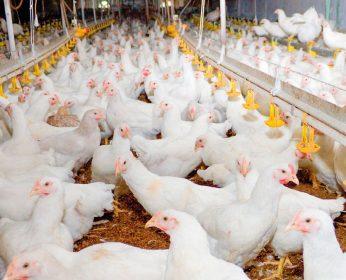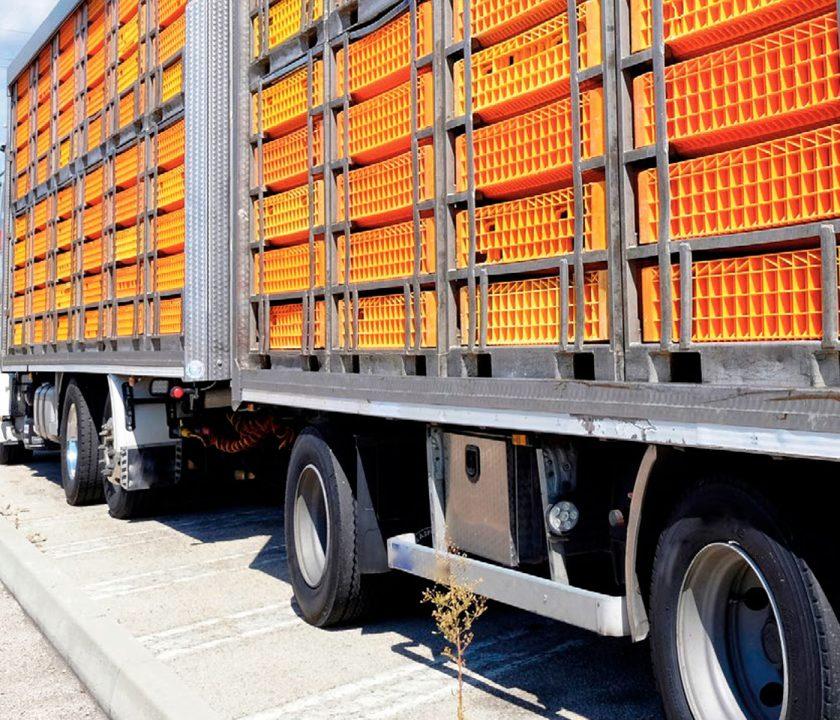
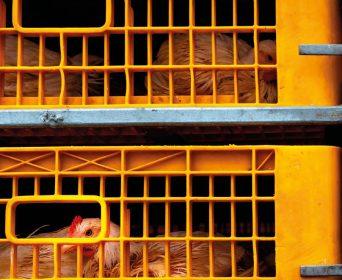
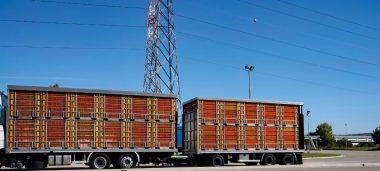
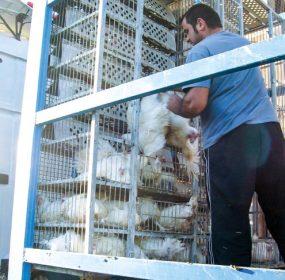
In the hours prior to slaughter, chickens are subjected to various stressful situations, such as being caught on the farm and placed in containers, the containers being loaded onto the truck, transport from the farm to the slaughterhouse, the containers being unloaded at the slaughterhouse, and the waiting period until the animals are stunned and slaughtered.
- It should be noted that during the various phases mentioned above, the chickens do not have access to water or food.
- In addition, stress during transport can be increased in adverse weather conditions.
- The situation can be so severe that it ultimately leads to death of the animal.
The mortality rate of chickens during transport is influenced by multiple factors. Among these, the following are noteworthy:
- Ambient temperature (Nijdam et al., 2004; Warriss et al., 2005; Caffrey et al., 2017; Teke, 2019)
- Loading density or space available in the containers (Nijdam et al., 2004; Chauvin et al., 2011; Caffrey et al., 2017; Jacobs et al., 2017)
- Mortality rate during the rearing period (Chauvin et al., 2011; Cockram et al., 2019)
- Chicken weight at slaughter (Nijdam et al., 2004; Caffrey et al., 2017; Grilli et al., 2018; Cockram et al., 2019)
Various authors who have studied the influence of different variables on the percentage of mortality during transport have considered one or a few factors, and in some cases the effect of the factors was established by including only one variable in the statistical analysis.
The objective of this study was to examine the effect of five variables on the mortality rate during transport using an ANOVA with a model that includes the five variables and their interactions. Among the variables studied, we included the duration of chicken loading, which has been studied on few occasions.

MATERIALS AND METHODS
The study was conducted at a slaughterhouse in Spain during the period from January 1, 2018, to June 30, 2020. The slaughterhouse is located in a region with a Mediterranean climate characterized by hot summers and mild winters.
The unit of study was the batch.
- A batch was defined as a group of chickens from the same farm, transported in the same truck to the slaughterhouse and slaughtered on the same day.
- For each batch, the following was recorded:
- The number of chickens loaded (in each container and in the truck as a whole),
- The ambient temperature on the farm during the loading of the chickens (in °C),
- The average weight of the live chicken (in kg),
- The duration of the chicken loading stage (in minutes),
- The cumulative daily mortality rate during the rearing period (CDMR).
This information was obtained from the documentation accompanying the birds during their transport from the farm to the slaughterhouse.
On the other hand, the number of chickens that arrived dead at the slaughterhouse was recorded.
- To obtain this information, at the slaughterhouse, birds that arrived dead were removed during the hanging phase of the chickens on the slaughter line.
- Once all the live animals belonging to a batch had been hung, a slaughterhouse employee counted the number of dead chickens in that batch.
- This value was systematically recorded in the Daily Inspection Report of the Official Veterinary Services under normal slaughterhouse operating conditions.
PERCENTAGE OF MORTALITY DURING TRANSPORT
The percentage of mortality during transport (PMT) was calculated for each batch.
- The PMT was calculated by dividing the number of chickens that died during transport by the number of chickens loaded at the farm, and the resulting value was multiplied by 100.
- On the farm, during loading, the chickens were captured and placed in containers, where they remained during the capture and caging of the rest of the chickens in the batch during the loading of the containers onto the truck, during transport from the farm to the slaughterhouse, and during the waiting phase at the slaughterhouse.
- However, the carcasses were counted at the slaughterhouse when the live chickens were hung on the hooks of the slaughter line. Therefore, the death of the chickens could have occurred during the loading phase at the farm, during transport, and during the waiting period at the slaughterhouse.
As part of the process of investigating the causes of high mortality during the transport of chickens to the slaughterhouse, a database was created that included the above variables for all slaughter days on which at least one batch had a transport mortality rate of more than 2%. The same number of days on which no batch exceeded 2% mortality were also included at random.

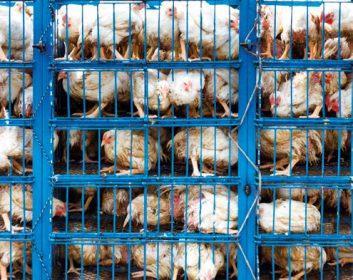
In this study, we will use the term transport mortality to refer to deaths occurring during all three stages (loading at the farm, transport, and waiting at the slaughterhouse). In addition, for each batch of birds transported, the loading density or available space (ED, in cm²/ kg of live chicken) was calculated for each batch of birds transported using the following formula:
ED= S/(P * NP)
- Where S is the container surface area (in cm²),
- P is the average weight of the live chicken (in kg), and
- NP is the number of chickens placed in each container.
To perform the statistical analysis, the PMT variable was transformed to its logarithmic value (Log PMT) in order to normalize the data distribution. The geometric mean was also calculated as the antilogarithm of the mean of the logarithms estimated by the model.
The effect of the ambient temperature measured during the loading of the chickens at the farm was analyzed (with three classes: < 20°C, ≥20°C, and < 25°C, ≥25°C).
- The live weight of the chicken (with 3 classes: ≥1.6 kg and <2.5 kg, ≥2.5 kg and <3.0 kg, ≥3.0 kg and ≤5.0 kg),
- The duration of the chicken loading stage (with 3 classes: <60 min, ≥60 min and <90 min, ≥90 min),
- The space available in the container (with 2 classes: <165 cm²/kg, ≥165 cm²/ kg)
- The cumulative daily mortality rate (with 2 classes: <4%, ≥4%) on the PMT.
The statistical program used was SPSS, and the model used was as follows:


Where Y is the PMT, in logarithms, μ is the overall mean,T^® is the fixed effect of temperature,Pj is the fixed effect of chicken weight,tk is the fixed effect of the duration of the chicken loading stage,EDl is the fixed effect of available space,TMDAm is the fixed effect of the cumulative daily mortality rate, interactions are all double interactions, andεijklm is the model error.

RESULTS
Effect of ambient temperature on the farm
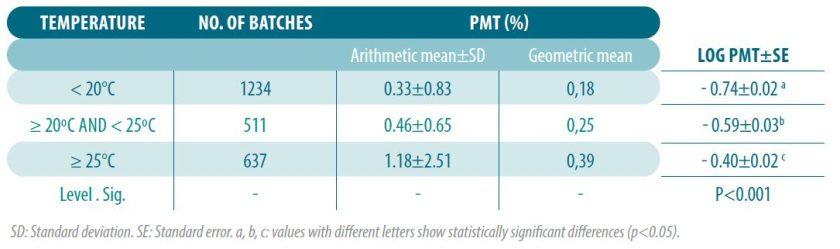
The effect of ambient temperature on the farm during chicken loading on PMT was significant (p<0.001), such that as the temperature increased, mortality also increased.
- When the temperature was ≥25°C, the geometric mean of the PMT (0.39%) was significantly (p<0.05) higher than that obtained at lower temperature values (Table 1).
- Likewise, when the temperature was in the range of ≥20°C and <25°C, the geometric mean of the mortality percentage obtained (0.25%) was significantly higher than the value reached at temperatures <20°C (0.18%).
Table 1. Percentage of mortality during transport (PMT) according to ambient temperature during loading of chickens at the farm.


Effect of chicken size
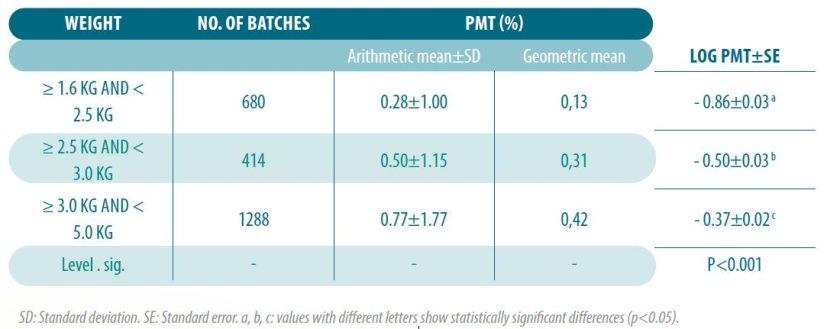
Chicken size had a significant effect (p<0.001) on PMT (Table 2), such that higher chicken weights resulted in higher PMT values.
- When chicken weight was in the range ≥3.0 kg and <5.0 kg, the geometric mean of PMT (0.42%) was significantly higher (p<0.05) than at lower weight levels;
- Likewise, when the weight was in the range ≥2.5 kg and <3.0 kg, the PMT was significantly (p<0.05) higher than when the weight was in the range ≥1.6 kg and <2.5 kg (0.31% and 0.13%, respectively).
Table 2. Percentage of mortality during transport (PMT) according to the live weight of the chicken.

Effect of the duration of the chicken loading process
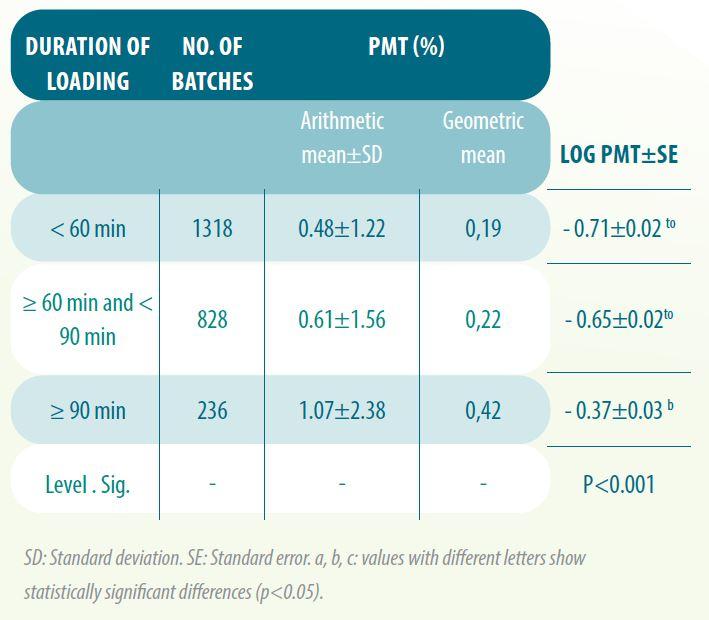
The duration of the chicken loading process had a significant influence on the PMT (p<0.001)(Table 3),
- such that when the duration of this stage was ≥90 minutes, the geometric mean of the PMT (0.42%) was significantly higher (p<0.05) than in the ranges of ≥60 min and <90 min (0.22%) and <60 min (0.19%).
- The differences between the latter two levels were not significant (p>0.05).
Table 3. Percentage of mortality during transport (PMT) according to ambient temperature during loading of chickens at the farm.

Effect of available space in containers
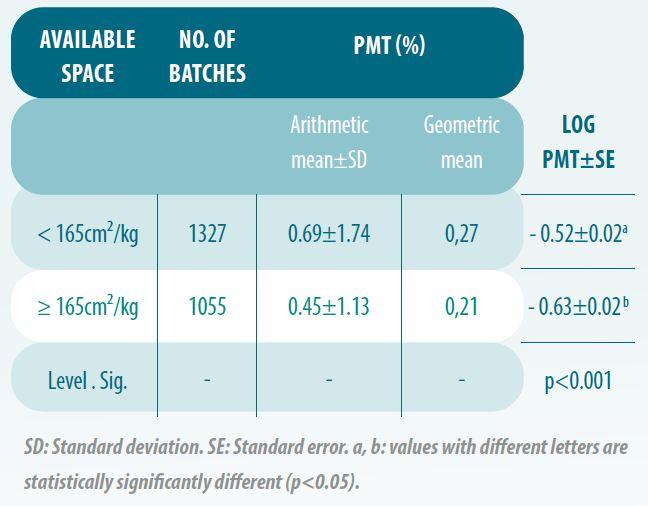
The space available in the containers had a significant effect (p<0.001) on the PMT (Table 4).
- Thus, when the available space was ≥165cm²/ kg, it resulted in a geometric mean PMT (0.21%) lower than when the available space was <165cm²/kg(0.27%).
Table 4. Percentage of mortality during transport (PMT) according to the space available in the containers.

Effect of the cumulative daily mortality rate during fattening
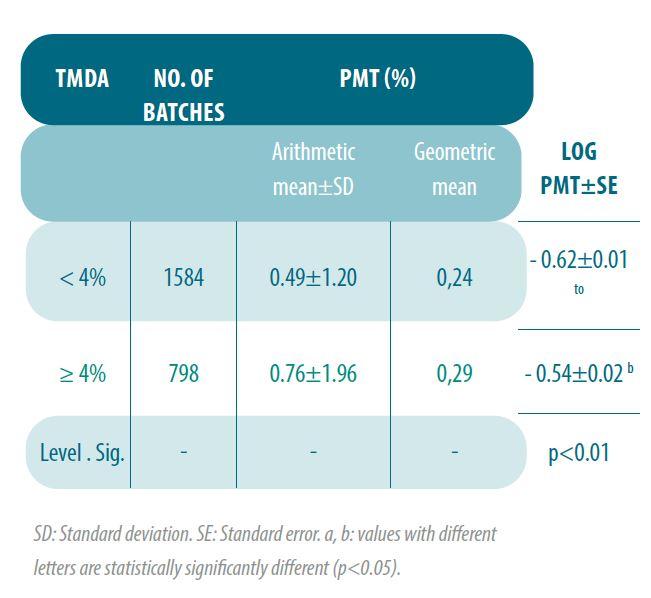
Finally, the cumulative daily mortality rate obtained during the rearing period (CDMR) had a significant effect (p<0.01) on the PMT.
- When the CDMR was ≥ 4%, the geometric mean of the PMT (0.29%) was significantly higher than when the CDMR level was lower (0.24%).
Table 5. Percentage of mortality during transport (PMT) according to the cumulative daily mortality rate (CDMR).