


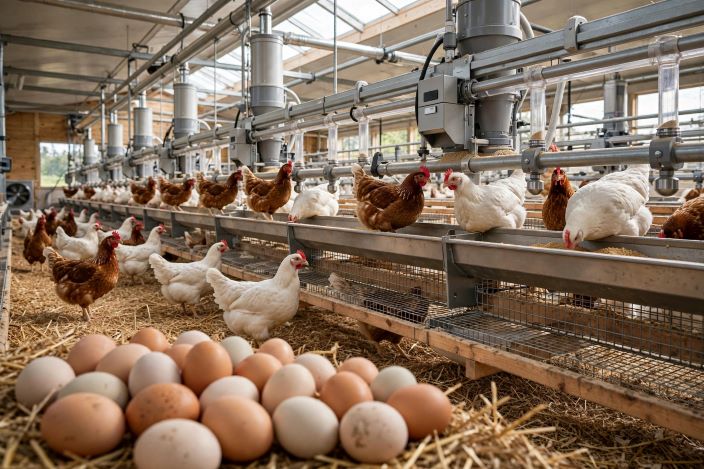
Why efficiency matters beyond egg numbers
Global egg production has expanded rapidly over the past two decades, increasing from approximately 51 million tons in 2000 to around 87 million tons in 2020. This growth has strengthened the role of eggs as an accessible source of high-quality animal protein, but it has also increased pressure on feed resources and production efficiency (1).
For the global egg industry, the challenge is therefore shifting from simply producing more eggs to producing more egg mass from every unit of feed consumed.
The hidden variation between laying hens
Feed efficiency is not identical across all laying hens. Recent research comparing two laying-hen genetic lines found substantial differences in feed intake, egg mass production and nutrient digestibility (2).
The researchers also identified relationships between digestibility measurements and feed-efficiency indicators. In some groups, correlations between residual feed consumption and dry-matter digestibility reached 0.79, demonstrating the potential value of understanding how efficiently individual hens utilize nutrients (2).
This variation creates an important opportunity for the industry: future breeding and management strategies could potentially identify hens that convert nutrients into eggs more efficiently without sacrificing productivity.
From feed conversion to sustainable egg production
Feed is particularly important because its environmental footprint extends beyond the poultry house. Producing feed requires land, energy, water and other resources, meaning that improving nutrient utilization at the bird level can potentially reduce environmental impacts throughout the production chain.
A 2025 life-cycle assessment of egg production demonstrated that feed consumption was the largest contributor to environmental impacts in the production systems evaluated. Optimization of farm management was estimated to have the potential to reduce environmental impacts by approximately 5–7%, while lowering global-warming impact by 6.1% (3).
The implication is significant: improvements in feed efficiency could simultaneously address production costs, resource use and environmental performance.
The next generation of egg-production metrics
Traditional indicators such as hen-day egg production, egg weight and feed conversion remain essential. However, future precision egg production may increasingly combine these measurements with individual feed intake, nutrient digestibility, genetics and metabolic indicators.
Such approaches could help producers identify the biological reasons why some hens produce more egg mass from the same quantity of feed.
For a growing global egg industry, the goal may no longer be simply “more eggs.” It may be more eggs from fewer resources.
References
(1) Future Directions for Sustainable Poultry Feeding and Product Quality: Alternatives from Insects, Algae and Agro-Industrial Fermented By-Products. Agriculture, 2026.
(2) Variation in digestibility parameters related to feed efficiency between and within two laying hen lines. Poultry Science, 2025, 104, 105719.
(3) Optimization of environmental and energy performance of egg production using data envelopment analysis and life cycle assessment. Science of the Total Environment, 2025, 963, 178493.