


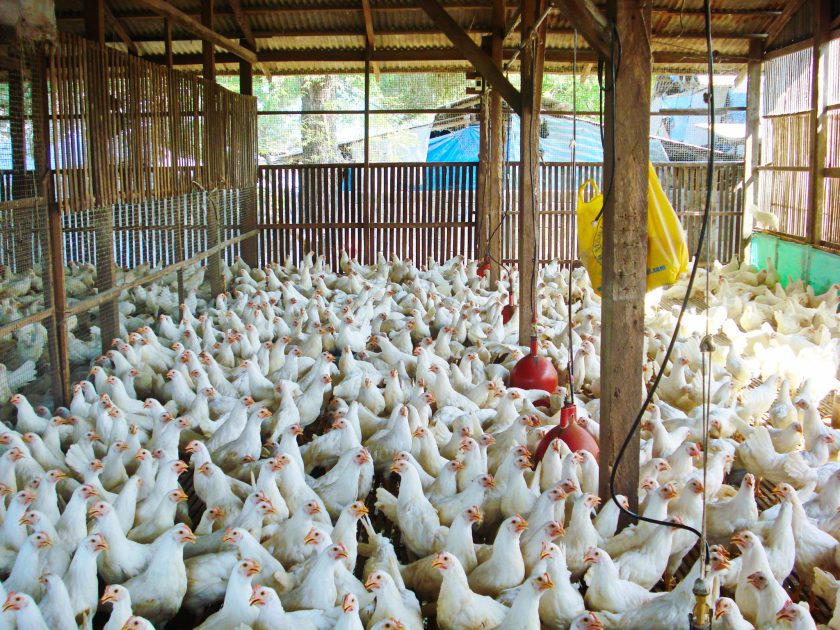
The Philippine poultry industry’s greatest challenge is the high cost of feed, particularly corn, according to the Philippine Institute of Development Studies (PIDS). The PIDS paper, Toward Competitive Livestock, Poultry, and Dairy Industries: A Consolidated Benchmarking Study, explains that feed accounts for the largest share of production expenses.
Corn tariffs of 35-50% keep domestic prices elevated, with wholesale corn in the Philippines at USD 0.42-0.44/kg compared to Thailand’s USD 0.19-0.24/kg and Viet Nam’s USD 0.22-0.29/kg. This disparity inflates poultry feed costs, raising farmgate prices of chicken and eggs and eroding competitiveness.
High feed costs ripple across the value chain:
- Broiler and layer operators face reduced margins.
- Processors contend with higher input costs.
- Consumers pay elevated retail prices.
Without decisive action on feed costs, the poultry industry will struggle to achieve sustainable growth and compete internationally.
Resilience tested by COVID-19
The industry entered the 2010s on a strong growth trajectory, with production value reaching USD 4.0 billion in 2018. By 2019, output rose another 6% but the COVID-19 pandemic reversed this momentum.
In 2020, production value fell by 3.4% as public health restrictions disrupted logistics, cut off market access, and forced producers to scale back both meat and egg supplies. This contractions highlighted the sector’s vulnerability to external shocks.
Backyard vs commercial systems
Chicken production remains highly diverse. Native and improved breeds—often raised in backyard settings—account for nearly half of the national inventory. These breeds follow longer production cycles and smaller scales, limiting efficiency compared to commercial broilers.
Broilers and layers are produced both commercially and in smallholder farms, with backyard broilers estimated at 20% of the industry.
This dual structure reflects inclusivity, but also complicates regulation, biosecurity, and standardization, since backyard systems are harder to monitor and enforce.
International benchmarking
Compared to neighbors, the Philippines lags in scale. In 2019, China’s inventory reached 5.2 billion heads, while Thailand and Vietnam reported 313 million and 383 million, respectively, against the Philippines’ 176 million.
Thailand’s industry is dominated by large corporations, with 10-12 firms controlling 80% of broiler production. China’s industry has consolidated rapidly, with large-scale farms producing over 100,000 heads and accounting for mor than half of output. Vietnam, by contrast, remains overwhelmingly small-scale, with 99% of households raising chickens.
Competitiveness challenges
Live prices in the Philippines remain significantly higher than in exporting countries. Between 2003 and 2012, chicken producer prices rose steadily reaching USD 2/kg by 2019. Despite a decline from earlier peaks, Philippine prices remained 37-62% higher than those in the US and Brazil, two of the world’s leading chicken exporters.
The benchmarking study also notes that while Thailand’s producer prices ranged from USD 1.05-1.10/kg in 2017-2018, similar to top exporters, China’s prices were much higher at USD 2.00-2.50/kg. This comparison underscores how Philippine costs align more closely with high-cost producers rather than competitive exporters.
Imports further highlight competitiveness gaps. The import dependency ratio peaked at 16% in 2016 then fell to 6% in subsequent years. While imports supplement supply, utilization consistently exceeded domestic production, reflecting the inability of local producers to fully meet demand.
Policy outlook
Trade protection remains strong, with poultry meat tariffs at 40%. Mechanically deboned meat, used in meat processing, enjoys a lower tariff of 5%, but this relief does not extend to live production.
The study emphasizes that the industry’s future lies in balancing backyard inclusivity with commercial consolidation. Recalibrating feed costs, strengthening farmer organizations, and upgrading technology are critical if the industry is to achieve resilience and global competitiveness.