


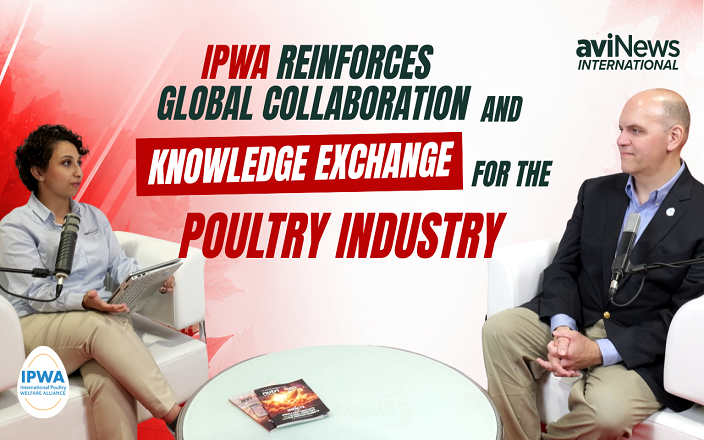
Toronto, Canada – At the World’s Poultry Congress for this year, aviNews International had the pleasure of conversing with Andy Vance, the Executive Director of the International Poultry Welfare Alliance (IPWA) and the U.S. Roundtable for Sustainable Poultry & Eggs (US-RSPE), about the organization’s newest initiative: Welfare Lab 2050. Designed as a collaborative platform rather than a traditional conference session, the initiative aims to bring together researchers, producers, veterinarians, food companies, retailers, and other stakeholders to identify practical solutions that continuously advance poultry welfare.
A Collaborative “Lab” for Solving Complex Welfare Challenges
According to Vance, the initiative reflects one of IPWA’s core principles: continuous improvement. Rather than viewing animal welfare as a fixed destination, the organization sees it as an ongoing process that requires scientific innovation, practical implementation, and collaboration across the entire poultry value chain.
Unlike conventional symposia, the Welfare Lab 2050 is built around short, highly interactive “sprint” sessions where participants work together to discuss current challenges, identify research gaps, and explore practical opportunities for improvement. Each session focuses on a specific segment of the poultry industry. During the World Poultry Congress, the emphasis was on poultry science and research, while previous events have addressed broiler production in collaboration with the International Poultry Council. Future sessions are expected to focus on layers, turkeys, food service, retail, and other sectors of the poultry supply chain. Rather than relying on presentations from a few experts, the format encourages every participant to contribute their experience and perspective.
Moving Beyond Traditional Welfare Discussions
One of the distinguishing features of Welfare Lab 2050 is its emphasis on dialogue instead of lectures. Unlike in traditional symposia where there’s few speakers for several hours, the Welfare Lab takes place over a shorter period of time, hence called a sprint, and engages a bigger number of people to discuss a specific topic at a real granular level. Participants are encouraged to discuss both scientific findings and the practical realities of commercial production, ensuring that potential solutions are not only scientifically sound but also economically and operationally feasible. This collaborative environment also helps identify where additional research is truly needed, reducing unnecessary duplication of effort while creating new opportunities for interdisciplinary collaboration.
“Collaboration is really the name of the game. We can do better when we work together. That’s one of the things I’ve always loved about working in the poultry science and adjacent communities, it’s this idea that we can work together to advance complex problems.”, emphasizes Vance.
Science, Technology, and Continuous Improvement
One of the main goals of the Welfare Lab sprint is to figure out what are the current gaps in literature and what are the current opportunities in scholarship. Through the lab and the Key Welfare Indicators (KWIs), IPWA helps people have a framework for understanding things across a lot of domains. Vance also emphasizes that advances in sensor technology, artificial intelligence, genomics, and data analytics are opening entirely new possibilities for poultry welfare research. Modern monitoring systems now allow researchers to analyze bird behavior, vocalizations, environmental conditions, and flock performance in ways that were not possible only a few years ago. These technologies are helping scientists develop a more comprehensive understanding of poultry welfare while supporting evidence-based decision-making throughout the production chain. However, Vance stressed that scientific discovery alone is not enough.
Bringing Every Stakeholder to the Table
IPWA’s membership spans the entire poultry value chain, including genetics companies, poultry producers, veterinarians, researchers, retailers, food service companies, and sustainability leaders. According to Vance, this diversity is one of the organization’s greatest strengths because it allows technical expertise, commercial experience, and consumer expectations to be discussed together in a pre-competitive environment focused on collective progress.
“Welfare is not a problem to be solved… There’s always going to be an opportunity to think and always improve our understanding”, says Vance.
Beyond scientific research, IPWA also invests heavily in education, training, communication, and practical implementation resources to help companies integrate welfare principles into their operations.
A Global Framework Adaptable to Every Production System
Another important aspect of IPWA’s work is its commitment to remaining system-neutral, which in terms makes it geography-neutral. Rather than promoting a single production model, the organization’s Key Welfare Indicators (KWIs) focus on evaluating the welfare status of the birds themselves, regardless of housing type or geographic location. This approach allows producers operating under very different production systems–from North America to Europe, Asia, and Latin America–to use the same scientific framework while adapting implementation to their local conditions. As an example of the adaptability of this global framework, Vance noted that following the World Poultry Congress he would continue discussions in China, demonstrating how these welfare principles can be applied across different production environments and cultural contexts.
An Open Invitation to Participate
Vance concluded by encouraging researchers, companies, and industry professionals from around the world to participate in Welfare Lab 2050, regardless of their specific expertise. Whether working in research, production, communications, sustainability, or business management, every stakeholder has a role to play in improving poultry welfare through collaboration and continuous learning. As the poultry industry faces increasing expectations for responsible food production, initiatives such as Welfare Lab 2050 seek to bridge the gap between science and practice, creating a global platform where innovation, education, and collaboration work together to advance poultry welfare for the future.