


Is it Worth Installing an Additional Evaporative Panel in a Broiler Shed?
When designing a broiler shed with tunnel ventilation, it is important to install the appropriate number of evaporative cooling panels.
- An insufficient number of panels will cause excessive static pressure, which will reduce air velocity and, therefore, the cooling of the birds.
- An excess of panels will result in a higher initial cost, more panels to maintain or replace, and a larger area of reduced airflow near the wall at the tunnel entrance end.

RELATIONSHIP BETWEEN PANEL AREA AND FAN CAPACITY
The panel area is not based on the size of the shed, but on the air movement capacity of the tunnel fans in it.
- Traditionally, it has been recommended that a shed have 1 square foot2 of six-inch evaporative cooling panel (flute angles of 45° x 15°) for every 350 cubic feet per minute (CFM) of tunnel fan capacity at the design static pressure (panel design velocity = 350 ft/min (107 m/min)).
The required panel surface does not depend on the size of the shed, but on the capacity of the tunnel fans.

DESIGN STATIC PRESSURE AND ITS IMPACT
The design static pressure represents the resistance faced by tunnel fans when all are operating. Although there are several factors that determine it, in general, a shed with a higher design air velocity will have a higher static pressure than one with a lower velocity.
For example, the static pressure in a typical broiler shed with:
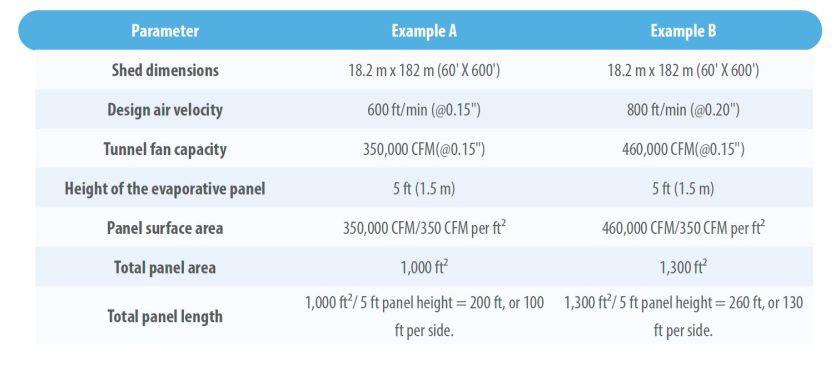
- Air velocity of 600 ft/min (182.9 m/ min) will be between 0.12 and 0.15″, and
- Air velocity 800 ft/min (243.9 m/ min), between 0.17″ and 0.20″.
Therefore, in a modern broiler shed with air velocities between 600 and 800 ft/ min (Table 1), the panel area should be determined by the total tunnel fan capacity at a static pressure between 0.15″ and 0.20″.

CONSIDERATIONS REGARDING AIR VELOCITY IN THE PANEL
Although a design velocity of 350 ft/min (107 m/min) has been widely used for decades, it is important to note that it is possible to use a slightly higher velocity without significantly affecting the cooling of the birds during hot periods.
Thirty years ago, the panel area for a shed with a 6-inch (15 cm) evaporative cooling panel (flute angles of 45° x 15°) was determined using a design velocity of 400 ft/min (1 ft² for every 400 cfm of tunnel fan capacity).
The reduction in design velocity through the panels is due to the idea that a larger panel area reduces static pressure, increases air velocity, and improves the cooling of incoming air. But is this true?



COMPARISON BETWEEN PANEL VELOCITY AND PRESSURE
At a panel velocity of 400 ft/min (121.92 m/min), the static pressure required to move air through a 6” (15 cm) panel is approximately 0.065” (1.65 mm). It is essential to keep in mind that this represents only a part of the static pressure against which the tunnel fans operate.
- Work/pressure is also required to move the air from the large area of the panel to the smaller cross-sectional area of the shed and along its length.
- Therefore, although the panel pressure is only 0.065” (1.65 mm), the total pressure against which the tunnel fans in a modern broiler shed operate (shed air velocity between 600 and 800 ft/min (182.9 and 244 m/ min) will tend to range between 0.15” and 0.20” (3.81 mm and 5.08 mm).
REAL EFFECT OF REDUCING PANEL VELOCITY
Reducing the panel velocity to 350 ft/min (107 m/min) (increasing the panel area) decreases the panel static pressure between 0.25 and 1.40 mm (0.01 to 0.055 inches). As a result, the total static pressure would theoretically decrease between 3.5 and 4.8 mm (0.14 and 0.19 inches) (shed air velocity between 600 and 800 ft (182 and 244 m/min).
A pressure change of 0.01 inch (0.25 mm) would have an insignificant effect on the shed air velocity.
IS THERE A DIFFERENCE IN AIR COOLING?
Interestingly, the cooling produced by a panel does not vary much with the air velocity passing through it.
- In fact, at 35°C (95°F), increasing the air velocity through a panel from 350 to 400 ft (106 to 122 m/min) would only result in a decrease of half a degree or less in the incoming air temperature (Figure 1).
- The truth is that decreasing the air velocity through a panel from 122 to 106 m/min (increasing the panel area by approximately 15%) will generally have an insignificant effect on the producer’s ability to keep their birds cool during hot weather.

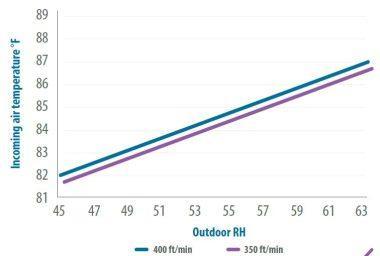
Figure 1. Incoming air temperature on a 95°F (35°C) day at various RH (Panel velocity 400 ft/min vs 350 ft/min).
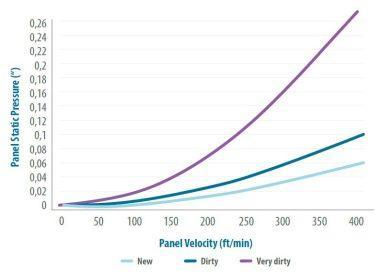

Figure 2. Static pressure vs panel velocity.
IS THERE A DIFFERENCE IN AIR COOLING?
What does affect the producer’s ability to keep their birds cool is the maintenance of the panels and fans.
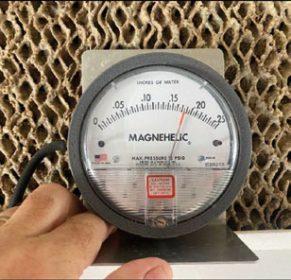
- For example, while increasing the panel area by 10% to 15% may reduce the pressure by approximately 0.01 inch, the reality is that, as dirt and minerals accumulate on the surface of the panels, the static pressure of these can increase more than double (Figures 2 and 3).

- Loose belts and worn pulleys can also have a much more drastic effect on the shed air velocity and, therefore, on bird cooling, than relatively small changes in the panel.
- In fact, at a static pressure of 0.15 inches, a reduction in fan speed of just 10% due to a loose belt or a worn pulley can result in a reduction in a fan’s air-moving capacity of up to 20%.
- It is unlikely that all tunnel fans in a shed would run 10% slower, but if only half of the fans had loose belts, it could result in a loss of shed air velocity between 50-100 ft/min (15 and 30 m/min).
- The key to keeping birds cool is not having more panels, but rather proper maintenance of the panels and fans.
- Proper maintenance has a greater impact on cooling than small changes in panel area.