


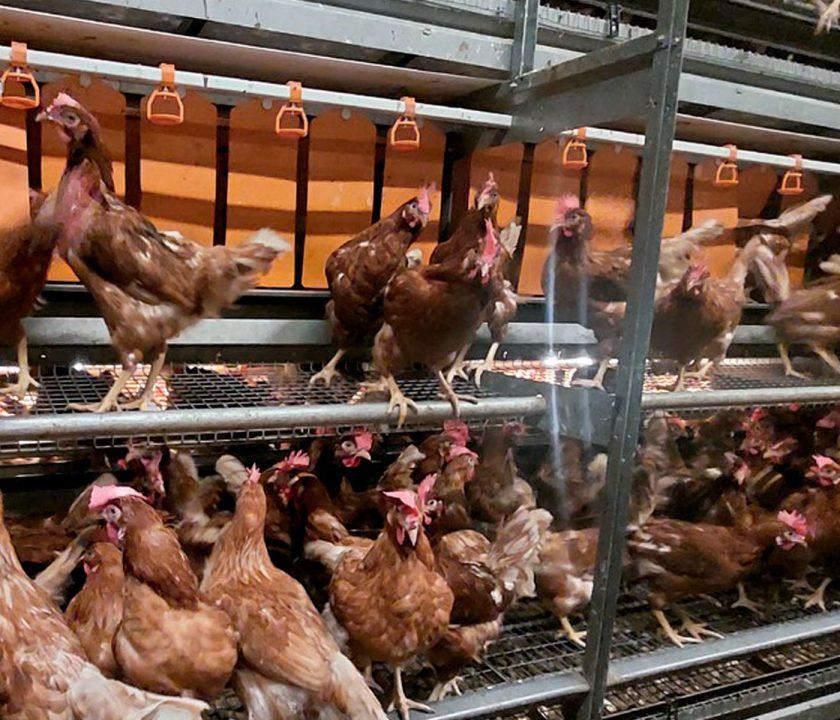
Malaysia’s egg industry is undergoing a structural transformation. Long dominated by battery cage systems, the market is now pivoting toward a more ethical and sustainable alternatives: cage-free egg production.
- This transformation is spearheaded by progressive producers and fueled by changing consumer expectations and corporate sourcing standards.
- Major players like Huat Lai are scaling to house up to 200,000 hens in aviary systems by late 2025.
- Early adopters like TC Farm and Liang Kee are refining their operations with precision feed and climate-controlled infrastructure. What began as a niche movement is now gaining national relevance.
PIONEERS SHAPING THE TRANSITION
Two producers stand out for their early and innovative contributions to cage-free farming. TC Farm, based in the Klang Valley, is Malaysia’s first large-scale cage-free egg producer.
- Led by General Manager Tiew Siew Sien, the company operates a hybrid model that combines cage-free and conventional systems.
- TC Farm currently produces 30,000 cage-free eggs daily, targeting upscale retailers and hotels, and aims to ramp up to 45,000 daily by the yearend.
- The farm’s approach emphasizes precision and control.
- With technical support from livestock solutions provider Big Dutchman, TC Farm uses modern aviary systems that allow hens to perch, nest, and dust bathe, all natural behaviors.
- Its vegetarian feed, developed in-house, avoids fish oil and uses yeast-based Omega-3 enrichment to ensure nutritional integrity.
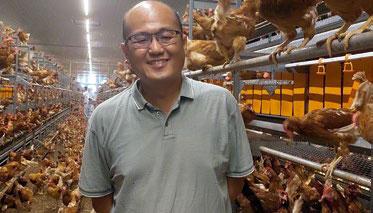

In the rural township of Temoh, Perak, another pioneer, Liang Kee stands out as Malaysia’s only Certified Humane cage-free egg farm.
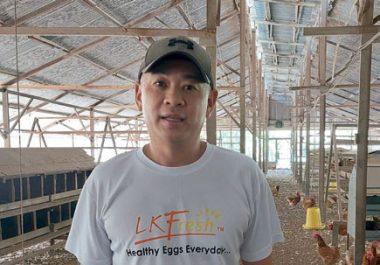
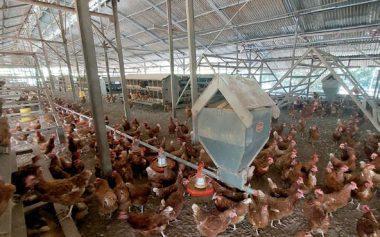
- Owner and Managing Director Tan Leng Yee started modestly with 1000 hens and now manages 30,000 birds across five aviary, free-ranging barns.
- The farm follows Certified Humane’s stringent welfare criteria, including 1.5 square feet per hen indoors and 2 square feet outdoors.
- Unlike farms that mimic cage-free setups without outdoor access, Liang Kee offers pasture-style foraging areas.
- Mr Tan further enhances this commitment to animal welfare by using black soldier fly larvae (BSFL) as a sustainable feed ingredient, providing a high-protein, gut-friendly alternative to soymeal and fishmeal.

TECHNICAL SYSTEMS DRIVING SUSTAINABILITY
Modern cage-free systems demand precision in barn design, climate management, and feed logistics. Liang Kee’s collaboration with Big Dutchman exemplifies how farms are adapting foreign concepts to Malaysia’s tropical conditions. Dual-pressure ventilation—positive pressure when windows are open and negative pressure when closed—ensures consistent airflow and ambient temperature within the barns.
- This is crucial in preventing heat stress, one of the most significant welfare and productivity risks in tropical poultry operations.
- Liang Kee’s in-house BSFL production is equally innovative.
- The facility, built with input from local insect protein startup Bioloop, raises larvae on plant-based organic waste.
- About 80% of the larvae are roasted and incorporated into layer feed, while 20% are served fresh to hens in outdoor zones, simulating natural foraging and enriching hen behavior.
This blend of advanced infrastructure with biologically aligned nutrition sets a benchmark for sustainable egg production that balances ethics, profitability, and food security.
CORPORATE CONSOLIDATION AND MARKET SCALE
While pioneers established the foundation, scale is now coming from industry giants. Huat Lai Resources, one of Malaysia’s largest egg producers, targets to launch the country’s biggest cage-free operation in Q4 2025.
- Its Malacca site will house 200,000 hens in multitier aviaries—more than quadrupling its current cage-free flock.
- Another 200,000 hens from 10 existing barns will be transitioned, pushing national cage-free capacity past 400,000 birds.
- Huat Lai’s expansion builds on its earlier venture via Singapore-based Chew’s Agriculture, initiated in 2012.
- Group Business Development Manager Edvin Lim notes a significant shift in corporate procurement.
“Hotels, retailers, and food chains now expect 100% cage-free sourcing— covering shell, liquid, and powder eggs,” says Mr Lim.
This demand is driven by internal sustainability mandates and external consumer pressure.
- A survey cited by Huat Lai, conducted by GMO Research, revealed that 77% of Malaysian consumers believe restaurants and food brands should use cage-free eggs, and 62% are willing to pay more for them.
HOSPITALITY AND EXPORT OPPORTUNITIES
Hotels and foodservice chains are the leading adopters of cage-free sourcing policies. TC Farm already supplies selected hotels, where high-volume purchasing supports price viability.
- Chains and health-focused grocers are exploring cage-free options, though most implementation timelines stretch to 2028 and beyond. For now, many promote alternative premium eggs like seaweed-enriched varieties.
- Export markets present another frontier. Avian influenza outbreaks have disrupted supply in Japan, Korea, Taiwan, and parts of the EU. Malaysia’s disease-free status gives it a competitive edge. TC Farm is eyeing Asian exports, however, high freight costs limit access to US and European markets.
BARRIERS TO BROADER ADOPTION
Despite growing momentum, cage-free production is not without challenges. Domestic market acceptance is still evolving.
“Cage-free eggs are priced at a premium—ranging from USD 1.50 for six eggs (Liang Kee) to USD 3.35 for 10 eggs (TC Farm).”
Eco-conscious urban consumers and expatriates are responsive, but mass-market adoption is hindered by price sensitivity and limited awareness of animal welfare standards.
- Seasonal demand volatility adds further pressure.
- During festive seasons like Eid, conventional producers often flood the market, driving prices down.
- This undercuts cage-free producers, who operate on thinner margins and longer production cycles.

Profitability remains elusive for some. Liang Kee, for instance, is still working toward full financial sustainability. However, its investment in BSFL and climate-smart design positions it for long-term resilience.
PDF