


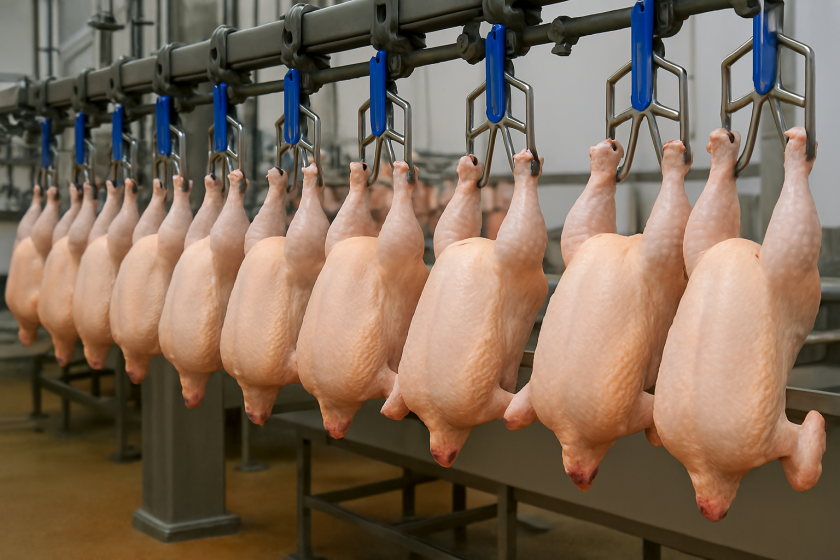
For broiler integrators, carcass quality defines economic success. Growth rate and feed conversion are important, but profitability is ultimately determined at the processing plant. Dressing percentage, breast yield, uniformity, and downgrade rates directly shape financial outcomes.
In South Asian markets, where feed costs are high and volatile, even small improvements in carcass yield protect margins. Carcass quality must be managed as a system-wide objective, not just a processing concern.
Defining carcass quality in practice
Carcass quality includes:
- High dressing percentage
- Optimal breast meat yield
- Uniform flock weights
- Minimal bruising and scratches
- Low incidence of breast myopathies
- Reduced condemnations
Carcass yield—not just growth rate—ultimately determines economic return.
In markets with both wet sales and processed products, carcass presentation is critical. Skin quality, absence of bruising, and uniform appearance influence acceptance at wholesale and retail levels. Across large operations, even small improvements translate into significant financial gains.
Genetics: Balancing growth and structure
Genetic progress has transformed broiler performance. Modern strains reach higher weights faster with better feed efficiency. Havenstein et al (2003) documented the scale of this improvement.
However, the push for higher breast yield must be balanced against structural and metabolic stability. Heavy birds increasingly show defects such as woody breast and white striping (Petracci et al, 2019). These reduce product value, especially in export markets.
Integrators must align strain choice with market demand, infrastructure capability, and environmental conditions.
Nutrition: Building lean muscle
Nutrition is not only about achieving target weight. The objective is efficient lean muscle deposition.
Digestible lysine is central to breast muscle growth. Increasing amino acid density improves yield up to an optimal point (Kidd et al, 2004). Beyond that, costs may outweigh benefits.
Energy-to-protein ratio must be carefully managed. High-energy diets increase fat deposition and reduce carcass efficiency. Strategic phase feeding and seasonal adjustments support lean tissue growth while controlling costs.
Pellet quality in humid conditions is another challenge. Poor pellet durability reduces intake consistency, affecting uniformity and yield.
Lean muscle deposition defines the true value of broiler production.
Health and disease control
High production density raises risks of enteric disease. Subclinical coccidiosis and necrotic enteritis reduce nutrient absorption and breast yield (Williams, 2005).
Respiratory issues also increase condemnation losses. Preventive health management protects flock performance and carcass quality.
Farm management and environment
Many carcass defects originate on the farm.
High stocking densities increase scratches and bruising. Poor litter management causes hock burns and skin lesions, lowering carcass grade and market acceptance.
Uniform flock growth is essential. Weight variability reduces processing efficiency and average yield.
Handling and processing alignment
Carcass quality can decline quickly if handling is inconsistent. Rough catching, transport stress, and long holding times increase bruising and mortality.
Standardized handling protocols and coordination between farm and plant teams reduce downgrades. Plant monitoring of trimming, rejection, and defect patterns should connect back to farm data for corrective action.
Managing breast myopathies
Rapid growth combined with management and nutritional factors contributes to woody breast and white striping. Moderating growth curves, avoiding excessive final weights, and reducing metabolic stress during peak phases help limit severity.
Continuous plant data analysis supports early detection and upstream adjustments.
Data integration as advantage
Progressive integrators now link feed formulation, farm performance, health records, and plant yield into centralized systems.
This integration reveals correlations between nutrition, management, and carcass outcomes. Carcass quality must be treated as a key performance indicator across the chain.
Economic perspective and conclusion
In high-volume operations, modest technical improvements create major financial impact. A one percent increase in breast yield or fewer downgrades directly raises revenue per bird. In volatile markets, protecting carcass yield safeguards profitability.
Maximizing carcass quality requires alignment across genetics, nutrition, health, environment, and processing. Coordinated management strengthens yield stability and competitiveness. Carcass performance reflects the cumulative effect of decisions made throughout production.
Carcass optimization reflects discipline across the entire production chain.
References
Havenstein, G. B., Ferket, P. R., & Qureshi, M. A. (2003). Growth, livability, and feed conversion of broilers from 1957 to 2001. Poultry Science, 82, 1500–1508.
Kidd, M. T., et al. (2004). Increasing amino acid density improves live performance and carcass yields of commercial broilers. Journal of Applied Poultry Research, 13, 593–604.
Petracci, M., et al. (2019). Muscle abnormalities in broilers: Occurrence and impact on meat quality. Poultry Science, 98, 746–755.
Williams, R. B. (2005). Intercurrent coccidiosis and necrotic enteritis of chickens. World’s Poultry Science Journal, 61, 423–433.