


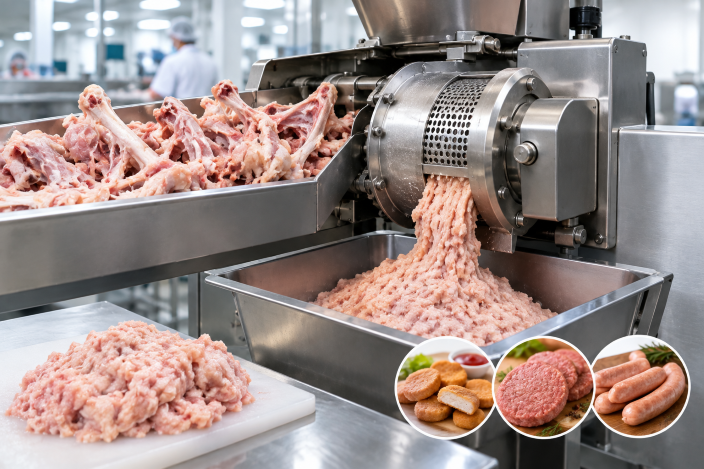
Advanced separation systems can recover edible poultry tissue while placing greater emphasis on process control, composition, and food safety
Poultry processors are increasingly looking at how much usable product remains attached to bones after conventional cutting and deboning. Mechanical separation provides a way to recover edible tissue from poultry bones, creating an ingredient that can be incorporated into a range of further-processed products.
According to the U.S. Department of Agriculture’s Food Safety and Inspection Service (FSIS), mechanically separated poultry is produced by forcing bones containing attached edible tissue through a sieve or similar device under pressure. The process separates edible tissue from the bone and produces a paste- or batter-like material (1). Mechanically separated chicken and turkey have been used in poultry products for decades.
The technology also creates an important processing-control challenge. Separation pressure and equipment operation can influence bone breakage and the characteristics of the recovered material. FSIS requires establishments producing mechanically separated poultry to meet specific requirements concerning bone particles and calcium content, with the final product subject to appropriate identification and regulatory controls (1).
From a processing perspective, mechanical separation can help manufacturers make greater use of poultry raw material that remains after conventional meat removal. The recovered material can subsequently become part of formulated products rather than being directed toward lower-value uses.
However, maximizing recovery cannot come at the expense of hygiene. The Food and Agriculture Organization emphasizes that mechanical separation operations should be designed and managed to prevent cross-contamination, while appropriate time and temperature controls are necessary for mechanically separated meat to maintain product safety (2).
The development of more efficient recovery systems therefore represents more than a yield opportunity. It requires processors to balance recovery efficiency, product composition, equipment settings, hygiene, and regulatory requirements.
As poultry companies continue seeking ways to extract greater value from every processed bird, mechanical meat recovery could become an increasingly important component of efficient, resource-conscious processing.