


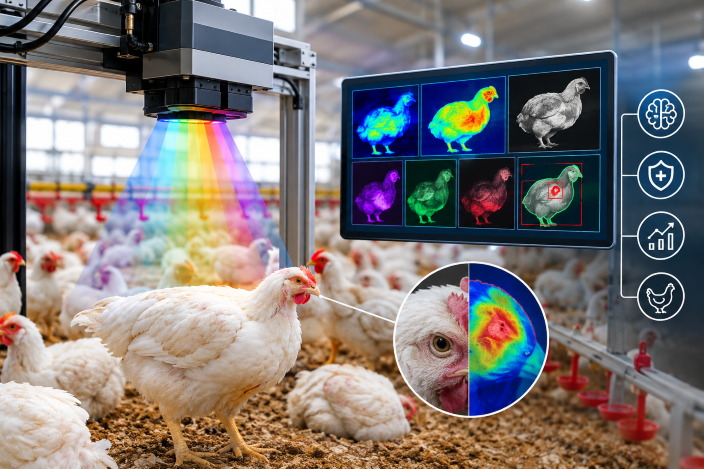
How spectral imaging and artificial intelligence could move poultry health monitoring from reactive inspection toward earlier intervention
Poultry health monitoring has traditionally depended on clinical observation, laboratory testing, post-mortem examination and production records. Although these approaches remain essential, many health problems begin with subtle physiological or tissue changes that may not yet be visible to the human eye. Multispectral imaging combined with artificial intelligence (AI) offers an emerging approach for detecting these hidden signals without requiring physical contact with the bird.
Unlike conventional RGB cameras, which record information primarily in the visible spectrum, multispectral systems capture selected wavelengths beyond or within visible light. These wavelengths can reveal differences associated with pigmentation, tissue composition, moisture, blood-related characteristics and surface abnormalities. Hyperspectral imaging, a closely related technology, can collect much larger numbers of contiguous wavelengths and has already demonstrated potential for non-destructive poultry safety and quality assessment (1).
Turning spectral differences into health indicators
The key advantage of spectral imaging is that an apparently normal area may have a different spectral signature from healthy tissue. When these differences are combined with machine-learning algorithms, the system can be trained to classify images according to predefined conditions.
Research has already demonstrated the feasibility of multispectral inspection in poultry processing. One commercial-line study used selected wavelengths and fuzzy-logic algorithms to distinguish wholesome chickens from birds exhibiting systemic disease. The system achieved 96.0% accuracy for systemically diseased birds and 97.6% for wholesome birds in the testing dataset, illustrating the potential of spectral information for automated inspection (2).
The technology is particularly interesting because AI does not simply look for a specific visual lesion. Instead, algorithms can analyze relationships among multiple spectral bands that may be difficult for an operator to recognize. This creates an opportunity to identify physiological changes before conventional visual inspection becomes sufficiently sensitive.
From processing plants to proactive flock management
Most established poultry applications of spectral imaging have focused on carcasses, meat quality and food safety. However, advances in compact cameras, machine learning and edge computing could eventually broaden applications to live-bird monitoring.
A camera positioned above a flock could potentially combine multispectral information with conventional RGB images and environmental data. Abnormal spectral patterns might then be compared with indicators such as feed intake, water consumption, activity, temperature and ventilation.
Such a system would not necessarily diagnose a disease automatically. Instead, it could function as an early-warning layer, flagging birds or areas of a house that require closer examination.
This distinction is important. Spectral abnormalities can have multiple causes, including lighting conditions, skin pigmentation, feather coverage, environmental stress or normal biological variation. Consequently, AI predictions would need to be validated against veterinary examinations and laboratory results before being used for clinical decision-making.
The rise of AI-powered spectral analysis
Recent research is moving beyond conventional statistical models toward machine-learning architectures capable of processing complex spectral-spatial information. A 2026 review reported that hyperspectral imaging is increasingly being combined with methods such as convolutional neural networks and other machine-learning approaches to identify chemical, microbial and physical changes in poultry products (3).
The same technological direction could eventually support real-time health surveillance, particularly as imaging equipment becomes smaller and more affordable. Instead of collecting images and analyzing them hours later, edge-based systems could process data directly inside poultry houses or processing facilities.
However, several barriers remain. Models must be trained using large and diverse datasets representing different breeds, ages, housing environments, lighting conditions and disease stages. Equipment calibration and differences between cameras can also affect model performance. A model that performs well in a controlled research environment may not automatically perform equally well on a commercial farm.
The most realistic future is therefore not AI replacing veterinarians or farm managers, but AI acting as an additional sensory layer. By combining spectral imaging, conventional cameras, environmental sensors and production data, poultry operations could identify abnormal patterns earlier and direct human attention toward the birds or areas most likely to require intervention.
Multispectral AI is still developing, but its potential is significant: health monitoring could gradually shift from detecting obvious problems to recognizing the invisible changes that precede them.
References
1. Kamruzzaman, M. et al. Literature review: spectral imaging applied to poultry products. Poultry Science, 99, 3709–3722.
2. Chao, K. et al. Hyperspectral-multispectral line-scan imaging system for automated poultry carcass inspection applications for food safety. Poultry Science.
3. Advances in Hyperspectral Imaging for Spoilage Detection in Meat and Poultry: A Non-Invasive Approach. Trends in Food Science & Technology, 169, 105558, 2026.