


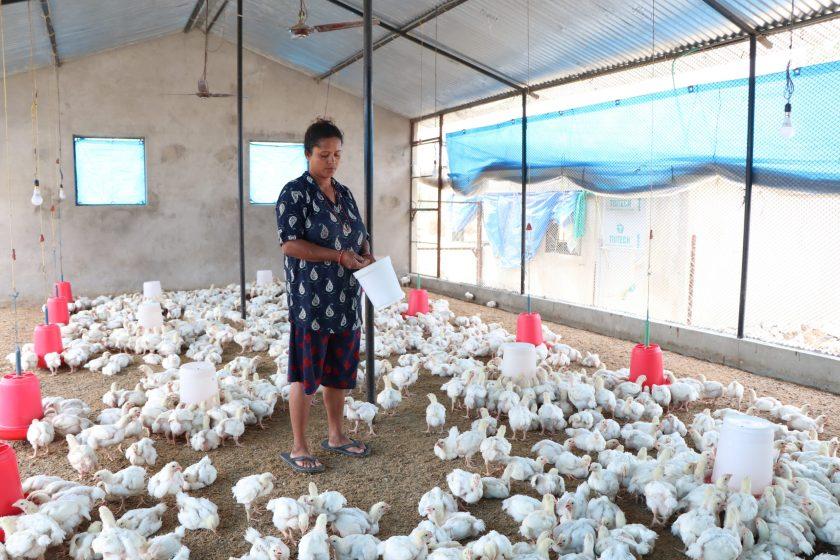
Chicken and eggs demand in Nepal during the Covid pandemic reached a record level as people searched for animal protein to remain immune to the virus.
Now, The Kathmandu Post reported that poultry entrepreneurs are wary about the future. This week, stakeholders discussed the current state of the sector, noting that the industry has faced continuous challenges and a downward trend post-Covid.
Raghunath Bhatta, President of the Nepal Poultry Entrepreneurs Forum, revealed that before the Covid pandemic, there were 14 hatcheries producing layer chicks for egg production; that number has now dropped to seven.
Similarly, hatcheries producing broiler chicks for meat have plummeted from 340 to just 109.
The number of feed industries has also shrunk from over 200 to 115.
The main reason for the drop was the rising feed cost and unauthorized imports of chicken and eggs from India, entrepreneurs said.
Situation of the sector
According to data provided by Mr Bhatta, total investment in Nepal’s poultry sector currently stands at USD 1.11 billion, with an annual turnover of approximately USD 1.01 billion.
While Nepal is nearly self-sufficient in chicks, feed, eggs, and meat, it remains heavily dependent on imports for feed raw materials, medicines, vaccines, and technical equipment.
Mr Bhatta added that the import of raw materials and other essential goods for the poultry business results in an annual capital outflow of USD 312.20 million.
Government officials said that despite past setbacks from avian influenza outbreaks, the poultry sector has been expanding at a rate faster than expected.
Chicken has become widely popular as it is cheaper than other meat products. As a result, the poultry market has been growing rapidly despite challenges.
Amid the gloomy outlook, poultry entrepreneurs are preparing to celebrate the 13th National Poultry Day.
According to them, poultry farming began in Nepal after the late King Mahendra inaugurated the central hatchery in Parwanipur, Bara district, on January 1, 1961. However, commercial chicken production in Nepal started in 1974. Between 2004 and 2013, the country saw many farmers shifting to the poultry business.
Imports of production inputs
Nepal started officially observing National Poultry Day on January 1 every year since 2013.
A press conference was organized by the forum in Bharatpur recently to provide information regarding the upcoming celebrations.
It was disclosed during the press meet that up to 70% of raw materials for feed are imported. Furthermore, 90% of medicines and 95% of vaccines and equipment are brought in from abroad.
Umesh Chandra Sapkota, Central President of the Nepal Feed Industries Association, said that while corn imports were once very high, the situation has now improved due to increased domestic cultivation.
“Currently, less than 50% of the corn required for feed is imported,” he said, adding that demand for feed industry has led farmers to switch to corn nowadays.
However, according to Mr Sapkota, soybeans that are needed for the preparation of the feed must be imported in large quantities.
“We rely on imports for 99% of our soybean requirements because domestic production is insufficient,” he said.
Since feed accounts for 70% of the total cost of poultry production, the reliance on foreign raw materials significantly drives up costs, he added.
“It is difficult to start producing vaccines immediately, and we may not be able to manufacture tools, equipment, and technology locally yet. However, we can certainly increase corn and soybean farming.”
Incentives are needed
“The government must provide incentives, and Nepali farmers need to step forward,” said Rajendra Lamichhane, Central President of the Nepal Hatchery Industry Association.
Poultry farmers have suggested the government totally ban illegal import of chicks, offer subsidies for the construction of poultry houses, and fix the price of chicken and eggs.
They have also suggested the government arrange market centers for selling chicken and eggs and provide loans at reasonable rates.