


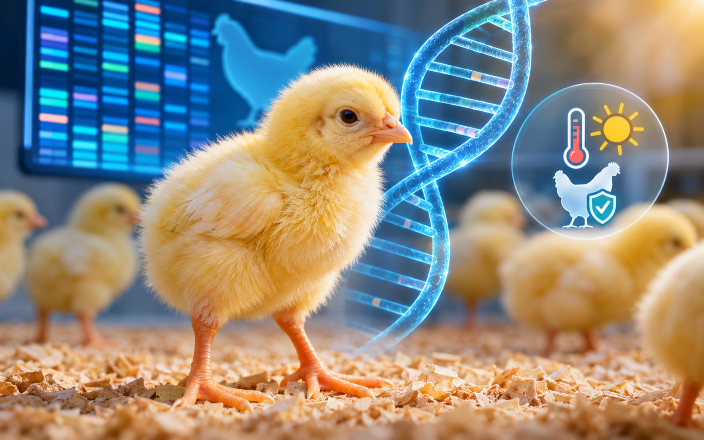
The growing impact of global warming is pushing poultry genetics beyond conventional selection for growth and feed efficiency. New genomic research is identifying biological pathways that could help produce chicks better adapted to high temperatures, potentially transforming future breeding strategies.
Why Heat Tolerance Is Becoming a Genetic Priority
Heat stress is one of the most important challenges facing poultry production, particularly in regions experiencing increasingly frequent temperature extremes. High environmental temperatures can disrupt metabolism, immune responses, cardiovascular function and growth, affecting both chick development and subsequent flock performance.
Traditional breeding programs have primarily focused on production characteristics, including body weight, feed conversion and reproductive efficiency. However, the industry is increasingly recognizing the importance of selecting birds that can maintain performance under environmental stress.
Genomic research offers an opportunity to identify the biological mechanisms behind this resilience and incorporate them into future breeding strategies (1).
New Research Identifies Genetic Pathways Linked to Heat Adaptation
A study published in Poultry Science in June 2026 investigated the genetic mechanisms responsible for heat adaptation in chickens from different geographical and climatic environments.
Researchers combined genomic selection analyses with gene-expression data from multiple tissues to investigate how chickens respond to high temperatures.
The study identified 25 high-confidence genes associated with heat adaptation, including ATP1A1, PLCB4, RYR2 and AKT3. These genes are involved in interconnected cardiovascular, calcium-signaling and survival pathways.
Importantly, the researchers identified a regulatory network connecting the heart, hypothalamus and liver, suggesting that heat tolerance is not controlled by a single gene or organ.
These findings provide potential genetic targets for developing chicken populations with improved thermoregulatory capacity and environmental adaptability (1).
Indigenous Chicken Populations Offer Valuable Genetic Resources
Another important development comes from research published in Scientific Reports in April 2026.
Researchers investigated the genetic diversity of indigenous chickens from Afghanistan, China, Indonesia, Iran and Pakistan, comparing them with White Leghorn chickens.
The analysis identified genomic regions associated with adaptation to heat stress, including 14 candidate genes linked to thermal sensation, calcium signaling and neurodevelopmental processes.
Among the identified genes were TRPV1, TRPV2, TRPV3, BDNF and CALM1.
These findings demonstrate how indigenous chicken populations can preserve valuable genetic variations that may help birds survive challenging environmental conditions.
Preserving this genetic diversity could become an important resource for future commercial breeding programs, particularly as poultry production expands into warmer climates (2).
What Does This Mean for Future Chick Genetics?
For breeding companies and hatcheries, the implications extend beyond identifying faster-growing or more uniform chicks.
Genomic information could eventually help breeders select parent stocks carrying genetic variations associated with:
-
Improved heat tolerance and thermoregulation.
-
Better physiological responses to environmental stress.
-
Greater adaptability to different production climates.
-
More stable performance under challenging conditions.
However, identifying candidate genes does not automatically mean that their benefits will be expressed in commercial chicks. Further validation across genetic lines and production environments is necessary.
From Genetic Potential to More Resilient Chicks
The future of poultry genetics will increasingly depend on balancing productivity with biological resilience.
Combining genomic selection, gene-expression analysis and the genetic diversity of indigenous populations could help breeders develop chicks better equipped for changing environmental conditions.
Rather than selecting exclusively for production efficiency, the next generation of breeding programs may increasingly prioritize birds capable of maintaining health, welfare and performance under environmental pressure.
References
(1) Integrative genomic analysis and gene expression patterns reveal a cardio-neuroendocrine signaling network for heat adaptation in geographically diverse chickens. Poultry Science, 2026, Volume 105, Issue 6, Article 106744.
(2) Hosseinzadeh, S. et al. (2026). Whole genome analysis of selection associated with resistance to heat stress in chickens. Scientific Reports, 16, 11726.