


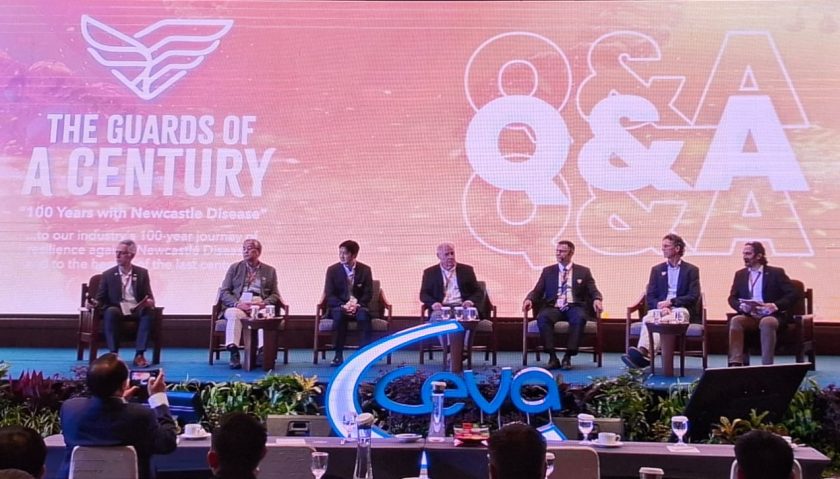
The second day and final day of Ceva Animal Health’s seminar entitled ‘The guards of a century: 100 years with Newcastle disease’ in Bogor, Indonesia, centered on vaccine breakthroughs.

Atsushi Yasuda and Moto Esaki of Ceva Japan traced the history of vector vaccine development, explained design considerations for HVT vector vaccines, and outlined future directions.
They described the trial-and-error process behind the early HVT-F vaccine and recalled how development of the HVT/ND vaccine began in 1985. Candidate selection in those early years laid the foundation for today’s advances.
“Future HVT vector vaccine development will incorporate advanced antigen design supported by artificial intelligence and bioinformatics,” said Mr Esaki.

Discovering the strength of eHVT-F technology
Dr Vilmos Palya, Ceva’s Scientific Support Expert, highlighted the immune response advantages of rHVT-F technology.
“Traditional ND vaccines prevent the clinical disease, but do not prevent infection and subsequent virus shedding. Vectormune ND delivered in-ovo or day-old s. c. proved to provide great potential for early and lifelong induction of active immunity in face of MDA, without inducing respiratory reaction,” he explained.
Professor Arjan Stegeman of Utrecht University then addressed how vaccine effectiveness against NDV transmission can be measured. Using data from commercial broilers exposed to velogenic genotype VII NDV, he demonstrated that vector rHVT-F vaccines significantly reduce transmission rates.
Proven protection against emerging genotypes
Ceva Consultant Dr. Marcelo Paniago presented extensive challenge trial results confirming rHVT-F vaccine efficacy against emerging velogenic NDV genotypes.
Findings showed that Vectormune ND consistently provided maximum protection across all NDV genotypes. It offered early onset and lifelong immunity while reducing virus shedding and transmission.

Closing the seminar, Mustafa Seckin Sandikli, Ceva’s Global Poultry Director, reaffirmed Ceva’s commitment to advancing animal health solutions worldwide.
“As there is only one serotype [of NDV], the genotype of the vaccine is not relevant. Thus, the critical point is the concept and technology of the vaccine choice. Vectormune ND has proven results against each genotype in different challenge conditions,” he stressed.