


This article is written by Muhammad Aakash and Abdul Rehman. Both are Undergraduate Students in Poultry Science at the University of Agriculture Faisalabad in Pakistan.


Muhammad Aakash (right) and Abdul Rehman
To support commercial poultry meat production, broiler breeder production systems are designed to maximize fertile egg production and hatchability. The efficiency of these systems depends on the reproductivity of male which is mostly evaluated by fertility rate, hatchability percentage, and overall chick output.
Most of the commercial breeder farms focus on the management of female birds in terms of nutrition, body weight and egg production performance. However, this female-centered approach often underestimates the critical contribution of males in determining reproductive success.
Male broiler breeders play a vital role in semen quality and effective mating behavior. In most commercial settings, fertility is not solely dependent on hen performance; it is the outcome of successful interaction between male and female.
Poor management can lead to low sperm viability, improper mating, reduced semen quality and decreased fertility rate. Whenever fertility declines, everyone misunderstands it as a problem of the female or hatchery, while the real problem is poor male management practices like poor flock uniformity, inadequate nutrients, improper male to female ratio and body weight control.
That is why male management is important to maintain good quality semen, active mating behavior and better reproductive performance in broiler breeder flocks.
This article explains simple and practical ways to improve male performance under commercial farms.
Importance of male performance
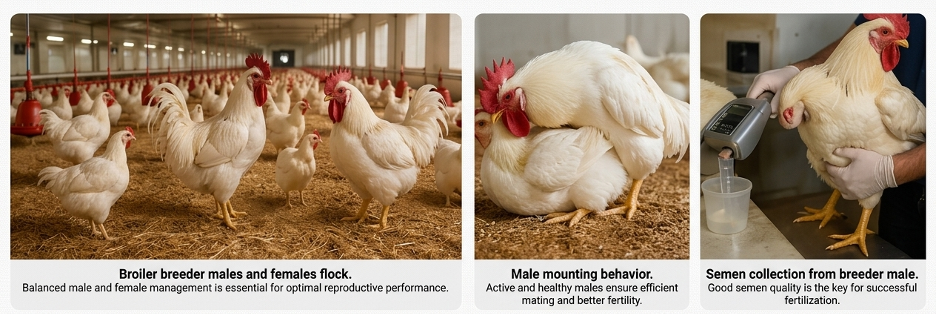
Male broiler breeders are important for flock fertility because one male mates with 8-10 females. That is why the condition and performance of each male has a direct impact on a large portion of the flock.
Active and healthy males show better mating behavior, effective sperm transfer and high libido. On the other hand, males that are weak, stressed, overweight, or have other deformities show low mating interest and reduced fertility rate.
In many farms, a decline in fertility after peak production is commonly seen even when hens are performing well. During such cases, the issue often lies with males becoming less active or losing physical fitness over time.
In many farms, poor management of males gradually reduces male activities which results in unnoticed fertility losses.

Factors influencing semen quality
Successful fertilization depends on the quality of semen. Poor semen quality can reduce sperm survival and movement and ultimately poor fertility. We can say that fertility is directly linked with semen concentration, volume and sperm motility.
To maintain standard body weight, mitigate heat stress and apply genetic selection to improve semen characteristic:
- Body weight: Maintaining optimal body weight is critical. Underweight or overweight males show lower sperm quality.
- Nutritional factors: Adequate levels of protein, vitamins and minerals especially trace minerals including selenium, manganese, zinc, copper and iodine, are essential for proper sperm production and function.
- Sexual maturity and age: 32–52 week of age is the peak time for better semen quality, which declines as rooster age, and requires careful management. Meanwhile, 30–39 weeks of age show high sperm motility compared to younger males.
- Genetic selection: Utilize tools like the sperm quality index to select younger males with high semen quality to improve whole flock hatchability.
- Environmental management: Heat stress also reduces the sperm quality; specific dietary adjustment like added antioxidants can mitigate this effect. A standard mating ratio is recommended for maximum fertility, as a higher male-to-female ratio can increase aggression and reduce mating frequency.
Body weight and uniformity
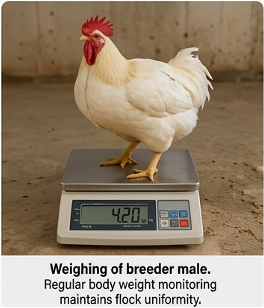
The most critical aspect of male management in broiler breeders is the control of body weight. Inactive and overweight males tend to become inactive and are less capable of mounting hens properly. Underweight males may lack the physical strength needed for mating. Both conditions have negative effects on reproductive performance.
Uniformity within the male flock is equally important. If there is wide variation in body weight, dominant males will mate more frequently while weaker males may not mate at all, resulting in uneven mating and inconsistent fertility across the flock.
Regular management practices include weekly weighing of males, removing non-performing and heavy males, and maintaining target body weight according to breed standards.

Male to female ratio and mating efficiency
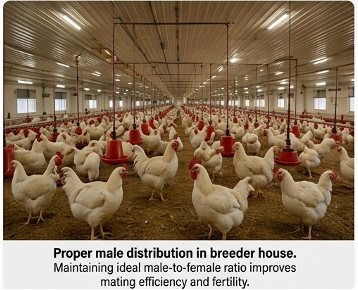
In broiler breeders, mating efficiency is not determined by the number of males alone, it is influenced by their physical activity, libido and exact distribution within house. Even if male-to-female ratio is maintained, poor mating behavior can still result in low fertility.
In commercial farms, it is mandatory to keep a proper ratio. However, simply achieving this number is not enough. If males are not healthy or are unevenly distributed, mating opportunities become limited for a portion of hens. An excess of males can lead to aggressive behavior, fighting and unnecessary stress. This not only reduces mating efficiency but also can cause injuries to hens which then can affect production.
Conversely, a shortage of males can cause insufficient mating frequency, leading to a higher number of infertile eggs. A common field issue is the clustering behavior of males. Males often gather around feeders, drinkers, or preferred areas of the house, leaving other sections under-served, resulting in some hens repeatedly mated while others may not be mated at all. This uneven mating pattern leads to inconsistent fertility across the flock.

Nutritional management
Semen quality, mating behavior and overall reproductive performance in broiler breeder males can be affected by nutritional management.
Diets containing 14-16% CP help maintain good sperm production, while essential amino acids support reproductive function. Vitamin E supports sperm motility and protects cells from damage, while selenium and zinc enhance sperm survival and fertility.
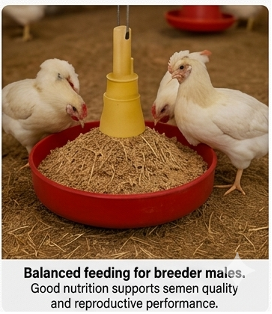
Feed restriction is commonly seen to control body weight, but excessive restriction can reduce male activity. Therefore, balanced feeding along with uniform feed access is essential to maintain both body condition and reproductive performance in breeder males.

Health, environment and management
It is important to manage the farm environment well for maintaining the reproductive performance of broiler breeder males. Even well-fed and strong males may show poor results if environmental conditions are not properly managed.
Important practices include proper ventilation in hot weather, effective disease control programs, clean water supply, good litter quality and reducing stress in the flock. All these factors support male activity and overall fitness.
The most serious challenge is heat stress during hot climates. An increase in temperature can reduce semen quality, lower sperm motility and reduce mating activity. Field observations show that heat stress reduces fertility by 4-14% in peak summer.
Any kind of disease can also weaken males and affect reproductive performance. Poor sanitation and wet litter increase stress and disease risk, directly affecting mating efficiency.
Conclusion
The fitness of males is key to the success of a breeder farm and influences the performance of hens. Although a hen may lay plenty of eggs, chicks cannot hatch healthy if the male is overweight, inactive or stressed.
To ensure high fertility, farmers should control the body weight of their broiler breeder males. Maintaining weekly base data for healthy and active flock. Good management is the fastest way to turn eggs into profit and keep the flock productive.