


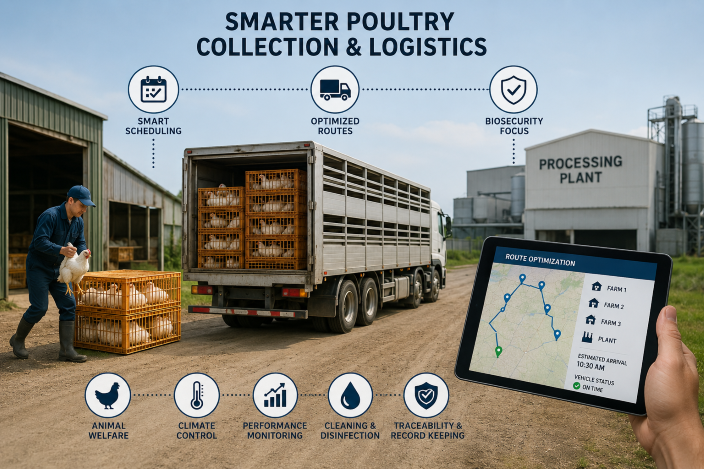
Why collection planning deserves a new approach
Poultry collection is often treated as the final step of farm production, but the movement of broilers from farm to processing plant is actually a high-risk transition point for bird welfare, meat quality, biosecurity, and operational efficiency. While recent industry discussions have focused on catching equipment, transport conditions, and digital monitoring, a less explored opportunity is the integration of collection scheduling, route optimization, farm conditions, and processing capacity into one coordinated system.
Research increasingly supports this approach. A 2025 poultry supply-chain model demonstrated that vehicle assignment and farm-to-slaughterhouse scheduling can be optimized together with slaughterhouse operations rather than being managed as separate activities (1). Another supply-chain study showed that combining farms at different distances from the processing plant can help maintain a more consistent flow of birds throughout the day (2).
From fixed schedules to dynamic collection
Traditional collection schedules are often based on predetermined farm sequences and expected arrival times. However, real-world conditions rarely remain fixed. Bird weights, weather, road congestion, catching speed, vehicle availability, and processing-line capacity can all change during the collection day.
A more responsive system could continuously update the collection plan according to these variables. Farms experiencing extreme heat, for example, could receive priority for early-morning collection, while longer-distance journeys could be scheduled during cooler periods. If a vehicle is delayed, the system could automatically adjust subsequent farm visits and inform the processing plant.
This concept moves logistics from simple transportation toward real-time decision-making.
Linking catching teams with transport capacity
Collection efficiency also depends on synchronization between catching crews and transport vehicles. A truck arriving before birds are ready can create unnecessary waiting, while a catching team waiting for transport increases labor costs and may extend the birds’ exposure to handling.
The World Organisation for Animal Health (WOAH) recommends that catching be performed by skilled handlers, that birds be handled carefully, and that collection be planned to reduce both slaughterhouse waiting time and climatic stress (3). Recent research comparing catching methods has likewise evaluated welfare, labor ergonomics, and economics together, highlighting that collection decisions involve several competing objectives rather than a single measure of efficiency (4).
The objective should therefore be synchronization—not simply speed.
Logistics as a biosecurity barrier
Every movement between farms creates a potential biosecurity pathway. Vehicles, crates, equipment, and personnel can transfer pathogens if sanitation procedures are inadequate. WOAH recommends cleaning and disinfection of vehicles entering poultry establishments, while the Canadian Food Inspection Agency emphasizes that transport equipment should be visibly clean and disinfected before reuse (5,6).
A stronger collection system could therefore include a digital sanitation record for every truck and crate set. Before a vehicle is assigned to another farm, its cleaning status could be verified electronically. Such traceability would help connect logistics management with disease prevention rather than treating them as separate functions.
Measuring the journey, not just the destination
The success of collection should not be evaluated solely by whether the required number of birds reaches the processing plant. Useful indicators include dead-on-arrival rate, bruising, wing injuries, loading time, travel duration, waiting time, fuel consumption, and deviations from scheduled arrival.
FAO notes that inadequate poultry transportation can cause production and quality losses while compromising bird health and welfare (7). These indicators can be combined into a logistics performance dashboard, allowing companies to identify farms, routes, vehicles, or collection teams associated with recurring problems.
Toward predictive poultry logistics
The next development in poultry collection may be predictive logistics, where historical flock data, weather forecasts, traffic information, vehicle locations, and processing demand are analyzed before collection begins.
Instead of asking, “Where should the truck go next?”, the system could ask, “What sequence is most likely to deliver the right number of birds to the processing line at the right time, with the lowest welfare and biosecurity risk?”
This shift could make collection a measurable component of poultry production strategy. Better synchronization can reduce unnecessary waiting, improve resource utilization, protect bird welfare, and support more consistent processing performance.
For an industry under pressure to improve efficiency while meeting higher welfare and biosecurity expectations, smarter collection logistics may become not simply a transportation advantage, but a competitive necessity.
Sources
(1) IFAC, 2025. A novel MILP model for the operation of the poultry supply chain.
(2) Dolgui et al., Optimisation of the broiler production supply chain, International Journal of Production Research.
(3) WOAH, 2024. Animal welfare and broiler chicken production systems.
(4) Tuyttens et al., 2025. Comparing methods for catching and crating broiler chicken flocks: A trade-off between animal welfare, ergonomics and economics. Poultry Science.
(5) WOAH, 2024. Biosecurity procedures in poultry production.
(6) Canadian Food Inspection Agency. Biosecurity Measures for Poultry Transportation.
(7) FAO. Collection and transport – Gateway to poultry production and products.