


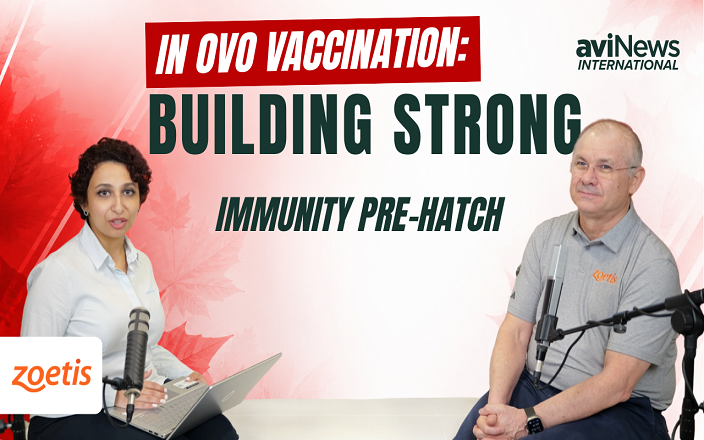
Toronto, Canada – As poultry producers continue to seek more effective ways to protect birds from early-life disease challenges while improving hatchery efficiency, in ovo vaccination has become a key technology in modern poultry production. During this year’s World’s Poultry Congress, aviNews International had the pleasure of speaking with Dr. Tarsicio Villalobos, Director of Clinical Research at Zoetis, about the principles behind successful in ovo vaccination, the importance of injection precision, and how this technology contributes not only to early immune development but also to more efficient hatchery operations.
Understanding the Principles of In Ovo Vaccination
“In ovo vaccination involves delivering vaccines directly into embryonated eggs during the embryo’s late stage of development, in a specific site where the vaccine is capable of stimulating an immune response.”, states Villalobos as the applied definition of in ovo vaccination in the poultry industry.
However, achieving consistent results requires a high level of precision. During incubation, eggs are continuously rotated, meaning that by the time they reach the vaccination stage, they are not always positioned perfectly perpendicular to the injection system. For this reason, one of the most important principles of in ovo vaccination is the adaptability of the equipment to the variations in egg position and accurately delivering the vaccine.
The process also requires creating a small opening in the eggshell without damaging the egg structure, since cracks or excessive shell disruption can negatively affect hatchability and embryo survival.
“The important part is that we create the hole, but we do not crack the egg,” Dr. Villalobos explains.
The precision of the process extends to the movement of the needle, which must follow a specific trajectory to reach the correct embryonic compartment where the vaccine can generate an effective immune response.
Disinfection also remains an important principle shaping the success of the in ovo vaccination process. Given the biology of the hen, having a system capable of constantly disinfecting the vaccine injection needles ensures the success of the process while minimizing any contamination that may arise from the pollution of the eggshell with fecal material.
Lastly, ensuring that the mechanistic aspect of the vaccine pumps is balanced in a way that it’s effective enough to deliver the vaccine without damaging the vaccine itself which is cell-associated.
Injection Site Determines Vaccine Effectiveness
One of the most critical factors influencing in ovo vaccination success is the exact location where the vaccine is deposited. Inside the developing egg, several compartments can potentially be reached, including the air cell, the allantoic compartment, the amniotic compartment, the embryo’s body, and the yolk sac. However, not all locations provide the same level of immune stimulation. For vaccines to achieve maximum effectiveness, the injection must reach the appropriate embryonic tissues. Dr. Villalobos emphasizes that targeting the correct compartment ensures that the vaccine is not wasted in an ineffective location.
For example, vaccination into the amniotic fluid or embryo’s body allows the developing chick to interact more efficiently with the vaccine and develop early immunity before hatch. This precision is particularly important for vaccines such as Marek’s disease vaccines, where early immune protection is essential immediately after placement. By ensuring that the vaccine reaches the correct site, hatcheries can maximize protection and improve the consistency of vaccination outcomes.
Embryo Development Scoring Helps Determine the Optimal Vaccine Timing
Timing is another fundamental element of successful in ovo vaccination. Vaccinating too early or too late can reduce effectiveness, making it essential to identify the precise developmental stage when the embryo is ready.
“We need to do this at the moment where the hatchability can be maximized but at the same time at the moment where we can access successfully the embryonic compartment where the vaccine is going to be effective. Not too early, not too late.”, emphasizes Villalobos.
To support this decision-making process, Zoetis has developed embryo development scoring systems that evaluate whether the chick has reached the appropriate stage for vaccination. According to Dr. Villalobos, several indicators are considered, including external or internal pipping, head position, and yolk absorption. The position of the embryo’s head is particularly important because it indicates preparation for the hatching process. Additionally, evaluating yolk absorption provides information about the physiological maturity of the embryo. By combining these observations into a numerical score, hatchery teams can determine whether embryos are ready for vaccination and adjust programs according to actual biological development rather than relying only on chronological incubation age. This approach helps optimize vaccine performance while protecting hatchability.
In Ovo Vaccination Stimulates Early Immune Development
Historically, one of the main advantages of in ovo vaccination was considered to be operational efficiency, allowing hatcheries to vaccinate large numbers of birds more rapidly compared with individual chick vaccination. However, research over the last decade has revealed additional biological benefits.
Dr. Villalobos explains that studies, particularly with HVT-based Marek’s disease vaccines, have demonstrated that in ovo vaccination can enhance immune system development before hatch. Vaccinated chicks show increased stimulation of immune cells, including different lymphocyte populations, as well as enhanced activation of immune pathways associated with innate immunity. This means that the benefits extend beyond protection against the specific vaccine-targeted disease. By accelerating immune maturation, in ovo vaccination may help chicks develop stronger early-life defenses against a broader range of viral and bacterial challenges.
Improving Hatchery Efficiency and Return On Investment
Beyond immunological benefits, in ovo vaccination has transformed hatchery operations by eliminating major bottlenecks associated with individual bird vaccination. Before the adoption of this technology, vaccination required handling chicks individually, which significantly increased processing time and delayed movement from the hatchery to the farm. According to Dr. Villalobos, in ovo vaccination allowed hatcheries to dramatically accelerate chick processing. Previously, movement to the farm could require many hours due to vaccination procedures. With in ovo systems, chicks can now be processed and transferred much faster, improving overall workflow efficiency. The removal of this bottleneck also encouraged the development of additional hatchery automation technologies, including conveyor systems, robotics, transfer equipment, and automated cleaning solutions. In this way, in ovo vaccination became a catalyst for broader hatchery modernization.
Technology that Supports People as Well as Production
While automation is often associated with reducing labor requirements, Dr. Villalobos highlighted another perspective: technology can also improve working conditions and enhance the skills of hatchery employees. In certain facilities, in ovo vaccination was viewed not as a way to replace workers, but as a way to support them by reducing physically demanding tasks and allowing employees to operate more advanced systems. As hatchery technology becomes more sophisticated, operators develop specialized knowledge and become highly skilled technicians rather than performing repetitive manual tasks. This evolution can improve job satisfaction, employee retention, and the overall quality of hatchery operations.
Precision Technology for the Future of Poultry Production
In ovo vaccination represents an example of how technology can simultaneously improve animal health, production efficiency, and workforce development. By combining precise equipment, accurate injection techniques, optimized timing, and improved vaccine delivery, hatcheries can provide chicks with stronger early protection while improving operational performance.
As poultry production continues to advance toward greater automation and biological precision, technologies such as in ovo vaccination will remain essential tools for producing healthier, more resilient birds. For Dr. Villalobos, the success of in ovo vaccination lies in its ability to bring together several benefits: strengthening the immune system of the developing chick, improving hatchery efficiency, and creating more skilled and sustainable production environments.