


Moving from fixed transport protocols to data-driven welfare management
The poultry industry is increasingly looking beyond simple transport-time limits to understand how distance, stocking density and lairage interact to influence broiler welfare and meat quality. New research suggests that preslaughter management may benefit from a more dynamic approach, where decisions are adapted to the actual conditions experienced by birds.
A 2026 study published in Poultry Science evaluated different combinations of transport distance, space allowance and lairage duration under commercial conditions. The researchers found that longer transportation was associated with greater physiological stress, increased microbial loads and changes in meat-quality characteristics. Importantly, the effects of transport distance, stocking density and lairage were not independent, highlighting the complexity of preslaughter management (1).
Real-time monitoring could become a key management tool
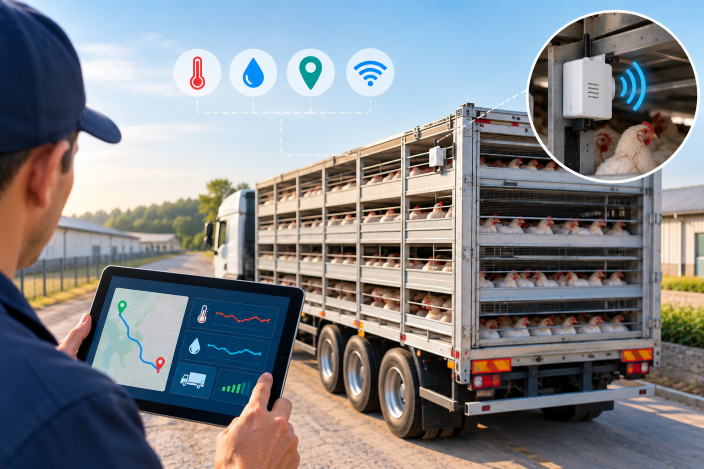
Rather than relying only on conditions recorded when a truck leaves the farm, continuous monitoring of the transport environment could provide a more accurate picture of the birds’ journey. Sensors positioned throughout transport systems can measure temperature and humidity and identify differences between locations within the same vehicle. Previous research has demonstrated the feasibility of transmitting microclimate information from poultry transport vehicles in real time (2).
This approach could allow processors and transport managers to identify thermal-risk zones, adjust journey schedules and respond more rapidly to changing conditions. Combined with information on flock weight, loading density, journey length and expected lairage time, these data could support more precise decisions before birds reach the processing plant.
From transport monitoring to predictive welfare
The next step may be the development of predictive preslaughter systems that combine environmental and operational data to identify high-risk journeys before losses occur. Such systems could help reduce mortality, injuries and quality downgrades while improving welfare and processing efficiency.
As climate variability increases, treating every journey identically may become less effective. The future of preslaughter management could be a dynamic system in which transport conditions are continuously measured and management decisions are adjusted accordingly.
References
(1) Poultry Science (2026). “Transportation welfare under commercial conditions: A multifactorial assessment of stress physiology, meat quality, and microbial load in broiler chickens.”
(2) Real-time web-based microclimate monitoring of broiler chicken trucks on different shifts. Revista Brasileira de Engenharia Agrícola e Ambiental.