


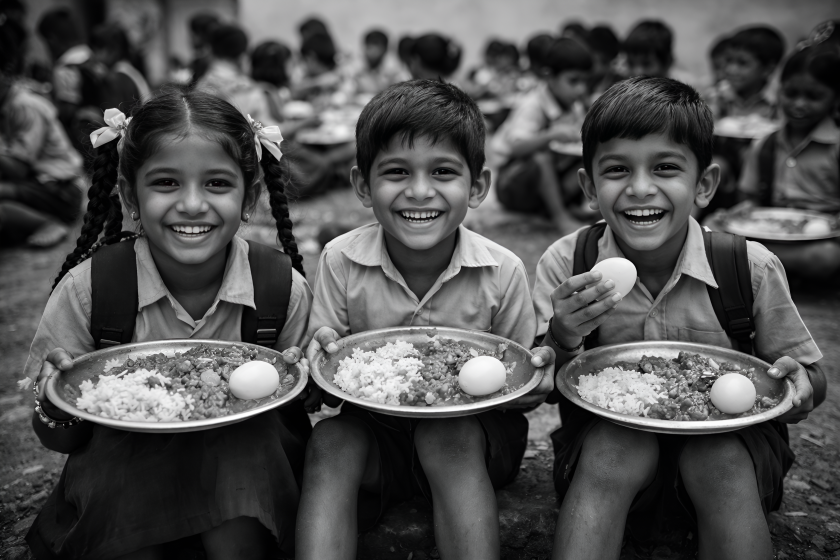
Around midday in India’s government schools, a quiet revolution unfolds. As 11.8 crore children sit down for their PM POSHAN lunch, the presence—or absence—of a boiled egg on their plates signals more than a menu choice. It reflects a high-stakes intersection of nutrition, agricultural stability, and the future of India’s poultry industry.
Nutrition meets policy
The midday meal is often the most reliable source of animal protein for millions of children. For governments, it is a low-cost, high-impact intervention. For poultry farmers, it represents a stable and predictable demand source.
The PM POSHAN scheme evolved from the Mid-Day Meal program, designed to fight classroom hunger and improve school participation. Today, it prescribes strict calorie and protein norms. Yet eggs remain optional. States can substitute milk, bananas, or pulses, creating a patchwork of strategies across India.
Southern and eastern states, traditionally strong poultry producers, embraced eggs early. Northern and western states, citing cultural or political preferences, often provide vegetarian alternatives.
- Egg-providing states: Andhra Pradesh, Tamil Nadu, Odisha, and others.
- Vegetarian bloc: Gujarat, Rajasthan, Punjab, Haryana, Madhya Pradesh, Chhattisgarh, Uttar Pradesh.
The economic engine of eggs
The scale of procurement is staggering. With about five crore children receiving eggs, and an average of 80 eggs per child annually, demand reaches 400 crore eggs annually.
Government procurement prices range from INR 5 to INR 7 per egg, with transport and handling adding INR 0.50-1. Delivered costs fall between INR 6 and INR 8. This translates to an annual expenditure of INR 2300-4500 crore, a manageable investment compared to the scheme’s total budget.
India is the world’s third-largest egg producer, with 142.77 billion eggs in 2023-24. Production grows at 6-8% annually. The top five producing states account for nearly two-thirds of national output, and they overlap with strong egg-inclusion policies. School meals consume 2.8-4% of total production.
Logistics and bioavailability
Handling eggs is often seen as a logistical challenge. Yet Andhra Pradesh and Tamil Nadu demonstrate efficient hub-and-spoke systems. Eggs move from farms to schools within 72 hours. Stamping with edible ink prevents leakage into open markets. Storage practices allow eggs to remain shelf-stable for up to 10 days, outperforming milk which requires refrigeration.
Nutritionally, eggs are unmatched. States that rely on soya or pulses overlook key differences:
- Anti-nutritional factors: Soya contains inhibitors that block mineral absorption.
- Choline gap: Eggs are the richest source of choline, vital for brain development.
- Protein Digestibility Corrected Amino Acid Score (PDCAAS): Eggs score a perfect 1.0, while vegetarian sources range between 0.6 and 0.8. Children must eat twice as much soya for equivalent protein.
Ripple effects across agriculture
Egg expansion is also a crop story. For every billion eggs, 200,000 tons of feed are required. Feed is composed of 60% maize and 25% soybean meal. This demand stabilizes crop prices and supports farmers, especially in states like Bihar and Karnataka.
School procurement offers predictability in a volatile market. Bulk contracts stabilize prices, while local sourcing through Farmer Producer Organizations and Self-Help Groups keeps money circulating within rural economies.
The universal adoption scenario
If all 11.8 crore children received eggs, demand would surge dramatically.
- Scenario A: Three eggs weekly → 14 billion eggs annually.
- Scenario B: One egg daily → 23.6 billion eggs annually.
Universal adoption would increase demand by 18-20 billion eggs, a 10-15% rise in national consumption. This would drive expansion in layer farming, hatcheries, feed industries, veterinary services, and rural employment.
A triple-win for India
Despite cultural and political barriers, eggs remain India’s most efficient intervention.
- The child: Gains the most bioavailable protein.
- The farmer: Secures a buyer of last resort.
- The economy: Benefits from multiplier effects across maize, soy, and logistics.
By 2030, the school plate may be the most vital market for India’s poultry industry. Every billion eggs added to demand ripples across agriculture, logistics, and rural livelihoods. The humble boiled egg is not just food—it is India’s golden oval of growth.