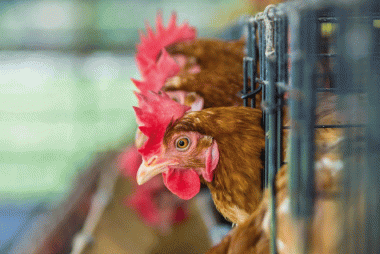
The Reality of the South African Egg Industry
How the Highly and Low Pathogenic Avian Influenza is handled in South Africa
The rise in Highly Pathogenic Avian Influenza (HPAI) or bird flu worldwide is alarming for South Africa. Presently HPAI is rampant in the USA with multiple cases reported involving tens of millions of birds. UK, Europe, New Zealand, Australia. In 2017 South African poultry industry reported its first case of HPAI on poultry, which was followed by the 2021 outbreaks and then the most devastating outbreaks in 2023.
- In South Africa all HPAI farms that test positive or suspected farms are immediately placed under quarantine and no movement of birds, eggs, or products are allowed on, off or through these farms.
- Samples are collected for verification of the suspicion and back and forward tracing is implemented to detect any possible spread of the disease.
- So far most of the affected properties are subjected to culling the chickens and carcasses that were affected by the diseases and dispose of them by dumping them at an approved hazardous dump site, incineration, rendering or composting on the farm, or on-farm burial are also allowed by the Government Department of Environmental Affairs.
- Eggs are then taken under veterinary supervision for pasteurization or moved after double fumigation or fogging.
HPAI
Passive and active six-monthly surveillance in the country is ongoing. In terms of the Animal Disease Act, 1984 (Act No 35 of 1984) any suspect or confirmed outbreak of any avian influenza strain must be immediately reported to the state veterinarian responsible for immediate investigation.
- If HPAI is suspected or detected in poultry, there is no scientific justification for placing a radius around the affected farms as a controlled/ protection zone, due to the mode of transmission, primarily by wild birds.
- However, all neighboring farms are immediately visited, and all epidemiologically linked properties to an affected farm are immediately placed under quarantine until preliminary investigations can be conducted.
LPAI
In accordance with Chapter 1.3 of the World Organisation for Animal Health (WOAH or OIE) terrestrial animal health code, the low pathogenic avian influenza (poultry) disease code has been delisted.
- As of 1 January 2022, LPAI is only reported to WOAH as part of a country’s six-monthly surveillance.
- All Low Pathogenic Avian Influenza strains, however, are still controlled animal disease in terms of the Animal Disease Act, 1984 and the control and notification measures remain unchanged.
South Africa stance on cage free with the existing concerns of the Highly Pathogenic Avian influenza
The following section focuses on the current existing production systems in South Africa highlighting the concerns of the HPAI and the push from the welfare lobbyists for only cage free production systems.
- As stated above how the HPAI disease is managed and handled in South Africa, I would like to state that as at this stage South Africa is not vaccinating for this disease, there are negotiations between the Government and the South African Poultry Association to consider the possibility of vaccinating as the backup mechanism against this disease, also boosting the biosecurity measures.
- In recent months there has been a high pressure on the South African Egg farmers to move or scrap out the cage-produced eggs completely and only produce free-range eggs.
- We are currently producing our Eggs from the cages, free range, and barn production systems.
- We are a country of about 63 million people with an estimated 32% of the population unemployed, with many people depending on Government grants, and with high food insecurity individuals, coupled with that as stated we are currently not vaccinating for HPAI disease.
- We have never been against cage-free systems but, however, we find ourselves operating in a very difficult space, with slow economic growth.
- We ultimately leave us with no options but to produce eggs on all 3 existing production systems (Cages, Free range and Barn).
In 2021, research was conducted to assess the cost, and the unintended consequences should we consider a 100% move to cage free systems. Below are more details about our research.

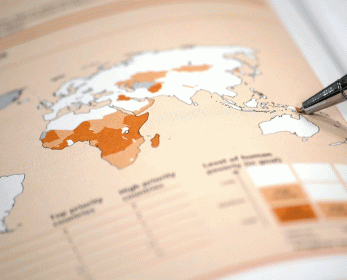
South Africa is a member of the World Organization for Animal Health (WOAH)
- The OIE’s development started in 1920 with the outbreak of rinderpest in Belgium because of zebus (Bos Indicus) originating from India and destined for Brazil via the port of Antwerp.
- The world organisation for animal health (WOAH) is a global institution looking after the protection of animals and preserving our future in several categories.

The primary objective of the (WOAH) is to ensure transparency in the global animal disease situation, collect, analyse and disseminate veterinary scientific information, encourage international solidarity in the control of animal diseases, safeguard world trade by publishing health standards for international trade in animals and animal products, improve the legal framework and resources of national Veterinary Services, to provide a better guarantee of food of animal origin and to promote animal welfare through a science-based approach.
SAPA (2012) published a code of practice for pullet rearing and table egg production and focus on the housing of different production systems. Further South African Poultry Association and the World Egg Organisation (WEO) continue to work with the (WOAH) to develop global standards for laying hen housing.
South African egg industry
The South African egg industry is fragmented, with a few major players and several small and medium-sized producers. Egg production takes place throughout the country and rearing of good quality pullets requires an extreme cold temperature, which is why the KwaZulu–Natal midlands seem to be the pullet-rearing capital of South Africa.
- There is a consensus that the South African poultry industry, which comprises of poultry for meat and eggs including the end of lay spent hens, provides the largest source of animal protein in the human diet in the country.
- The poultry industry remains the largest single contributor to the country’s agriculture sector GDP and employment.

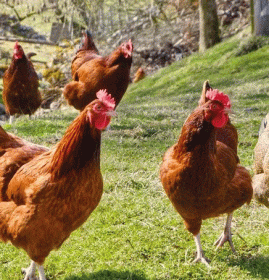
Eggs are one of the most versatile food products and one of the most affordable sources of protein compared to other animal proteins, as well as being very easy to obtain. Population and real income growth are the two most important factors influencing egg demand, other factors influencing demand include change of lifestyles due to health scares, and egg production systems.
The results of the research that was conducted by the National Agricultural Marketing Council found that the macro-economic and socio-economic impact indicates that it is foreseen that egg production in South Africa will decline by approximately 26.3% in line with a 36% increase in production costs due to the implementation of the additional regulations on the layer hen production systems.
The impact on the various economic indicators is presented as follows:
- The impact of the decline in production is very different for the various economic variables.
- For instance, the impact on the GDP of the egg industry will decline by 21%, whereas the impact on the use of Capital will decline by 27%, and the impact on employment will only be a 12% decline.
- The contribution to employment of the egg industry will decline by 6158, down from a total of 49776 jobs before the regulations to 43618 jobs after the implementation of additional regulations.
- It is also important to note that the direct impact within the egg production sector is an increase of 6014 jobs, which means that job losses will be experienced in other sectors indirectly linked to egg production.
- A positive point is that the decrease was not that high with regards to unskilled workers, which only decreased by -0,4% whereas the total contribution of egg production regarding employment will decrease by -12%.
- State revenue of approximately R1 092 million will be forfeited due to the implementation of the additional regulations.
Socio-Economic Impact
This macroeconomic impact study does not only consider the fact that the cost of local egg production will increase, but that the cost structure will also change significantly. Now looking at the current situation in South Africa zooming into the socio-economic, and economic impact and the viability of the Egg industry versus the animal humanitarian (Animal welfare lobbyists) side for layers to walk around in a free-range system will only be possible if policymakers contribute in terms of subsidies, assist farmers with improvements on biosecurity and also allow the vaccines furthermore improve the economic situation of the country.
- We need to first see the demand rising for cage-free eggs and then farmers will produce eggs based on the rise in demand, which unfortunately, currently, there is no demand for these particular eggs.
- From the producers’ side, more concerns are on the HPAI, zero compensation for the culling of infected chickens from HPAI and unfortunately in 2023 about 30% of the local production was destroyed by the HPAI.
- This then suggests that all 3 existing production systems should remain in South Africa and allow the consumer to choose which eggs to purchase based on their affordability.
- From the South African Poultry Association, we are not against free-range eggs, however, we believe our members should not be forced by animal welfare lobbyists to only produce cage-free eggs and burn cages.