


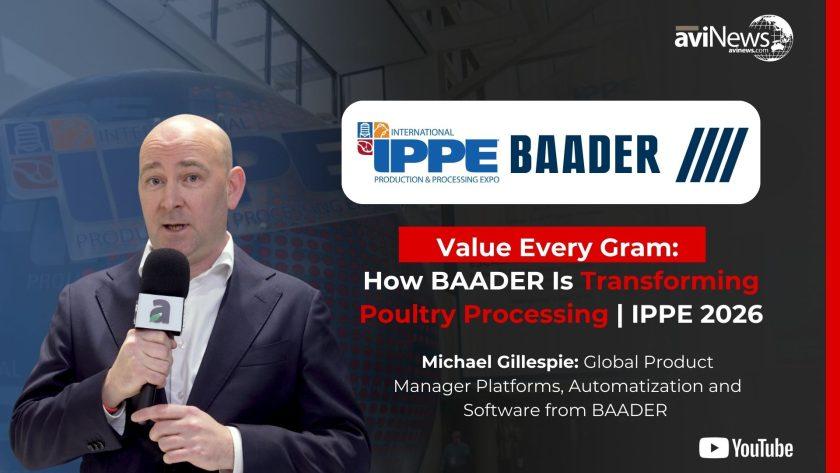
From the heart of IPPE 2026 in Atlanta, we sit down with Michael Gillespie, Global Product Manager – Platforms, Automation and Software at BAADER, to explore how data automation, and digital platforms are reshaping poultry processing.
In this exclusive AgriNews Play interview, we dive into BAADER’s core philosophy — “Value Every Gram” — and what it truly means for plant performance, efficiency, yield optimization, and cost control.
- The role of data quality and automation in modern processing plants
- How predictive analytics and machine learning are driving smarter decisions
- Turning raw data into actionable insights
- Live demonstrations of ClassifEYE and BAADER ONE, BAADER’s digital platform that converts machine data into real operational value
Join us as we explore how BAADER continues to set the standard in digitalization, automation, and precision processing, helping shape the future of the poultry and animal protein industries.
WATCH THE FULL INTERVIEW BELOW:

BAADER works under a very clear concept: “Value Every Gram” in processing. Explain what this really means for the industry and why optimizing every gram makes a difference in performance, cost and efficiency.
When you have modern fast high-speed processors, processing up to 20-25 million birds a year, if you increase the amount of output that that processor processes, from even 2 g per bird, that’s a significant amount. We´re talking about 50.000 kg of chicken meat that you can actually sell onto the market, you´re not wasting it, so that has a lot of impact on producing foods, but also the profitability for our customers. So, you have to look to the fact that we have processes that don’t have so much footprint that they can expand with.
- So they have to make it with what they currently have in their processing line.
- They’re really trying to extract as much as they can from that processing line.
- You have restrictions on environmental permits.
- You have restrictions on noise permits.
- So really, our processes, our customers, are looking to really extract everything that they can from the line that they have in the future.
- The global population is growing, I think in the next 25 years we get something like 1.5 billion more people on the planet. That increases the demand for foods. So again, our customers really need to value every gram that they’re producing so that they can extract everything from their production line.
As processors move towards higher requirements for automation and traceability, how do you see the role of predictive analytics and machine learning evolving within poultry processing lines over the next years?
Data collection is really where it all starts. If you’re talking about automating processes, improving processes, then collecting data; collecting valuable data is really where it all starts. In order to create a new software, new control solutions, everything that comes with automation; you need to have data to be able to start that process. It needs to be valuable data.
- So data that’s coming from sources that our customers can use to really improve their processes.
- At the moment you still find that there’s a lot of manual data collection. We believe and we have definitely seen that you can take data collection to the next level, without having that manual collection there.
Today we talk a lot about data, but having it isn’t enough—what really matters is knowing how to use it. How have you managed to organize, visualize, and turn data into meaningful and actionable insights for your clients?
The first part is actually collecting the data and we already have a lot of data that is available to us from our machines, from our sensors. Normally it comes via PLCs. The first step that we’ve taken is we’ve embraced edge computing. So in all of our PLCs that we send out with our machines, each one of them comes with a B1 edge and we use that to extract certain data points that we believe are useful for our customers.
We use that data, we display it to our customers in dashboards in very nice to use, nice to see dashboards. But we also have that data stored on databases and we can also transfer it to our customers’ own systems so they have access to that data, they can be import it into their own systems, so they can incorporate it into their dashboards that they have coming from other systems in their factory.
As we have discussed previously, BAADER has developed very interesting digital solutions. One of them ClassifEYE, which uses computer vision to improve performance, could you show us how it works?
We have BAADER ClassifEYE breast meat detection system. It’s a vision system that is actually incorporated directly into our breast deboning systems.
The 6630 deboning system
- The camera is installed in the door.
- It’s taking an image of each carcass that is passing by and it’s measuring the performance of the machine.
- It’s looking at how much breast meat is actually remaining on each carcass; if there’s fillets remaining, left, right, center fillets, if there’s any damaged carcasses, and also the efficiency of the loading onto the machine.
- Then after that we send the data through to our ClassifEYE software system which is then used by the users in the processing factory to monitor how the deboning machine is working.
Another solution that has drawn a lot of attention is BAADER ONE, a platform that transforms machine data into actionable information. Could you show us how it works?
BAADER ONE is a software solution that takes the data that we’ve collected from all of the machines in the production line. For example, the ClassifEye system that I’ve just shown you, it takes the data, it’s communicated to one central server and then it allows the customer to visualize that data into dashboards that they can use to then monitor the machine, monitor the process and make decisions in order to improve it.
- So this is an example of a dashboard in BAADER ONE from the classify breast meat detection.
- You can see we have a lot of different charts, a lot of different graphs and also some heat maps here to really direct our processes into where they should be going to improve their process.
- This is completely customizable.
- So each user can have multiple dashboards.
- Depending upon what they’re producing during the day, they can go in and they can change the dashboard very quickly to get an overview and to react quicker to what’s happening in the line.