


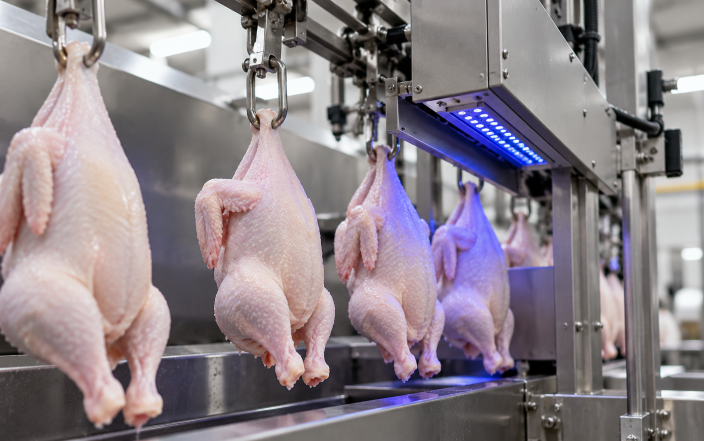
A promising light-based technology could provide poultry processors with an additional way to control bacterial contamination without adding chemical antimicrobials to chicken meat.
A study investigating violet-blue light technology has explored its potential to control Campylobacter, a major foodborne pathogen associated with poultry. Researchers tested the approach against 64 bacterial strains collected through poultry surveillance programs.(1)
A chemical-free approach to pathogen control
The technique, known as violet-blue photodynamic inactivation (VB-PDI), uses visible light at approximately 405 nanometers. The light activates molecules inside bacterial cells, generating reactive oxygen species that damage essential cellular structures and can ultimately kill the bacteria.
Key Scientific Finding
All 64 Campylobacter strains tested were susceptible to the treatment. Repeated laboratory exposure also did not produce a detectable increase in tolerance in the strain used for resistance testing.(1)
Unlike conventional chemical interventions, this approach does not require adding an antimicrobial substance to the product. It could therefore offer an additional option for processors seeking to strengthen food-safety controls.
From laboratory results to processing lines
Campylobacter remains a significant food-safety concern worldwide. Poultry processing is an important stage at which contamination can potentially be reduced before products reach consumers.
A UK Food Standards Agency evidence review also examines interventions intended to reduce Campylobacter levels at slaughterhouses, highlighting the importance of evaluating pathogen-control approaches in practical processing conditions.(2)
However, laboratory susceptibility does not establish how effectively violet-blue light will reduce contamination on poultry carcasses under commercial conditions. Further trials involving naturally contaminated chicken and industrial processing environments are needed to determine its effectiveness, operating requirements and economic feasibility.
What this means for poultry processors
If validated at commercial scale, violet-blue light could complement existing hygiene procedures and pathogen-control measures, providing another potential barrier against foodborne bacteria.
For now, the technology requires further validation. Its practical value will depend on whether laboratory findings translate into reliable contamination reductions without compromising meat quality or processing efficiency.
References
(1) Bembridge, F. et al. (2026). One light to rule them all: photodynamic inactivation of diverse Campylobacter. Microbiology.
https://doi.org/10.1099/mic.0.001769
(2) UK Food Standards Agency (2026). Interventions Applied at Slaughterhouse to Reduce Campylobacter spp. Load.