When the Supply Chain Breaks: Poultry Prices and the Economics of Maritime Disruption in the Middle East
The 2026 maritime disruption in the Middle East has done more than interrupt oil flows. It has exposed a structural fragility at the heart of regional food systems: a region that imports up to 85% of its food, feeds its poultry on imported grain, and routes the majority of that grain through the Strait of Hormuz, a single 21-nautical-mile chokepoint. This article traces the economic transmission chain from blocked straits to rising chicken and egg prices and identifies three forces that make this episode more complex than a simple shipping disruption.

A region running on imported grain…
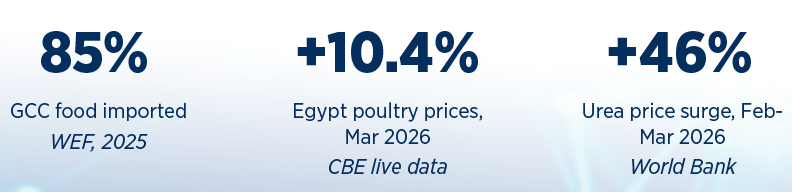
- The GCC imports up to 85% of its food. That number is well known.
- Less understood is the specific mechanism through which maritime disruption translates into poultry price inflation and how quickly it happens:
- A broiler chicken raised in Saudi Arabia or the UAE is, in economic terms, a machine for converting imported feed grain into protein. Feed accounts for 65–75% of total broiler production costs in the Middle East, with the typical blend running 60% corn and 40% soybean meal.
- Both are sourced overwhelmingly from South America and the Black Sea region, both travel by sea, and approximately 81% of the GCC’s rice imports – along with a substantial share of corn and soybean shipments – transit the Strait of Hormuz.
- When commercial shipping through the strait fell by approximately 95% between February and March 2026, according to UNCTAD, the cost shock was not gradual.
- Container spot rates on Gulf-linked corridors rose by 300-400% and war-risk insurance premiums tripled. Emergency bunker surcharges reached $3,000 per forty-foot equivalent unit (FEU).
- Vessels rerouted via the Cape of Good Hope added 10 to 14 days and thousands of nautical miles per voyage. For a production system where feed is already 70% of cost, these freight increases land hard and fast.
“Ship transits dropped from around 130 per day in February to just 6 in March – a collapse of about 95%.” – UNCTAD, April 2026
Three forces make this worse than a shipping crisis…
The current episode is not simply a freight cost problem. Three converging forces make it structurally more serious than the headline shipping numbers suggest.
1. HPAI has already thinned global flock supply
- The Hormuz disruption lands on top of a global poultry sector already constrained by Highly Pathogenic Avian Influenza (HPAI). Between September 2025 and February 2026, nearly 5,000 HPAI H5N1 detections were recorded across Europe alone, affecting domestic flocks in 32 countries.
- As of early 2026, the ongoing HPAI outbreak that began in February 2022 has surpassed 200 million total bird losses in the US, affecting over 2,000 flocks. Costs related to the response have exceeded $1.8 billion, driven by massive depopulation of egg-laying hens and turkey.
- US retail egg-prices rose by over 20% as a direct result. The Middle East has been partially insulated from this specific wave, but the effect on global flock availability is real: there is less surplus supply to draw on precisely when the region most needs import flexibility.
The interaction of disease pressure and logistical disruption is materially worse than either factor in isolation.


2. The fertilizer feedback loop
- Here is the dimension most poultry market analyses miss. The GCC is not only a food importer; it supplies approximately 43% of global seaborne nitrogen fertilizer exports. The World Bank reported urea prices surging over 45% month-on-month between February and March 2026.
- This matters for poultry economics because fertilizer prices directly affect the input costs of corn and soybean farmers in Sub-Saharan Africa, South Asia, and Latin America – the regions that grow the feed grains the Gulf imports. A Hormuz closure simultaneously disrupts food imports and inflates the input costs of the crops that will be harvested next season.
Even with the strait reopening in 2026, feed grain prices face upward pressure into 2027 from disrupted spring planting cycles already underway.
3. Live market data confirms the transmission is already active
- Egypt’s Central Bank reported on April 18, 2026 that urban poultry prices rose 10.4% in March alone, a third consecutive monthly increase. In the UAE, it is reported that smaller farms in Sharjah and Ras al-Khaimah are already suspending operations due to feed shortages, with industry sources noting that only the largest integrated players are able to absorb the current disruption.
- These are not forecast numbers. They are the leading indicators for the risk that Saudi Arabia, Jordan, and Iraq might face over the following months.
Egypt’s 10.4% single-month poultry price spike is not an outlier – it is the leading indicator for what the rest of the region might face over the next period. The global feed industry news confirm that a number of small-medium UAE farms are already halting production.


The figures indicate three possible price scenarios…
Calibrated against Egypt’s March data and the feed cost transmission pathway, three scenarios can be mapped for GCC retail poultry prices, using pre-crisis 2025 baselines of approximately SAR 22/kg for broiler chicken and SAR 20 per 30-egg tray.
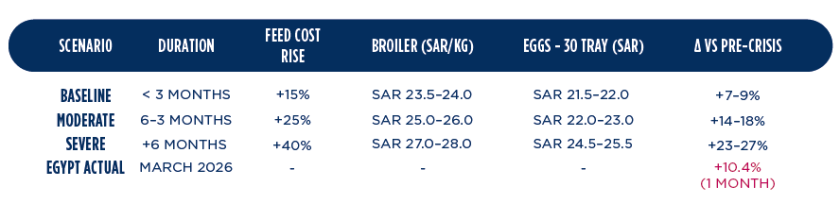

These are not marginal movements. Chicken accounts for 83% of total Middle East poultry consumption and is the default protein for low- and middle-income households across the region, priced 40–50% below beef or mutton (FAO). A 20–25% price spike under the severe scenario does not represent a market adjustment for these households.
- It represents a direct reduction in protein access. Historically, food price shocks of this magnitude in the MENA region are reliable predictors of government market intervention: export restrictions, price controls, and emergency procurement mandates. Industry participants should treat regulatory intervention as a base-case scenario, not a tail risk.
Three things the industry can act on now…
- Hedge feed grain for 2–3 production cycles immediately. The cost of forward purchasing corn and soybean meal today is lower than the cost of price volatility in 90 days. Large integrated producers in Saudi Arabia – Al Watania, Tanmiah, NADEC – have the balance sheet to do this. Smaller operators should explore cooperative purchasing arrangements urgently.
- Audit breeding stock and parent flock replacement schedules. Day-old chicks and parent stock travel by air from European genetics houses. Air cargo capacity through the Gulf has been reduced by approximately 20% (BCG) due to hub disruptions and jet fuel surcharges. If the crisis extends beyond Q3 2026, replenishing parent flocks becomes the next production bottleneck – one with a lead time measured in months, not weeks.

- Diversify feed grain sourcing corridors now, not after reserves deplete. South African corn via Cape Town, Australian grain, and Eastern European alternatives routed outside the Suez/Hormuz corridor are all viable but require lead time to establish. The IFIF estimates that strategic ingredient diversification can reduce supply disruption risk by up to 40%. The window to act ahead of reserve depletion – estimated at 3–6 months for most GCC governments – is open, but not indefinitely.


The Saudi buffer and its limits
Saudi Arabia’s Vision 2030 investment in domestic poultry production is meaningful in this context. Chicken self-sufficiency rose from 45% in 2016 to 68% in 2022 and to over 70% in 2025, with near full self-sufficiency targeted by 2030.
- The Kingdom is already self-sufficient in eggs and exports surplus to GCC neighbours. The September 2025 commissioning of Tanmiah’s new feed mill in Dahna and Al Watania’s expanded processing capacity represent exactly the kind of vertical integration that reduces vulnerability in a crisis.
But the limit is important to state clearly: self-sufficiency in birds does not mean self-sufficiency in the grain those birds eat. Every broiler in Saudi Arabia still depends on imported corn and soybean meal. The Vision 2030 agricultural programme is heading in the right direction, but the feed dependency is the residual vulnerability that no amount of farm expansion resolves without a parallel investment in diversified, crisis-resilient grain supply chains.
Saudi Arabia’s Vision 2030 trajectory – from 45% to nearly 100% chicken self-sufficiency – is the right playbook. But self-sufficiency in birds is not the same as self-sufficiency in feed. The grain dependency is the last mile of vulnerability.
Conclusion
- The economics of this crisis follow a logic that is blunt and fast-moving: feed is 70% of the cost; feed requires imported grain; imported grain requires open sea lanes; sea lanes are severely disrupted. Egypt’s March 2026 data show that the transmission is already active. UAE farm suspensions show that there is already a structural impact on smaller operators. The fertiliser feedback loop means that the price pressure does not disappear with the strait reopening; it continues into the next planting and harvest cycle.
- The baseline scenario, assuming resolution within this year, limits retail price increase to 7–9%. The severe scenario, assuming a prolonged disruption, implies 20–25% increase across the region’s most affordable protein. The difference between those two outcomes is not just an economic question. It is the difference between a manageable market adjustment and a meaningful reduction in household protein access for tens of millions of people across the Middle East. The industry window to act – on hedging, on genetics supply, on sourcing diversification – is open right now.
ABOUT THE AUTHOR
Dima Chatila is an Associate Director in Economics, Infrastructure Innovation and Strategic Transformation. She has 15+ years of experience in applied economics, financial planning & analysis, infrastructure advisory and strategic consulting across major projects & programmes in multiple industries in the Middle East.