Introduction
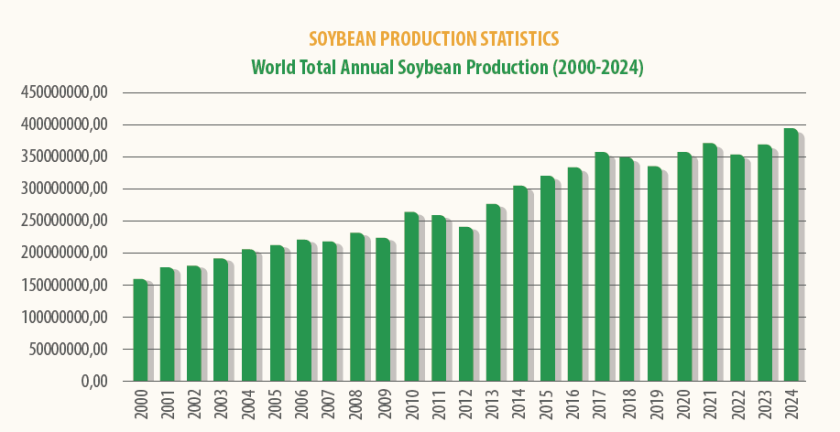
Global projections indicate that the world population will reach 9.7 billion by 2050, and that demand for animal protein will increase by 14% and egg consumption by 39% as a result. This massive increase in demand is further deepening dependence on key feed raw materials such as corn and soybeans. Therefore, the quality of soybean meal in animal feed is a critical issue (Ravindran et al., 2014).

The Importance of Soybeans in Animal Feed
The most important characteristic of soy is that it provides more protein per unit area and at a lower cost compared to other plant and animal feed sources. Soy protein is the protein closest to animal protein and has a very high biological value. For this reason, by-products derived from soybeans (primarily soybean meal) are used as a protein source in rations for poultry and small ruminants, as well as dairy and beef cattle (Anonymous, 2019; Tüfekçi, 2019).
The protein content of soybean meal is influenced by several factors, including soybean variety, tillage, soil properties, climate, harvest, and processing conditions (Grieshop et al., 2003; Thakur and Hurburgh, 2007; de Coca-Sinova et al., 2008; Frikha et al., 2012; Ravindran et al., 2014; García-Rebollar et al., 2016; Lagos and Stein, 2017). The protein content of raw materials is one of the parameters routinely determined by the feed industry and is crucial for ensuring the proper composition of the matrix in feed formulations.
- From this perspective, even small 1% changes in the use of protein sources during ration formulation can ultimately result in significant financial implications.
- The factors determining economic value are not merely the amount of crude protein, but rather the precise biochemical analyses of the digestible amino acids and metabolic energy included in the ration matrix.
Laboratory analyses
The objective of this project is to determine the differences in the nutrient composition, amino acid profile, and protein quality of soybean meal imported from various countries and used in feed production for animal nutrition.
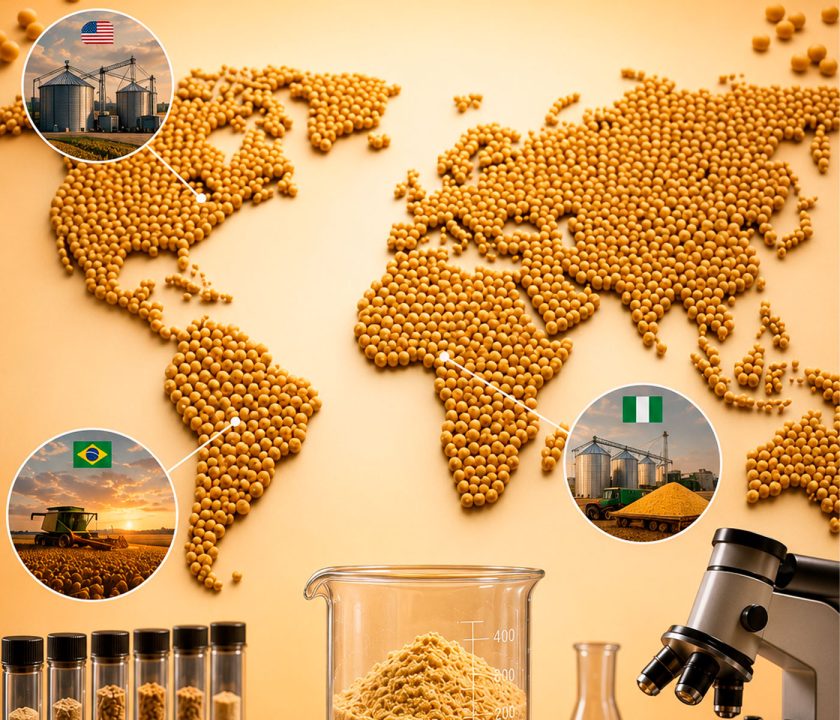
- Soybean meal imported from five different countries—the United States, Brazil, Nigeria, Ukraine, and Uruguay—was used as the study material.
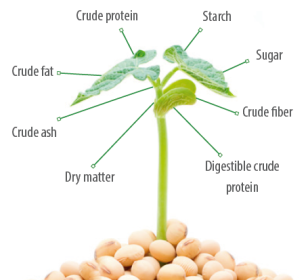
- The levels of dry matter, crude ash, crude fat, crude protein, starch, sugar, crude fiber, and digestible crude protein were determined in these meals, and the metabolic energy value for poultry was calculated using the obtained data.
- To determine protein quality, analyses were conducted regarding the amino acid profile, urease activity, protein distribution index, protein solubility in potassium hydroxide, and trypsin inhibitor activity.

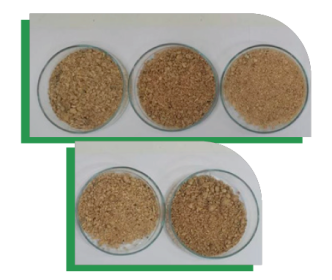

In this study, soybean meal was used as the material, and meal imported from five different countries was utilized.
As shown in Figure 2, meal from various origins—including the United States, Brazil, Nigeria, Ukraine, and Uruguay—was obtained from a private supplier.


Table 1. Comparison of nutrient content in soybean meal from different origins

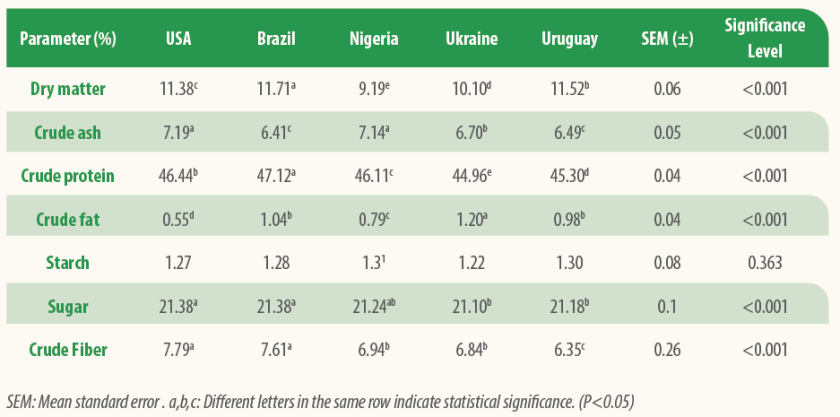
The differences observed in the table are consistent with the results of previous studies; the variations in nutrient values can be attributed to differences in the genotype of the seeds used (Zarkadas et al., 2007), variations in bean-growing areas across countries (Wilcox and Shibles, 2001; Karr-Lilienthal et al., 2005), and environmental conditions during the growing and harvesting seasons (Rotundo et al., 2016; Pfarr et al., 2018).
Results
The results of a study conducted by Ibáñez et al. (2020) highlighted that the crude protein content of soybean meal may be related to the latitude of the country of origin (day length, humidity, and temperature conditions), and even emphasized that the protein content in meal derived from soybeans grown in regions closer to the equator is higher.
The findings of our study are consistent with these results. The higher protein content of the soybean meal from Brazil compared to that from soybeans grown in the other four countries was found to be consistent with the literature.
Data regarding the nutrient content of soybean meal are presented in Table 1.
As shown, the nutrient contents of the samples examined, with the exception of starch content, differed significantly from one another (P<0.001).
- It was determined that the dry matter content was higher in soybean meal from Brazil, with an average value of 11.71%, while the crude ash content was higher in soybean meal from the United States and Nigeria, with average values of 7.19% and 7.14%, respectively.
- Crude protein content was highest in soybean meal from Brazil (47.12%) and lowest in that from Ukraine (44.96%).
- Similarly, the crude fat content was found to be higher in soybean meal from Ukraine compared to the others (1.20%).
- On the other hand, it was observed that meal from the United States (21.38% and 7.79%) and Brazil (21.38% and 7.61%) had higher levels of both sugar and cellulose content.
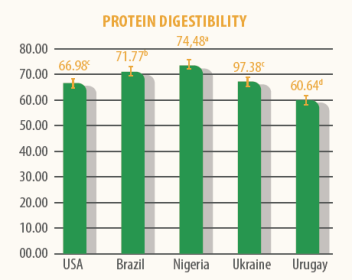

The average protein digestibility values for soybean meals sourced from different countries are presented in Figure 4. Based on this parameter, it was determined that the meal from Nigeria had the highest digestibility (74.48%) and the meal from Uruguay had the lowest (60.64%) (P < 0.001).
Table 2. Amino acid profile of soybean meal from different sources

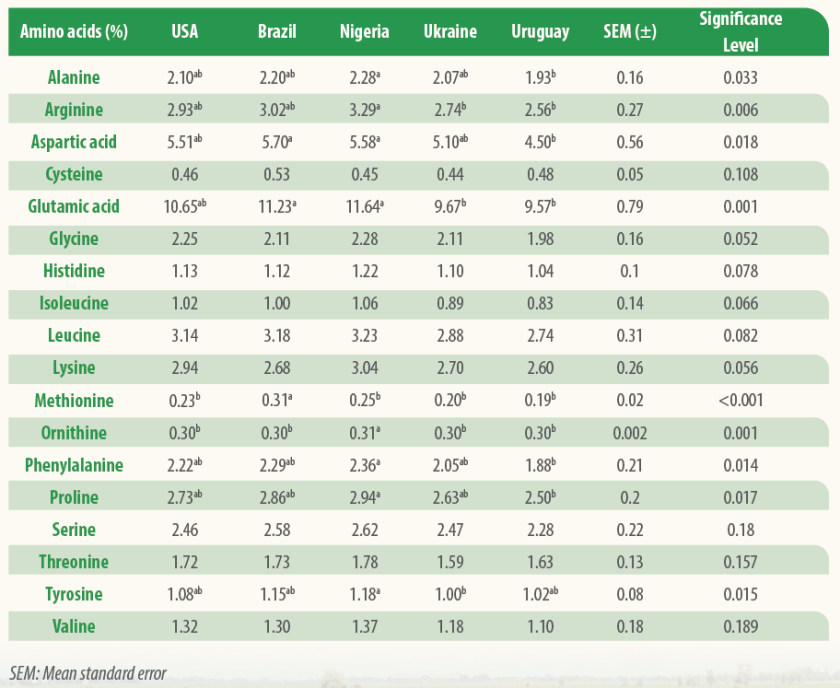
Data on the amino acid profiles of soybean meal are presented in Table 2.
It was found that the alanine and arginine content in the Nigerian soybean meal was higher than in the other meals, at 2.28% and 3.29%, respectively (P<0.05).
- It was also determined that the Brazilian and Nigerian meal samples contained higher amounts of aspartic acid and glutamic acid compared to the other meal samples (P<0.05).
- In the analysis of methionine content, it was found that the Brazilian meal had a higher content (0.31%) while the Uruguayan meal had a lower value (0.19%) (P<0.001).
- It was found that the Nigerian meal had a richer content of ornithine, phenylalanine, proline, and tyrosine (P<0.05).
The amino acid profile of soybean meal observed in this study is similar to the results reported by Goldflus et al. (2006), Thakur and Hurburgh (2007), Medic et al. (2014), and Lagos and Stein (2017), and the geographical characteristics of the growing region and cultivation conditions are among the factors determining the amino acid content of the meal. In addition, there are research findings suggesting that the protein level of the meal also affects the amino acid profile (Medic et al., 2014; Mourtzinis et al., 2017; Pfarr et al., 2018).
Conclusion
In conclusion, it has been demonstrated that the country of origin of soybean meal affects its protein quality through its nutrient content and amino acid profile.
- Among the soybean meals examined, the Brazilian meal was found to have the highest crude protein, metabolizable energy, and methionine content.
- In terms of methionine, the soybean meal from Brazil was found to have a higher content.
- The soybean meal from Nigeria was observed to have the highest digestibility, while urease activity was found to be at the lowest level in the soybean meals from the United States and Ukraine.
- In light of all these findings, it was determined that the soybean meal of Brazilian origin is more advantageous in terms of protein and methionine content, while the soybean meal of Ukrainian origin is more advantageous in terms of protein quality (urease activity, protein distribution index, protein solubility in potassium hydroxide, and trypsin inhibitor activity).
- Therefore, it was concluded that when using soybean meal of different origins in commercial feed production, different nutrient matrices should be employed based on these criteria.