


Artificial Intelligence (AI) in Poultry: Building the Nervous System of the Modern Broiler, Breeder & Layer Industries
The Bullet Train Moment for Poultry
Artificial Intelligence (AI) has been described as agriculture’s “bullet train moment”—a rapid acceleration that changes not just tools but entire systems. In poultry, an industry producing over 145 million tons of broiler meat and 1.6 trillion eggs annually worldwide, this acceleration is no longer theoretical. AI is reshaping decisions from hatchery to processing plant, creating both profound opportunities and daunting risks.


The poultry sector, with its short production cycles, vast datasets, and vertically integrated value chains, is uniquely suited to AI adoption. Yet adoption is uneven, and leaders face hard choices: move early and shape the industry’s trajectory, or lag behind and cede advantage to competitors.
- From Instinct to Prediction

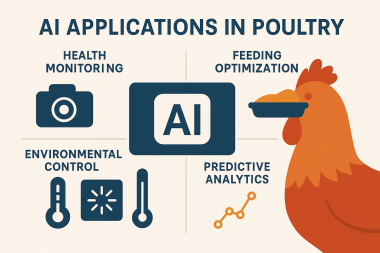
For generations, poultry production relied on intuition and experience. Today, AI turns instinct into prediction.
- Hatchery Management: Machine vision now assesses egg fertility, embryo development, and chick quality with precision that rivals human graders. Algorithms predict hatchability, reducing waste and improving flock uniformity.
- Health Monitoring: AI-powered cameras and microphones detect coughing, footpad lameness, or abnormal feeding patterns long before farmers notice. Early alerts mean faster interventions and healthier flocks.
- Feed Optimization: Machine learning models balance diets in real time, factoring in ingredient availability, prices, and nutrient profiles. This reduces costs while meeting performance targets.
AI transforms poultry from reactive management to proactive control, improving profitability and animal welfare simultaneously.

- Integrating the Poultry Value Chain
Poultry is the most vertically integrated animal protein industry. This integration creates fertile ground for AI.
- Genetics: Breeding companies already use predictive analytics to select traits such as feed efficiency, disease resistance, and carcass yield. AI accelerates these models, reducing trial times.
- Farming Operations: Integrators combine feed mills, hatcheries, farms, and processing plants. AI unites data streams—temperature, mortality, feed intake—into a central nervous system.
- Processing Plants: Machine vision grades carcasses at speeds beyond human capacity, ensuring compliance with welfare and food safety standards.
- Retail Feedback: Consumer demand data feeds upstream, adjusting supply and product mix. Retailers calling for more antibiotic-free or smaller birds can trigger adjustments in breeding and nutrition programs.
As Shail Khiyara noted: “This isn’t about incremental gains—it’s about reimagining how food is grown, moved, and consumed.”
- Winners and Laggards
Not all poultry companies will benefit equally. Large integrators with rich datasets and digital infrastructure are building “data moats.” Smaller operators risk being excluded.
- Early adopters: Companies in North America, Brazil, and Asia investing in AI-enabled hatcheries, barns, and processing.
- Laggards: Contract growers without data access may become dependent on integrators’ systems, raising questions of data equity and ownership.
Damien McLoughlin’s warning applies directly here: “Benefits will accrue first to those with data-rich operations, leaving others behind.”
- Jobs in Transition
Automation reshapes poultry employment:
- At Risk: Manual grading of eggs and carcasses, routine data entry, basic logistics coordination.
- In Demand: “Digital poultry managers” who oversee AI dashboards, data-savvy veterinarians, and AI-enhanced nutritionists.
- Enhanced Roles: Trusted advisors such as veterinarians and consultants can use AI as a co-pilot, expanding their reach and precision.
As Charlebois observed: Agriculture people “who can code” will be the new generation of producers in the poultry industry.
- Leadership Imperatives for Poultry Executives
AI is not an IT project—it’s a leadership challenge. CEOs in poultry companies must:
- Own the strategy: Align AI with core goals such as reducing feed conversion ratios (FCR) or improving welfare.
- Pilot, then scale: Start with use cases like predicting coccidiosis outbreaks or optimizing breast meat yield.
- Build AI literacy: Ensure leadership and middle managers understand AI’s potential and limitations.
- Embed ethics: Protect data privacy, especially for contract growers, and ensure transparency in algorithmic decisions.
- Risks and Concerns
The opportunities are vast, but poultry must confront risks head-on:
- Hype vs. reality: Some “AI” tools are glorified statistics. Misaligned expectations erode trust.
- Data inequality: Integrators may monopolize value, widening the gap with smallholders.
- Ethical risks: AI could prioritize efficiency over welfare unless checked.
- Overdependence: A hacked hatchery or malfunctioning algorithm could cripple production.
- Cybersecurity: Processing plants and feed mills connected online become targets.

As Shelman cautioned: “Responsible adoption is essential—build trust and protect equity.”
- Immediate Actions (Next 6–12 Months)
The consensus: speed matters. Poultry leaders should follow the acronym DRIVE

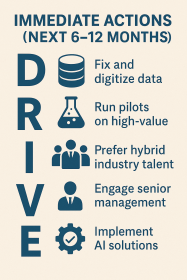
D = Get your data fixed and audit it. Digitize flock records, feed intakes, and processing yields.
R = Run purposeful pilots. Focus on high-value problems like salmonella risk prediction.
I = Insiders are preferred rather than a reliance on external consultants. Hire hybrid talent. Recruit data scientists who understand poultry and cross-train veterinarians/nutritionists with AI basics.
V = VIPs, especially senior management, need to be part of the program rather than oservers. They also need to set rules for ethics and data sharing.
E = Execute now. Test image classifiers in farms or ChatGPT-style tools in reporting.
- Humans and Machines: Co-Creation, Not Replacement


A major lesson from both human experts and “Agentic AI” panels is clear: AI multiplies human expertise—it doesn’t replace it.
- Amplification: AI scales farmers’ judgment across millions of birds.
- Feedback loops: Monthly farmer feedback retrains models, boosting accuracy.
- Trust through governance: Clear explainability dashboards (“Why Meters”) increase adoption.
As one virtual panelist put it: “If it doesn’t work on the farm, it doesn’t matter.”
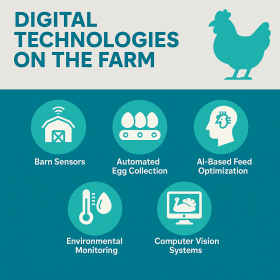
- Examples of digital technologies on the farm
The poultry industry—spanning broilers, egg layers, breeders, and turkeys—is rapidly adopting digital tools. With short production cycles, high biological complexity, and tight margins, poultry producers stand to benefit enormously from real-time data and automation. From sensors in barns to AI-driven feed optimization, digital technologies are creating a new era of predictive, efficient, and welfare-friendly poultry production. Here’s a look at the tools being used across different poultry systems and the startups driving innovation.

9.1 Broilers: Smart Barns and Precision Growth
Broiler production thrives on efficiency—feed conversion, growth rates, and uniformity are everything. Digital tools now allow producers to monitor and optimize every parameter.
- Precision Monitoring:
- Birdoo from Knex, an MIT spinout, uses real-time camera imaging to digitize and extract insights on broiler weights, health, and disease—even in barns housing tens of thousands of birds.
- SenseHub Poultry (UK, acquired by Merck Animal Health) provides wireless sensors to monitor barn temperature, humidity, CO₂, and bird weight. These feed into dashboards that flag welfare issues and improve growth predictability.
- BinSentry (Canada) uses IoT sensors to monitor on-farm feed bins, reducing waste and ensuring timely deliveries. Another company active in this area, albeit at a lower price point, is Dystnct, a provider of farmer connectivity and water monitoring.
- AI Health Monitoring:
- Verax measures changes in blood metabolites. Backed by the leader in animal nutrition, DSM Animal Nutrition, it uses AI to precisely predict changes in health and nutrition, analyzing biological metrics (saliva, digesta and excreta contents, feed and water consumption, and genetics) as part of the reports generated.
- SoundTalks (Belgium, also acquired by Merck Animal Health) deploys microphones that “listen” for changes in flock respiratory health, providing early warnings for diseases such as bronchitis.
- OpticFlock (US startup) uses computer vision to monitor bird movement, detecting lameness or abnormal behavior before it escalates.
- GAI Ventures, based in North Carolina, is a futuristic AI company that is perfecting a system to predict intestinal health in real time using camera and video images combined with artificial intelligence. GAI automates bird health and nutritional imbalance evaluations in real time, more accurately than traditional posting sessions.
- Feed & Nutrition:
- Flockman was one of the first platforms (1988) to offer precision nutrition systems that adjust feed delivery in real time based on growth and flock performance.
- Management Systems
- M-Tech provides intelligent, AI informed systems to record poultry performance from the broiler barn to the processing plant, allowing producers to make better real time management decisions. M-Tech systems dominate global poultry data, used by 90% of the worlds largest integrated broiler companies.
- Intelia designs and manufactures smart controls, farm data collection devices and software that enable the real-time data flow between the farm and every other function of the chicken value chain.
- Robotics
- Apelie Avisense, an Atlanta-based robotics company, designs cost-effective robots that roam chicken houses, moving birds to improve feed and water intake, leg health, and overall welfare.
- Birdseye Robotics (Nebraska) automates tasks in commercial poultry barns, notably removing dead birds and improving bedding conditions.
These tools mean broiler farms can move from reactive management to predictive control—reducing mortality, improving welfare, and tightening margins.
9.2 Egg Layers: Digital Layers of Efficiency
Laying hen systems face unique challenges: monitoring thousands of birds, ensuring shell quality, and tracking productivity per hen. Digital solutions are enabling greater transparency.
- Automated Egg Counting & Grading:
- Ovotrack (Netherlands) uses barcoding and tracking software to follow eggs from collection to grading, ensuring traceability and compliance.
- Moba Group (Netherlands) integrates AI into egg grading machines to detect shell cracks and internal defects.
- Orbem uses AI powered MRI to scan and classify eggs in a non-invasive way, for any poultry breeds.
- Flock Monitoring:
- Big Dutchman (Germany) offers “BIRD Control,” a camera-based system that monitors flock movement, identifying welfare issues such as piling or feather pecking.
- iChase uses cameras and AI to recognize threats from wild birds—potential disease carriers onto the farm or feedmill—and frightens them away using lasers.
- Digital Traceability:
- Noble Foods (UK) has piloted blockchain traceability for eggs, giving consumers confidence in sourcing and production standards.
- Unitas Poultry Manager software, with a focus on layers and broiler breeders, uses simple online forms to improve feeding, forecasting, planning, and performance monitoring.
For egg layers, the promise of digital tools is twofold: improved welfare through early detection of issues, and stronger consumer trust through digital traceability.
9.3 Broiler-Breeders: Genetics Meets Data
Breeder flocks are the foundation of the poultry sector, and genetic companies are rapidly digitizing to improve selection and management.
- Precision Breeding Data:
- Aviagen (Global) and Cobb-Vantress (US) now use genomic data combined with machine learning to select birds with optimal traits for feed conversion, health, and welfare.
- Hendrix Genetics (Netherlands) is investing in digital platforms that integrate on-farm performance data with genetic predictions.
- Hypereye uses hyperspectral imaging and artificial intelligence to sex layer chicks before they hatch, allowing for non-invasive identification of males and females from the fourth day of incubation. This “in-ovo” sexing technology addresses animal welfare concerns by eliminating the need to cull male chicks.
- Reproductive Monitoring:
- Ceva Santé Animale (France) is piloting digital vaccination monitoring systems that track flock coverage and effectiveness.
- Sensor-equipped nest boxes and AI-powered image recognition track egg production per breeder hen, reducing variability and can improve fertility outcomes.
For breeder operations, data integration is key. Digital tools allow managers to link genetic potential with real-world performance—shortening feedback loops and accelerating genetic progress.


9.4 Turkeys: Catching Up in Digitization
The turkey sector has traditionally lagged behind broilers in technology adoption due to smaller scale and complexity. That’s changing fast.
- Barn Sensors & IoT:
- AgriNerds (US) provides custom dashboards for turkey barns, integrating temperature, feed, and water flow data into decision platforms
- Faromatics (Spain) developed “ChickenBoy,” a robot originally designed for broilers that monitors CO₂, temperature, and welfare—now being trialed in turkey houses.
- Processing Plant Tech:
- Meyn (Netherlands) and Baader (Germany) have developed AI-driven turkey processing lines that optimize cutting and portioning based on carcass size and demand signals.
- Health Monitoring:
- Turkeys are prone to leg health issues. Computer vision startups like OpticFlock are expanding trials into turkey houses to spot locomotion problems earlier.
Though still early days, digital adoption in turkey farming is expected to accelerate as integrators seek cost savings and welfare improvements.

9.5 Cross-Species Trends: The Digital Poultry Future
Across broilers, layers, breeders, and turkeys, several trends are shaping the digital future:
- Integration of Data: Platforms that combine genetics, feed, farm, and processing data are creating “digital twins” of poultry systems.
- AI & Machine Learning: Predictive analytics is reducing disease risk, improving feed efficiency, and smoothing supply chain volatility.
- Robotics: From robotic litter management to egg collection, automation is reducing labor challenges.
- Blockchain & Traceability: Transparency is moving from niche to mainstream, particularly in premium markets.
- Alveo Sense Poultry Avian Influenza test is powered by AI to detect avian influenza in real time.
- Hygiena Solutions monitors process control and pathogen contamination at every stage of processing poultry meat in the plant to ensure final product quality and safety.
Digital technologies are no longer optional in poultry—they are becoming foundational. Whether it’s broiler barns using AI microphones, layer systems with automated grading, breeder genetics powered by machine learning, or turkey barns catching up with sensors, the poultry industry is embracing data as its new currency.
As one industry leader put it: “AI will not replace farmers. But farmers using AI will replace those who don’t.”
The challenge now is scaling these tools responsibly—ensuring data is shared fairly with growers, that animal welfare is prioritized, and that technology serves the entire poultry ecosystem.
- Looking Ahead: Toward a Smarter, Fairer Poultry System
The future of poultry won’t be determined by who has the largest barns, but by who adapts fastest. AI offers a generational opportunity to make the sector:
- Smarter: Optimizing feed, health, and processing with data-driven precision.
- More Resilient: Predicting disease, managing volatility, and responding to shocks faster.
- Fairer: Empowering growers with tools—if governance ensures inclusivity.
Conclusion
Poultry leaders should recognize that this is the bullet-train moment. The industry can either jump aboard—using AI to improve efficiency, welfare, and resilience—or risk being left on the platform. For AI to be effective it must have clean and accurate data. This will be key to using technology and connecting it all up for holistic insights and accurate decision making. Success depends not on technology alone, but on leadership, ethics, and a willingness to integrate human insight with machine intelligence.