


OBJETIVE
High doses of copper (Cu) are extensively used as a growth promoter in poultry production, with Cu sulfate as the traditional source.
However, Cu Methionine-Hydroxy-Analogue Chelate is an alternative due to its higher bioavailability.
- The objective of this study was to evaluate sources of Cu (Cu Methionine-Hydroxy-Analogue Chelate and Cu Sulfate) on performance and incidence on footpad lesions (FPL) in broilers.
MATERIALS & METHODS
Animals:
- A total of 570 Cobb day-old male chicks were used in this study and randomly distributed into 3 treatments with 10 replicates per treatment of 19 birds per pen.
Diets:
- The diets were formulated to meet nutritional requirements, with Cu sources added to the diet to replace inert substances.
Treatment:
- The treatment groups were as follows: T1. 10 ppm Cu sulfate (Cu-Sulf10); T2. 125 ppm Cu sulfate (Cu-Sulf125) and T3. 30 ppm Cu Methionine-Hydroxy-Analogue Chelate (Cu-HMTBa30).
- New litter was used to avoid interference in previous trials and a water spray program was adopted to increase litter moisture and promote footpad lesions.
- At 35 days, feed intake, body weight (BW) and feed conversion ratio (FCR) were evaluated.
- Feet from 3 birds/pen were frozen on the slaughter day and evaluated by the same person for the incidence of FPL according to 1 to 5 score scale.
- Data were subjected to analysis of variance (ANOVA-GLM) and means were compared by the Tukey test at 5%.
RESULTS
The results showed that from 1 to 35 days, there were no statistical differences (P>0.05) in feed intake and feed conversation across treatments.
There was trend to increase Body Weight (p=0.0709) in a group supplemented with Cu-HMTBa30 (2.462kg) and Cu-Sulf125 (2.449kg) compared with Cu-Sulf10 (2.363kg).
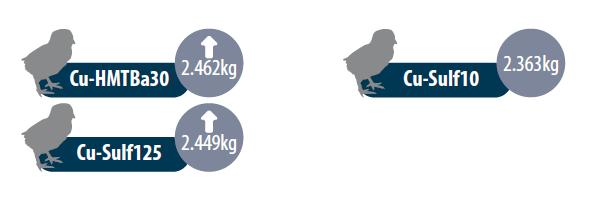
Weight gain from 21 to 35 days was significantly (P<0.05) higher in the Cu-HMTBa30 (1.524kg) and Cu-Sulf125 (1.427kg) in comparison to the Cu-Sulf10 (1.431kg).
Results of FPL were significantly (p<0.05) lower in the Cu-Sulf125 and Cu- HMTBa30 in comparison to the Cu-Sulf10.
CONCLUSION
The results indicate that a lower dosage of Cu in the form of Methionine-Hydroxy- Analogue Chelate (30ppm) can replace high dosages of Cu sulfate (125ppm) with no harm on performance or feet pad health.
PDF