At H&N International, we continuously evaluate how nutrition strategies impact laying performance, egg size, and overall flock efficiency.
A recent trial with Nick Chick layers explored the effect of four dietary protein and amino acid levels while maintaining constant energy.
MATERIAL AND METHODS
Nick Chick hens were housed (368 birds, 72 cages) at 16 weeks of age and light stimulated at a body weight of 1,250 grams. All hens were offered the same feed the same feed until the trial started at 26 weeks of age.
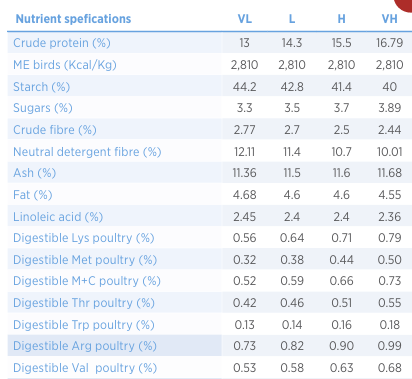
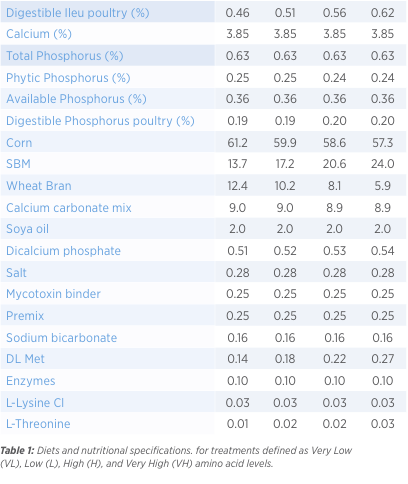
Trial diets were formulated by the H&N nutrition team and produced in a local facility. Raw material analysis was conducted with the support of EVONIK and the diets were a combination of corn, soya bean meal, wheat bran, and soya oil (Table 1).
- Diets were formulated to achieve a feed intake of 110g.
- The treatment diets consisted of different amino acids levels and were defined as: Very Low (VL), Low (L), High (H), and Very High (VH).
- The ideal protein ratio remained constant for all diets, as did energy (2,810 kcal).
RESULTS
LAYING RATE
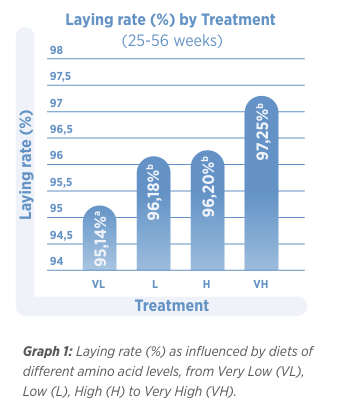
Hens fed the Very Low amino acid diet showed a significant decrease in rate of lay when compared to the other three treatments.
Rate of lay was numerically increased for hens fed the Very High diet, but their performance remained statistically similar to the Low and High groups.
EGG WEIGHT
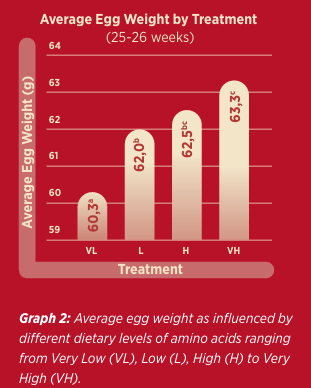
There was a clear progression of egg size based on the levels of amino acid intake.
Significant differences were noted between the VL, L, and VH diets, confirming that higher amino acid intakes are associated with increases in egg size.
Interestingly, the Low treatment produced an egg size similar to the Nick Chick standard.
TOTAL EGGS PER HEN HOUSED (EHH)
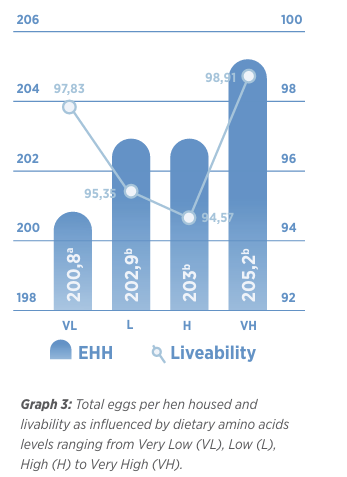
There was a clear and significant effect on the number of EHH depending of the diet. This parameter was defined by the significant effect of the % of lay shown in graph 1 and the non significant effect of the mortality.
FEED INTAKE AND BODY WEIGHT
- Feed intake remained similar between the treatments 111–112 g due to the diets being formulated to the same energy.
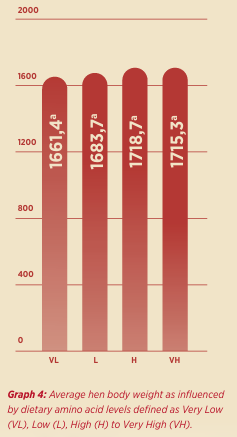
Body weight was also not significantly different between treatments, however a numerically higher body weight was noted for the treatments which produced the highest egg weights (H and VH). (Graph 4).
COST ANALYSIS OF EGG PRODUCTION
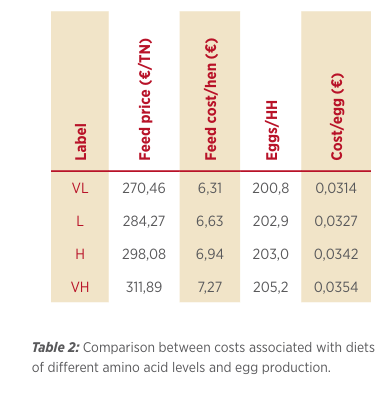
It is important to understand the cost implications of using all these diets in different scenarios. Based on the cost of feed at the time of the trial and applying the same feed intake, the cost per egg was not significant different (Table 2).
- However there was a numerically higher cost associated with the increase egg production.
This analysis does not include the price producers can receive for the different egg sizes produced by each treatment, which could help offset production costs.
- Feed consumption for the period 30 week x 7 days x 111 grams = 23,31 kilo grams
- Cost / egg = Feed cost × Feed consumption Eggs / Hen housed
PRACTICAL TAKEAWAYS
- AMINO ACIDS DRIVE EGG SIZE: Increasing digestible Lys from 0,56% to 0,79% raised average egg weight by 3 g.
- EFFICIENCY MATTERS: While differences in laying rate were modest for the 26 – 56 week trial period, in a longer production cycle higher level of amino acids can further influence the number of eggs produced.
- ECONOMIC BALANCE: The Very High diet had the highest feed cost and best production compared to the lower amino acid treatments.
However producers must weigh feed cost against production costs and their market’s preference for larger eggs to decide which diet is best for them.
Producers must weigh the added feed cost against gains and market preference for larger eggs.
NUTRITIONAL DISCUSSION
AMINO ACIDS DRIVE EGG SIZE
The sensitivity of egg size to amino acid intake in Nick Chick hens is very clear from these results.
- Therefore, when challenges with achieving egg size arise, one of the first points to examine should be if the birds have a sufficient level of amino acid intake and if this intake is being used for egg production.
CRUDE PROTEIN VS % LAY
There is a lost of % lay when using diets of 13% Crude protein at an intake of 111 grams.
- As per the literature, we can assume that the nonessential amino acids play a role in egg production that is only influential when diets are too low in crude protein.
CONCLUSION FOR NICK CHICK SUPPORTERS
Nick Chick hens respond positively to different levels of amino acids.
The versatility of Nick Chick allows egg producers to aim for different egg markets with the same bird.