


INTRODUCTION
The first seven days of a broiler’s life represent the most sensitive and impactful phase of the entire production cycle. During this short period, the basis is laid for growth rate, nutrient conversion efficiency, immune system efficiency, and flock homogenization. Any deviation from optimal environmental conditions during this phase may result in negative impacts that are difficult to compensate for later.
- The newly hatched chick does not have an integrated device to regulate its body temperature, which makes it highly dependent on the surrounding environment.
- This physiological limitation makes careful control of environmental factors a vital necessity, not just an administrative measure.
- Effective environmental management during the first week relies on the integration of elements of heat, relative humidity, ventilation, lighting, and air quality, with the aim of creating a stable environment that reduces stress and supports early physiological development.
Heat management: the primary driver of early performance
Temperature is the most influential factor during the incubation period, as chicks rely almost entirely on external heat to maintain their thermal equilibrium.
Global guidelines recommend maintaining a temperature of 32-33°C during the first days, with a regular step-down thereafter. This gradient is necessary to:
- Incentivize early feed consumption
- Support the uptake of the yolk sac
- Enhance digestive health
- Enhance the efficiency of the immune system
Both heat stress and cold stress negatively affect performance, but temperature fluctuations are more serious, hindering the bird’s physiological adaptability and increasing stress levels.
Relative humidity: an equally important complement
Relative humidity plays an important role in supporting respiratory efficiency and achieving environmental comfort.
- The ideal level of relative humidity during the first week of a chick’s life should be between 60 and 70%.
- Any deviation from the ideal level of relative humidity affects the health of the chicks and further contributes to the deterioration of the environmental conditions.
- For instance, a decrease in humidity to less than 50% causes the drying of the chicks’ respiratory membranes and increased dust in the house.
- As for an increase in humidity level to above 70%, we start seeing a deterioration of the litter and an increase in the concentration of ammonia.
The variation in humidity and its interaction with heat is what determines the actual sensation of the environment for the bird, not each factor separately. Accordingly, maintenance of proper environmental conditions should be orchestrated among all parameters to ensure optimal conditions for the broiler chicks.
Ventilation and air quality: invisible but critical factors
To ensure air regeneration without heat loss, minimum ventilation should be applied from day one, even in the presence of heating. Ultimately, ventilation remains one of the main parameters for managing ammonia and carbon dioxide levels in poultry houses. That is because ventilation directly regulates air exchange between the indoor environment and the outside air.
- Ventilation reduces the level of ammonia in the house, as fresh air dilutes the concentration of ammonia.
- The concentration of ammonia inside the house should be within optimal levels, i.e. less than 10-15 ppm preferably.
- The air circulation also helps to displace the ammonia-saturated air away from the bird’s presence level.
- Additionally, the litter tends to stay drier with proper ventilation, which leads to reduced microbial activity and thus reduced production of ammonia from the ground.
- Adequate ventilation also helps to get rid of carbon dioxide and replace it with fresh air.
- This maintains carbon dioxide concentration levels close to the base level of outdoor air (about 400–500 ppm, which is within the optimum level of less than 3000 ppm).
- By preventing the accumulation of stagnant air, ventilation indirectly increases oxygen availability.
- Conversely, poor air quality leads to respiratory damage in birds, as well as weakened immunity and increased susceptibility to disease.
- Therefore, ventilation should be thoughtfully applied from day one.
Lighting Programs: behavior regulation and vital functions
Lighting is not just a means of vision, it’s an essential tool for regulating behavior and physiological functions in birds. Therefore, modern programs recommend introducing early dark periods and then gradually increasing them in line with the needs of the flock. These practices have shown multiple benefits, including improved res, reduced stress levels, enhanced melatonin secretion, as well as stimulation of the immune system. Therefore, smart management of lighting programs is a crucial element for improving chicks’ health and raising their production efficiency.
Immunization and environmental stability
Environmental factors significantly affect the health of chicks. Thus, environmental conditions must be taken into account when adopting bird vaccination. The efficiency of immunization programs directly depends on the stability of the surrounding environment, as the implementation of immunizations in inappropriate conditions may lead to a weakened immune response, the emergence of unwanted vaccine reactions, in addition to increased stress levels in chicks. Therefore, it is necessary to work on stabilizing the environmental conditions before, during and after the vaccination process. That ensures the best immune response and reduces the potential negative effects, which positively reflects on the health of the flock and its productive performance.
Field evidence: environmental stability outweighs fluctuations
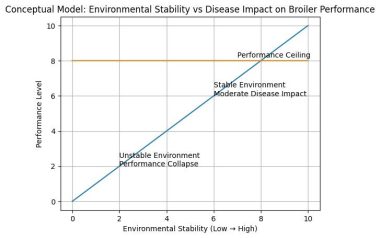
Based on field experiments and applied observations, flocks raised in a stable environment have been shown to achieve a significantly better performance than those exposed to environmental fluctuations, even in the presence of high pathological challenges.
- In stable environments, growth rate improves, nutrient conversion efficiency increases, the mortality rate decreases, and flock homogeneity improves significantly.
- In contrast, unstable environments lead to increased physiological stress, impaired immune response, and higher rates of respiratory problems, which negatively affect overall productive performance.
- This confirms that the stability of the environment is one of the strongest factors that reduce the impact of pathological challenges and enhance production efficiency.
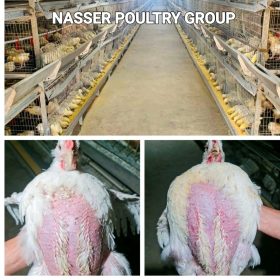
When raising broilers in battery systems under stable environmental conditions, we observe a clear flock homogeneity and an excellent development of the chest area (Picture 1). This reflects the efficiency of temperature control, ventilation, and environmental quality during the early stages of brooding. These conditions have been directly associated with achieving high production performance, even in the presence of epidemiological challenges (Figure 1).


Practical recommendations
To ensure the best performance during the first week of a broiler chick’s life, focus on creating the perfect environment from the start. This is done by preparing the broiler house and raising the temperature 24 hours before receiving the chicks, to ensure their comfort upon arrival.
- Continuous monitoring of chicks’ behavior is also a key indicator for assessing the suitability of environmental conditions, along with the use of accurate measuring devices to control temperature and humidity.
- It is also important to keep the litter dry to avoid health problems, and to avoid any sudden changes that may cause strain to the flock.
- It’s also extremely important to ensure a homogeneous distribution of heat and air within the house.
In the end, careful management of these factors in the early days forms the basis for the success of the entire production cycle. Environmental management is not just a routine procedure, it is the decisive factor in the success of the entire production cycle.
PDF