From Chat to Farm Insight: Bridging the Social Data Gap in Indonesian Broiler Farming
The Invisible Data Problem in Poultry Farming
Modern poultry production is increasingly data-driven. Metrics such as Feed Conversion Ratio (FCR), mortality rate, and average body weight are the lifeblood of operational decision-making. Integrators and farm managers rely on these indicators to monitor flock performance and respond quickly to production risks. However, in Indonesia—an archipelagic nation where broiler production is dominated by smallholder farms—collecting reliable operational data remains a significant challenge.
- Much of the industry operates under the kemitraan (partnership) model, where production responsibilities are distributed between companies and independent farmers.
- Integrators typically supply day-old chicks (DOC), feed, veterinary inputs, and technical guidance, while farmers provide housing, labor, and daily farm management.
- Field officers, known as Petugas Penyuluh Lapangan (PPL), supervise multiple farms and serve as the primary link between farmers and company management.
- This decentralized system allows poultry companies to scale production efficiently, but it also creates a complex data collection environment.
- While management teams in Jakarta or Surabaya rely on precise analytics, the raw operational data originates in rural poultry houses spread across provinces such as Central Java and West Java.
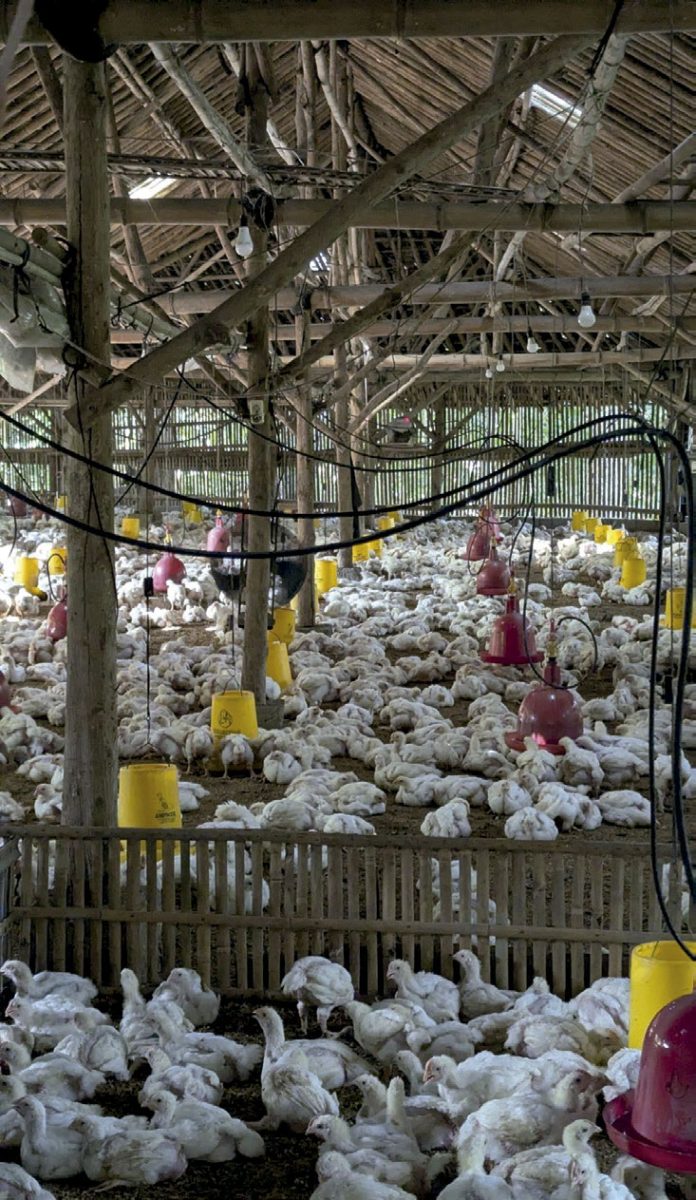
Under the kemitraan partnership model, many broiler farms operate as decentralized production units managed by independent farmers. Field officers supervise multiple farms, while daily operational data—such as feed consumption, mortality, and body weight—is typically recorded manually at the farm level before being reported to company management.
At the farm level, daily operational indicators are typically recorded manually during the production cycle. Farmers or farm helpers track information such as flock age, feed consumption, mortality (deplesi), body weight sampling, and remaining bird population using handwritten recording sheets. Figure 1 shows a typical example of this type of manual farm record.

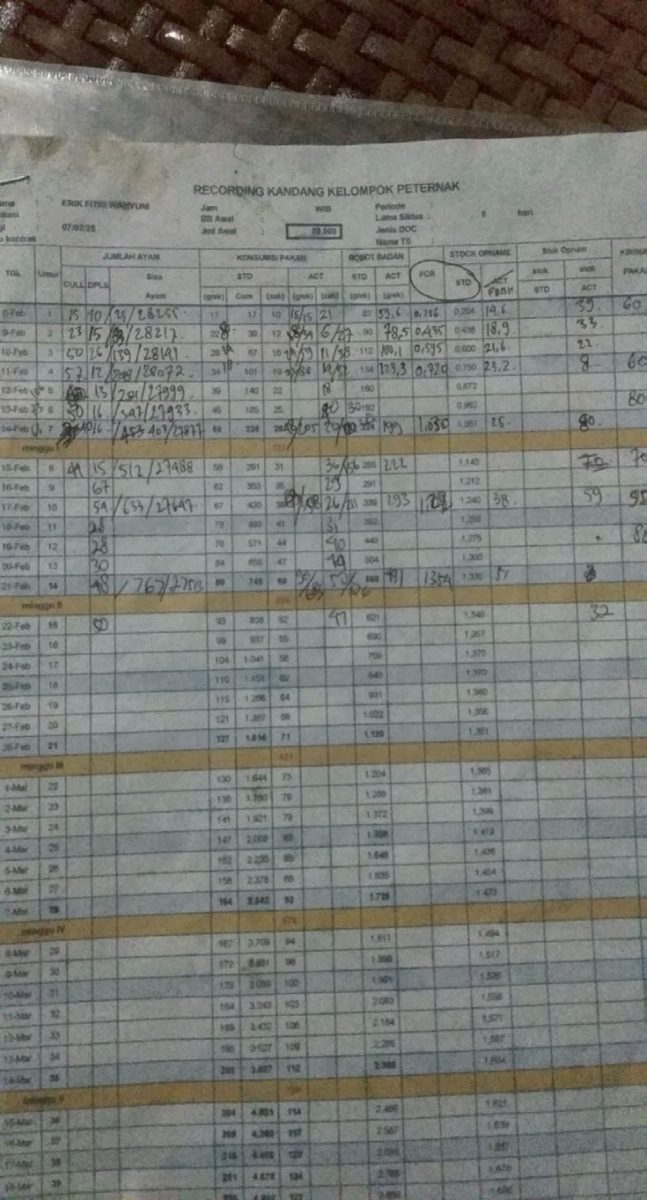

Although these records contain the core indicators required for production monitoring, they often remain disconnected from company-wide data systems. A field officer might receive a WhatsApp message such as: “Day 2, feed 6 bags, mortality 44.” This short message already contains three critical indicators for flock monitoring. Yet unless someone manually transfers that information into a spreadsheet or reporting system, the data remains trapped in chat histories.
- Over time, this creates a familiar operational pattern.
- Field officers collect updates from multiple farms through messaging applications, administrative teams later compile the information manually, and company management receives the data only after several layers of transcription.
- This manual relay introduces delays, inconsistencies, and transcription errors.
- The result is a paradox: the poultry industry generates enormous volumes of operational data every day, yet only a fraction of it becomes structured information that can support real-time decision-making.
The Reporting Bottleneck in Partnership Systems
The decentralized nature of Indonesian poultry farming creates a unique reporting bottleneck. Unlike vertically integrated facilities, partnership farming relies on a manual flow of information between farm helpers (ABK), farmers, field officers (PPL), and administrative teams. Several structural factors contribute to this:
- WhatsApp as the Default OS: In Indonesia, WhatsApp is not just an app; it is the primary infrastructure for coordination. However, unstructured chat is difficult to audit or aggregate.
- The “Manual Relay”: Data moves from a notebook in the pen to a PPL’s phone, then to an admin’s spreadsheet. Each step is a point of failure.
- Geographic Barriers: With farms spread across vast distances, physical data collection is slow. By the time a report reaches the office, the window for corrective action has often closed.
Rahayu: Using WhatsApp as Data Infrastructure
Recognizing that farm workers are unlikely to adopt complex, rigid management software, the Rahayu system was designed to meet them where they already are: on WhatsApp.
Instead of a rigid command structure, Rahayu utilizes Flexible Conversational Logic. It allows an ABK to report production updates using natural language. Behind the scenes, an AI-assisted parsing engine extracts key indicators—flock age, feed usage, and mortality—without requiring the user to navigate complex menus or forms.

Turning Conversations into Structured Records
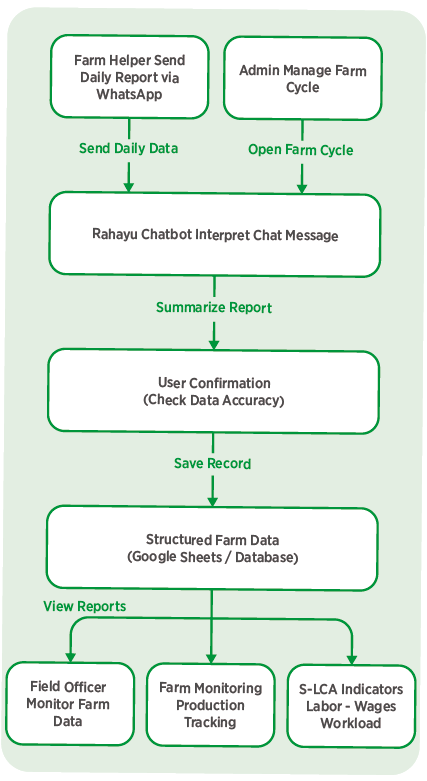
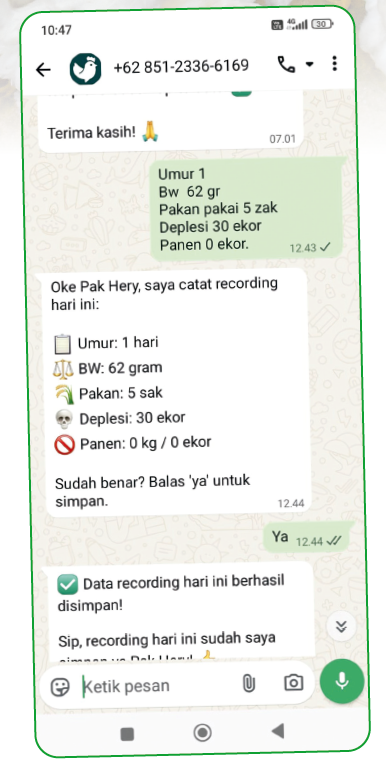
The core innovation is the ability to turn a natural Indonesian sentence into a machine-readable record. A typical interaction follows these steps:
- Reporting: An ABK sends a message: “Umur 2 hari, pakan 6 sak, mati 44.”
- AI Interpretation: The engine extracts the variables (Age: 2, Feed: 6, Mortality: 44).
- Confirmation: The system replies: “Confirming: Age 2, Feed 6 bags, Mortality 44. Correct?”
- Data Structuring: Upon confirmation, the data is automatically logged into a centralized dataset accessible via live dashboards.
This approach removes the “Software Barrier.” From the farm worker’s perspective, they are simply chatting. From the company’s perspective, they are receiving clean, structured, and real-time data. Much of this production takes place in open-house poultry farms managed by independent farmers across rural areas.

Field Evidence: The Pilot Implementation
A pilot implementation was conducted in partnership with an Indonesian broiler integrator across several units in Central Java and Yogyakarta. The goal was to demonstrate how digital workflows could replace manual reporting in a high-pressure partnership farming environment, feeding real-time data directly into sustainability metrics.
Case Study: Unit Jogja & Magelang
In these units, field officers (PPL) and farm helpers (ABK) used the system to record daily production data. The results highlighted several operational breakthroughs:
- Real-Time Visibility: Administrative teams in the Head Office could monitor mortality and feed usage daily through a live spreadsheet, without waiting for weekly recaps.
- Data Consistency: By using role-based templates, the reporting became standardized across different farms, regardless of the individual worker’s technical literacy.
- Verification: By tracking daily inputs, the system could flag anomalies—such as mortality counts that exceeded population limits—providing an immediate layer of quality control.
The operational impact of conversational reporting becomes clearer when compared with traditional reporting workflows commonly used in smallholder poultry systems.
Table 1. Traditional reporting vs conversational reporting workflow

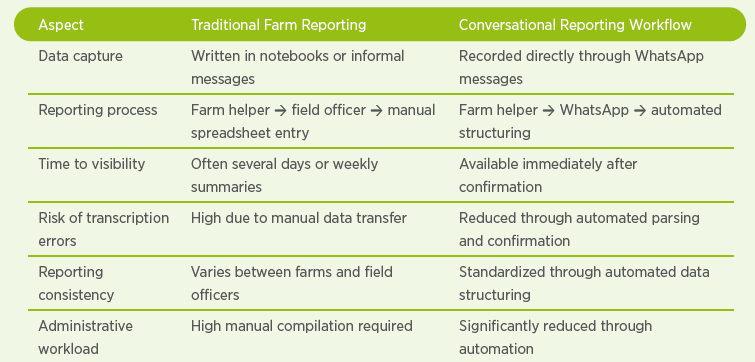
By shortening the data relay process, conversational reporting allows operational information to move directly from the poultry house to management dashboards with minimal manual intervention.
Operational Insights and Sustainability Implications
The availability of continuous operational data creates new opportunities for poultry management. When production indicators such as mortality, feed usage, and flock age are captured daily, managers can detect patterns that would otherwise remain hidden in weekly summaries.
- For example, sudden mortality increases can be investigated earlier, allowing field officers to identify potential environmental stress, disease pressure, or management issues before they escalate.
- Similarly, continuous reporting improves visibility across multiple farms, enabling integrators to compare performance and respond more quickly to operational anomalies.
Beyond operational monitoring, structured farm data also supports broader sustainability assessments. Frameworks such as Social Life Cycle Assessment (S-LCA) aim to evaluate the social impacts of agricultural production systems, including labor conditions, workload intensity, and the economic resilience of smallholder farmers.
- Traditionally, these assessments rely on periodic surveys or interviews.
- However, conversational reporting systems generate continuous operational records that can complement such studies.
- By linking daily production data with social indicators, poultry companies gain a more realistic picture of how operational events affect farm workers and smallholder livelihoods.
- In this way, improved farm data infrastructure can support both better operational management and more transparent sustainability monitoring.
Key Takeaways for the Industry
- Adapt to Behavior: Technology is most successful when it fits into existing habits. WhatsApp is where the work happens; that is where the data should be captured.
- Simplicity is Scalable: Conversational AI lowers the barrier to entry for digital transformation in smallholder systems.
- Continuous Data is Better Data: Real-time, daily recording provides far more insight into social and operational risks than periodic audits ever could.
Conclusion
- The path to a more sustainable poultry industry is paved with better data.
- By bridging the gap between grassroots communication and global sustainability frameworks, we can create a more transparent, fair, and efficient value chain.
- Conversational workflows prove that sometimes, the most sophisticated solution is a simple conversation.