


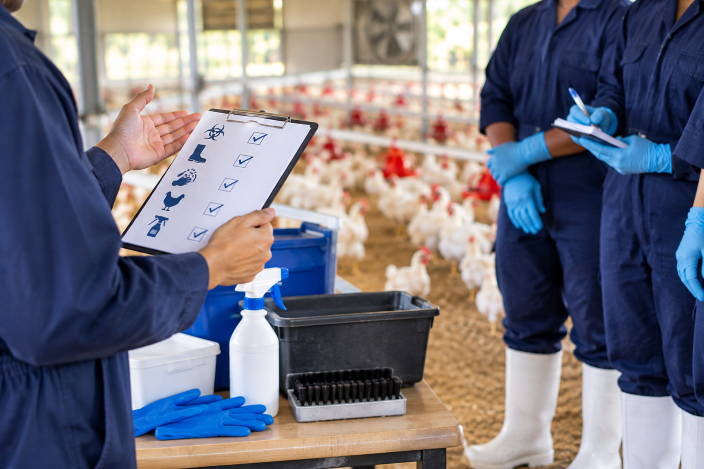
Practical, competency-based training is emerging as a powerful tool for strengthening poultry biosecurity, responsible antimicrobial use, and day-to-day farm performance.
Poultry production is becoming increasingly dependent on workers who can translate technical recommendations into correct actions on the farm. As disease prevention, antimicrobial stewardship, welfare, and food safety receive greater attention, training is shifting from simply delivering information toward demonstrating practical competence.
One emerging model is the Farmer Field School approach, in which poultry producers learn through demonstrations, observation, experimentation, and direct application of improved practices. In Zambia, FAO’s Broiler Farmer Field Schools have recently focused on husbandry, biosecurity, vaccination, disease prevention, and responsible antimicrobial use. The program places farmers at the center of the learning process rather than treating them as passive recipients of information (1).
Training that mirrors real farm decisions
The value of practical training is particularly evident in biosecurity. A worker may understand the importance of sanitation theoretically but still require practice to correctly identify contamination routes, manage entry procedures, disinfect equipment, or separate clean and dirty areas.
Competency-based training addresses this gap by asking workers to demonstrate what they can do, not only what they know. Training can therefore include farm inspections, disease-recognition exercises, vaccination simulations, water-quality checks, litter assessments, and case-based problem solving.
This approach is also relevant to antimicrobial stewardship. FAO’s poultry training programs increasingly connect production management with antimicrobial resistance, emphasizing hygiene, sanitation, disease prevention, and measures that reduce the need for antimicrobial treatments (2).
Short training cycles could strengthen retention
Another development is the move toward continuous learning. Instead of relying on an annual training session, farms can use short practical sessions throughout the production cycle. A five- or ten-minute demonstration during a routine farm meeting can reinforce a specific procedure without significantly disrupting daily operations.
For example, one session could focus on correct boot-changing procedures, followed later by a practical exercise on equipment sanitation. Supervisors can then observe whether the procedure is consistently followed.
The objective is not simply to complete training, but to convert knowledge into repeatable behaviour.
Building a more resilient poultry workforce
As poultry systems become more technically demanding, workforce development is becoming an operational issue rather than only a human-resources responsibility. Training that combines technical knowledge, practical demonstrations, observation, feedback, and follow-up can help farms respond more consistently to disease risks and changing production requirements.
The growing use of participatory training models suggests that the future of poultry education may be less about the classroom alone and more about learning where production decisions actually happen: inside the poultry house, hatchery, processing facility, and farm workplace.