


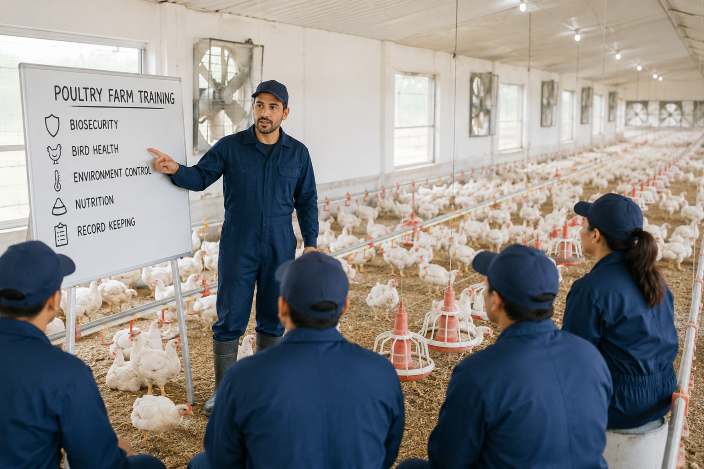
Why Poultry Training Needs a New Approach
Poultry production is becoming increasingly technical. Modern farms depend on precise environmental control, vaccination programs, data interpretation, biosecurity procedures, responsible antimicrobial use, and increasingly automated equipment. In this environment, training should not be measured only by how much information workers remember, but by how effectively they apply it on the farm.
The International Labour Organization (ILO) has emphasized competency-based and practical on-the-job training as a way to address skill gaps across the poultry value chain, particularly by combining technical knowledge with hands-on learning and competency assessment (1). This approach can help transform training from a periodic activity into a measurable component of farm management.
From Knowledge to Competence
Traditional poultry training often focuses on classroom presentations, manuals, and standard operating procedures. These remain useful, but they do not necessarily demonstrate that a worker can perform a task correctly.
A stronger model is competency-based training, where employees must demonstrate specific abilities. A poultry house worker, for example, should not only know the recommended brooding temperature but also be able to identify temperature-related chick behaviour, adjust the environment, and recognize when corrective action is required.
The same principle applies to vaccination, water management, litter assessment, mortality recording, equipment sanitation, and bird handling. FAO training resources cover these areas across poultry production, health, welfare, management, and processing, reflecting the multidisciplinary knowledge required by today’s poultry workforce (2).
Training Should Reflect Real Farm Problems
One of the most effective ways to improve learning is to connect training with situations workers actually encounter. Instead of teaching biosecurity exclusively through presentations, trainees can be asked to inspect a farm entry point and identify possible contamination routes. Similarly, disease-recognition training can use photographs, flock observations, production records, and realistic case scenarios.
A 2026 study involving 183 poultry farmers in Bangladesh found that structured training improved knowledge in areas including day-old chick selection, vaccine failure, antibiotic functions, and antimicrobial resistance. However, the researchers also concluded that one training intervention was insufficient to produce sustained behavioural change, highlighting the importance of continued communication and follow-up (3).
This finding has an important practical implication: training should continue after the classroom session ends.
Measure What Happens After Training
A modern poultry training program should include three stages: assessment before training, evaluation immediately afterward, and follow-up during routine farm operations.
The first assessment identifies knowledge gaps. The second determines whether learning objectives were achieved. The third asks the most important question: Did behaviour change?
For example, if employees receive biosecurity training, managers can subsequently monitor compliance with boot changes, hand hygiene, visitor procedures, equipment sanitation, and movement controls. If handling training is provided, indicators such as bird injuries, mortality during catching, and handling-related stress can be monitored.
WOAH recommends that personnel responsible for broilers receive appropriate training or demonstrate competence in areas including bird behaviour, handling, emergency procedures, biosecurity, disease recognition, and animal-welfare indicators (4).
Building Continuous Learning Into Farm Culture
Training should also become part of everyday management rather than an occasional event. Short refresher sessions, toolbox meetings, mentoring, practical demonstrations, and digital learning modules can reinforce important procedures without removing workers from production for long periods.
Micro-training can be particularly valuable for rapidly changing topics, such as disease alerts, vaccination updates, antimicrobial stewardship, equipment changes, and new welfare requirements.
Training should also be adapted to different roles. Farm workers, supervisors, hatchery technicians, veterinarians, transport personnel, and processing employees do not require identical competencies. A role-based approach makes training more relevant and allows companies to identify specific gaps rather than providing the same course to everyone.
A Strategic Investment in Poultry Productivity
The future of poultry training is therefore moving beyond simply transferring information. The objective is to create workers who can observe, interpret, act, and adapt.
As poultry systems become more automated and data-driven, human competence remains essential for recognizing abnormal flock behaviour, responding to equipment failures, interpreting production information, and maintaining biosecurity and welfare standards.
For poultry companies, investing in competency-based training can strengthen not only workforce capability but also consistency, flock health, welfare, food safety, and operational resilience. The most successful training programs will be those that connect learning with measurable changes in farm performance.
Sources
(1) International Labour Organization (ILO). On-Job-Training Manual for the Poultry Sector. 2025.
(2) Food and Agriculture Organization of the United Nations (FAO). Gateway to Poultry Production and Products – Training Materials.
(3) Islam M, Silva-Fletcher A, Esha EJ, et al. Poultry Farmer Training in Biosecurity and Production Within an Evaluation Framework in Bangladesh. Veterinary Medicine and Science. 2026;12:e70773. doi:10.1002/vms3.70773.
(4) World Organisation for Animal Health (WOAH). Terrestrial Animal Health Code, Chapter 7.10: Animal Welfare and Broiler Chicken Production Systems.