


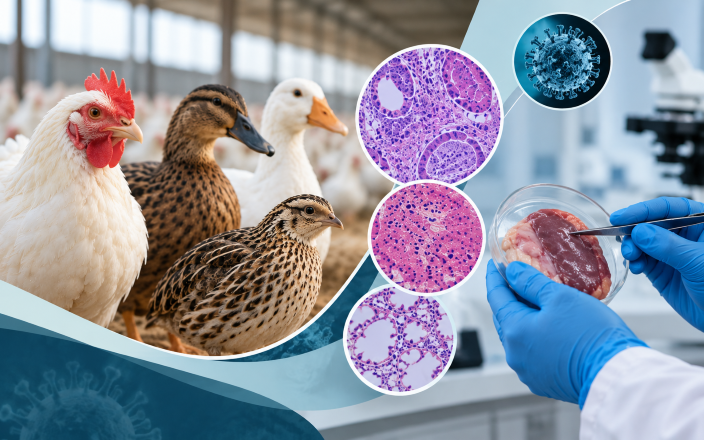
Highly pathogenic avian influenza (H5N1) can produce different patterns of organ damage across poultry species. Understanding these differences is essential for improving disease diagnosis, pathological investigations, and surveillance.
POULTRY HEALTH & PATHOLOGY
A Global Poultry-Health Challenge
Highly pathogenic avian influenza (HPAI), particularly the H5N1 clade 2.3.4.4b lineage, remains a major concern for poultry production and animal health worldwide. Beyond its rapid spread and potential to cause substantial mortality, understanding how the virus damages different organs is essential for improving disease diagnosis and surveillance.
A 2026 study published in Poultry Science investigated naturally occurring H5N1 infections in poultry in Taiwan, examining pathological changes across multiple species. The findings provide insights into how the same viral lineage can produce different disease patterns depending on the host species (1).
KEY SCIENTIFIC FINDING
The same H5N1 viral lineage can produce different patterns of organ damage and cellular responses across poultry species.
Different Species, Different Pathological Responses
Researchers examined samples from 41 H5N1-positive farms, including 23 chicken farms, four duck farms, ten goose farms, and four quail farms. The investigation combined gross pathology, histopathology, immunohistochemistry, and analyses of cellular apoptosis.
The researchers evaluated tissues from several organs, including the brain, heart, liver, spleen, lungs, kidneys, and pancreas.
CHICKENS
Widespread systemic infection, extensive tissue necrosis, and viral antigen distribution.
DUCKS
Generally milder lesions and a more coordinated apoptotic response.
GEESE
Intermediate pathological characteristics.
QUAILS
A distinct pattern involving prominent splenic lesions and different relationships between viral distribution, cell death, and tissue damage.
These differences demonstrate why clinical signs or examination of a single organ may not fully characterize the severity and distribution of HPAI infection (1).
Why Diagnostic Pathology Matters
Gross examination can identify visible abnormalities, including haemorrhages, organ enlargement, and tissue discoloration. However, these findings may overlap with those associated with other infectious diseases.
Histopathology allows veterinarians to examine tissue architecture and cellular injury under a microscope. Immunohistochemistry helps identify viral antigens within affected tissues, allowing investigators to assess viral distribution.
The study also investigated apoptosis, the regulated process of cell death. Comparing apoptotic signals with tissue lesions and viral antigen distribution helps clarify how infection and host responses contribute to organ damage.
A review of avian diagnostic pathology emphasizes the potential value of combining conventional pathological examination with molecular diagnostics, immunohistochemistry, and digital pathology. Artificial intelligence and machine learning may further support diagnostic interpretation and disease surveillance as these technologies develop (2).
Implications for Poultry Disease Surveillance
Pathological severity and viral distribution are not necessarily identical across poultry species. Diagnostic investigations should consider the host species, clinical history, affected organs, and laboratory findings rather than relying on one visible lesion or symptom.
For poultry veterinarians and diagnostic laboratories, a structured investigation combining necropsy, tissue examination, and confirmatory laboratory testing can support more accurate characterization of suspected outbreaks.
These findings do not establish a universal pathological pattern for every H5N1 infection. The study was based on naturally infected farms in Taiwan, and its results should be interpreted within that epidemiological context.
Nevertheless, the research strengthens the case for integrating species-specific pathology with laboratory confirmation and surveillance to improve understanding of HPAI and other emerging poultry diseases.
Scientific References
(1) Yi, Z.-J., Huang, Y.-I., Lin, Y.-J., Tsai, Y.-W., Cheng, M.-C., & Chen, Y.-M. (2026). Comprehensive pathological, immunohistochemical, and apoptotic analysis of the highly pathogenic avian influenza A virus H5N1 clade 2.3.4.4b in poultry in Taiwan. Poultry Science.
(2) Getnet, G. M., Getnet, M. A., & Atenaf, A. S. (2026). Advances in Avian Diagnostic Pathology: Current Trends, Challenges and Future Directions: A Review. Veterinary Medicine and Science, 12(3), e70905.