


The Ishikawa Diagram helps to analyze the factors that contribute to a problem in a structured manner, in order to identify the root causes that generate it. Identifying these causes facilitates the design of actions to be taken in order to control or eliminate the problem.
The Ishikawa diagram (also called fishbone diagram) is a type of Mind Map, in which the immediate or direct causes of the Central Problem are grouped into six (6) categories, called the six “M’s”. The purpose of grouping the causes in this way is to try to be as rigorous as possible in the analysis of the problem.
In turn, for each immediate cause, second-order, third-order, etc. causes can be identified, depending on the level of detail one wishes to achieve.
To illustrate the application of this technique, examples are presented of two situations that are highly relevant to the performance, quality, and safety of processed chickens.
CASE # 1
POORLY BLED CHICKENS
- Depending on the climate and altitude above sea level, the control parameters change. Furthermore, when the people performing the slaughter do not carry out their work properly and the automatic equipment is not properly calibrated, this quality issue also arises.
- Blood represents approximately 7% of the live weight. Commercially, between 45% and 50% of it is evacuated. It should be noted that blood is distributed as follows: 84% in the network of blood vessels and 16% in the various organs.
To keep this process within parameters, it is suggested to select a group of chickens during the shift and weigh them individually. Their live weight is equivalent to 100%. Before the animals enter the scalding tank, remove them from the hooks and weigh them again.
This weight difference should be around 3%. Therefore, the chickens should weigh 97% compared to the live chicken.

Poultry Slaughter in Warm Climates and altitude below 800 meters
Their cardiovascular physiology is characterized by vasodilation, to dissipate heat. Additionally, air enters the lungs with the highest possible pressure.
The appropriate bleeding time ranges from 1 minute and 30 seconds to 1 minute and 45 seconds. Each plant must establish the most suitable time.
Slaughter of chickens in temperate to cold climates, with altitudes above 800 meters
The animals arrive at the plant with dilated blood vessels. This specific detail can be clearly observed when opening the wings from the inside. In these climates, their physiology promotes vasoconstriction to conserve heat.
If to the previous situation we add the increase in altitude, which induces the birds to produce more red blood cells -the only ones capable of transporting oxygen – at the time of venous exchange, returning the blood to the heart properly oxygenated. Homeostasis is maintained because the pressure with which this gas enters the lungs is increased.
- Result: The extra amount of red blood cells increases the viscosity of the blood.
These special circumstances require increasing the bleeding time to between 3.0 and 3.5 minutes, thus avoiding the accumulation of blood in the wings. During the animals’ journey from the last plucking machine to the first automatic evisceration equipment, or in the carcass when the process is carried out manually, the floor is covered in blood just below the chickens’ path.
- In some plants, when the situation becomes critical, they resort to Electrical Stimulation, in order to increase the amount of blood evacuated.
- This detail – blood stored in the chickens – leads Quality Inspectors to partially or totally reject the birds. Such a decision affects the yield of the chickens being processed.

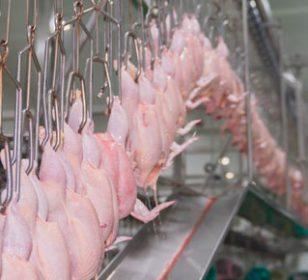
Slaughter
Regardless of whether it is manual or automatic the trachea and the nerve cord must be avoided from being severed. If this occurs, the birds die from asphyxiation and the interruption of messages sent by the brain that do not reach the heart, causing it to stop beating. In some countries, the trachea is cut due to special requirements. Depending on the presentation of the animal, quality inspectors partially or totally reject them, affecting the dry yield of the processed chickens.
- The control parameter for poorly bled chickens is 0.03% of the total number of processed birds.
CASE # 2
POORLY PLUCKED BIRDS
- A good plucking requires that the previous operations be carried out correctly, from hanging the birds on the overhead slaughter conveyor to their entry into the plucking machines.
- In fact, the removal of feathers requires careful handling.
Hanging
- Keep all hooks filled. Furthermore, the legs must be well secured and symmetrical. During plucking, empty hooks move excessively, injuring the chickens on the sides.
Path of the last hanger entry to the stunner
- If the birds are unsettled, during their transport they flap their wings with varying levels of intensity.
Causes
The breast massager is not properly adjusted and the path is not suitably darkened. For this reason, they arrive at the stunner stressed, preventing them from immersing their heads in the water tank and losing consciousness upon arrival. They pass through this section with their necks raised and flapping vigorously. This behavior is the result of the Pre-shock they feel upon entry. In some processing plants, this situation is not resolved; instead, the voltage and consequently the amperage are increased.
Stunning
This equipment meets one of the requirements of Animal Welfare. As the current increases, as mentioned previously, it causes greater muscle contraction, which tightens the feathers more within the follicle. The consequences of this anomaly are detected when the birds leave the last plucking machine. Feathers on the wings, thighs, and tail. Remember that the feathers of the wings and tail are the only ones inserted into the muscles.
Scalding
To achieve good quality in this operation, it is necessary for the following aspects to function properly:
- Temperature according to the type of chicken to be slaughtered: White (without epidermis) yellow (with epidermis).
- Time in accordance with the characteristics of the birds to be processed.
- Water agitation, uniform throughout the surface of the tanks, maintaining the initial level. When this requirement is not met, the water does not reach the skin, preventing the opening of the follicles and the detachment of the feathers. Consequently, their removal becomes more difficult.
Total immersion of the animals while they move inside the tanks. This condition is of utmost importance, since when the birds float, they tilt, causing the tail and wing feathers—which are the most difficult to remove, as previously mentioned—to rise to the surface.
- Since in the scalding tank the surface temperature measured at the breast is increased, it is necessary to maintain it until entry into the first plucking machine.
- Some plants have built tunnels in stainless steel for sanitary reasons.
Plucking
During this operation, the following specific details must be taken into account so that the chickens are plucked more than 96%.
- The discs must be complete and in good condition.
- The fingers on each of the discs must also be in proper condition.
- All hooks must be connected.
- The sprayers must supply water at a temperature between 34ºC and 38ºC. This film is directed towards the fingers in order to prevent them from overheating. Furthermore, it acts as a lubricating layer between the fingers and the chickens.
- The bodies of the plucking machines must be centered with respect to the path of the hooks.
- To increase the effectiveness in removing the wing feathers, these machines must have a downward inclination at the exits.

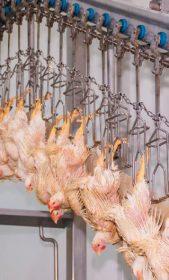
When these aspects among others, are not fully met, the birds are subjected to greater pressure that can tear the skin in the most fragile area: breasts, wings, and the upper part of the thigh near the tail. These damages may be considered partial or total, according to the quality inspectors, affecting the dry yield of the chickens involved.
PDF