


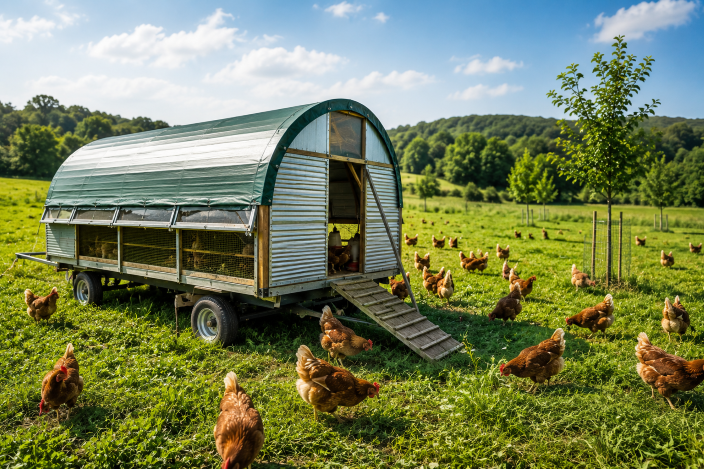
Moving the house to manage the production environment
Mobile poultry housing is becoming an increasingly relevant component of alternative production systems, particularly where producers want to combine outdoor access with more controlled management of pasture and flock movement. Unlike conventional free-range systems, where birds repeatedly use the same area around a permanent house, mobile housing allows the production environment itself to be relocated.
Modern systems range from small skid-mounted units to wheeled houses accommodating more than 2,000 laying hens. A 2026 field study involving 48 mobile houses on 42 farms found that mobile systems can provide good welfare outcomes, although management quality remained more important than the specific type of mobile house used (1).
The technical value of mobility therefore lies not simply in putting poultry on pasture, but in controlling where and when birds interact with the soil, vegetation and outdoor environment.
Rotation as a nutrient-management tool
Poultry manure contains valuable nutrients, particularly nitrogen and phosphorus, but repeated deposition in the same area can exceed the soil’s capacity to retain them. Birds also tend to congregate around the house, feeders, drinkers and shaded areas, creating localized nutrient hotspots.
Moving the housing unit can distribute these inputs over a larger area. Research and extension guidance indicate that frequent relocation can help reduce nutrient accumulation, erosion and vegetation deterioration around poultry houses (2,3).
However, there is no universal relocation interval. The appropriate frequency depends on stocking density, rainfall, soil type, vegetation growth, season and the condition of the range. Recent field research found that actual relocation was sometimes delayed because wet conditions prevented machinery from entering the pasture or because fresh pasture was unavailable (1).
This makes pasture monitoring essential. A mobile system should not be considered successful simply because the house moves; the rotation program must prevent persistent bare patches and excessive nutrient loading.
Biosecurity does not stop at the house
Mobility creates both opportunities and challenges for disease management. Moving birds to fresh areas can reduce prolonged exposure to contamination in heavily used sections of pasture. However, outdoor production simultaneously increases contact with soil, wild birds, parasites and other environmental sources of infection (4).
Equipment can also become a vehicle for transferring organic material between paddocks. Wheels, fencing equipment, feeders and water systems therefore need to be incorporated into the farm’s biosecurity program.
A mobile house should have a defined movement protocol, including inspection of the new site, management of equipment between locations and monitoring for signs of disease or excessive contamination.
The issue becomes particularly important during periods of avian influenza risk, when outdoor access may need to be restricted. The latest research on mobile layer houses identifies the need for alternative enrichment, predator protection and management strategies when free-range access is temporarily unavailable (1).
Ventilation remains a critical weakness
One of the greatest technical challenges is environmental control. Mobile houses are generally smaller and lighter than conventional poultry buildings, and some have limited insulation or mechanical ventilation.
This can become dangerous during hot weather. EFSA has identified heat stress as a particularly important hazard in mobile broiler systems, especially when houses have poor ventilation, insufficient insulation, direct solar exposure or excessive stocking density (5).
The solution begins with design. Houses should allow effective cross-ventilation, provide adequate roof insulation and minimize solar heat gain. Outdoor shade from trees or artificial structures is also important because birds may otherwise remain inside the house to escape direct sunlight, increasing internal stocking density and heat load (5).
For producers in hot climates, mobile housing should therefore be designed around the worst thermal conditions, not average weather.
Mobility requires engineering as well as husbandry
Moving a poultry house repeatedly places additional demands on structural design. Wheels, skids, flooring, feeders, water lines, doors and automatic systems must tolerate repeated movement.
Field projects have identified practical problems including insufficient summer ventilation, damage to lightweight materials, limited mobility, structural weaknesses, automatic-door failures and fencing difficulties (6).
These issues demonstrate that mobility should be treated as an engineering parameter. The easier a house is to move safely and consistently, the more likely producers are to maintain the intended rotation program.
From mobile housing to precision pasture management
The next development could be the integration of mobile houses with digital monitoring. GPS can record the location and duration of each move, while sensors can measure temperature and humidity inside the house. Soil testing can identify areas of nutrient accumulation, and cameras can determine how effectively birds use different parts of the pasture.
Combining these datasets could eventually allow producers to determine when a house should move based on pasture condition, soil nutrients, weather and bird behaviour rather than a fixed calendar.
Mobile poultry housing is therefore more than an alternative building design. When properly managed, it can become a precision tool for distributing poultry activity across the farm while balancing welfare, pasture health, nutrient management and biosecurity.
Sources
1. Dorkewitz, K., Keppler, C., Gieseke, D., et al. (2026). Opportunities and challenges of modern mobile housing systems for laying hen welfare – an observational study. Poultry Science, 105(8), 106992.
2. National Center for Appropriate Technology (NCAT). Pastured Poultry: Egg Production. Guidance on mobile housing, pasture rotation and nutrient distribution.
3. Effects of shelter type, early environmental enrichment and weather conditions on free-range behaviour of slow-growing broiler chickens. Animal, 2017. Research demonstrating the use of mobile houses and range repositioning to improve outdoor-area utilisation and reduce point pollution.
4. Pastured Poultry Production in the United States: Strategies to Balance System Sustainability and Environmental Impact. Frontiers in Sustainable Food Systems, 2019.
5. EFSA AHAW Panel. Welfare of broilers on farm. Scientific assessment of welfare risks in mobile systems, including heat stress, ventilation, stocking density and outdoor shelter.
6. EU CAP Network. Technological innovation line: Mobile Poultry Houses. Field-project findings on ventilation, mobility, structural design, predator protection and manure distribution.