Nutritional Recommendations in the Feeding Program for Growing Laying Hens
New genetic lines of laying hens are recommending that we extend production to 100 weeks of age, with a single goal: to reach 500 eggs per cycle. Apparently, genetic improvement does not end there; the next goal of geneticists is to reach 550 eggs per cycle.
- In the new genetic lines of laying hens, the level of persistence they show in the field is surprising.
- Some flock are reaching a persistence level 8 or 10% above the production curve recommended by the parent company.
- But this super layer has also brought challenges, not only in the implementation of new management practices but also in the nutrition of this bird.
- This article will address some nutritional aspects to consider in a feeding program for laying hens in order to achieve 500 eggs per cycle.
- This article describes each of the feeding phases based on the zootechnical objective that each bird should achieve according to its age, and then makes the relevant recommendations to describe the nutrients included in these diets.
- As is well known, the key to production lies in the rearing of the bird; therefore, we must focus on achieving efficient development in the formation of all structures (skeleton, reproductive system, digestive system).
- If the objective of each growth phase is not achieved, the bird experiences a negative growth balance; thus causing deficient development and negatively affecting laying.
- That is why it is advisable to analyze a feeding program based on the growth or production objective of each feeding phase or age of the bird.
To achieve a long-cycle layer, we will address the nutritional requirements of the bird during growth and laying.
1. PRE-STARTER DIET
- Duration Time: 1-2 weeks
- Objective: To promote the growth and maturation of the bird’s gastrointestinal and immune systems.
- Nutritional description of this phase:
- This nutritional phase requires an adequate protein intake.
- Studies mention that in this stage of growth, some amino acids are retained at a high percentage at the digestive tract level.
- This is with the sole objective of maturing and developing the gastrointestinal system of a bird.
- If we review a modeling curve to identify the days of pre-starter feed consumption of a bird, we can observe that it requires around 8 to 10 days of consumption of this diet.
One of the greatest challenges in this stage of growth is reaching the given standard weight, and it must be achieved to ensure that the entire digestive tract has reached that development.
- The energy level included in this diet must be thoroughly reviewed.
- In this first phase, consumption may range between 13 to 15 grams and in that volume, we must include all the nutrients of that phase.
- An important strategy to achieve the weight objective in this phase is the use of glutamine or arginine in the diet.
We must not forget that the immune system requires a high supply of nutrients, especially when it is developing.
- Including insoluble fiber in this stage is beneficial for the bird. It has been described that insoluble fiber helps to rapidly mature the gastrointestinal system.
- This effect is achieved due to the structure of insoluble fiber, which stimulates the walls of the intestine, causing an increase in villi and the production of endogenous amylases and proteases.

2. STARTER DIET
- Duration time: 6 weeks
- Objective: Develop the skeletal and muscular system of the bird.
- Nutritional Requirement:
- In this phase, we can decrease the percentage of protein.
- We must have properly developed the bird with the previous phase.
- In this stage, the bird is in a phase of exponential growth (modeled with the Gompertz equation) or what is known as protein-dependent metabolism.
The results obtained from the derivative in the Gompertz equation (aviNews magazine, October 2023) indicate that the maximum growth gain of the bird is at 8 weeks. Therefore, it is during this period that we must provide this diet.
If the diet or management (vaccination) does not allow the standard weight to be reached, we must continue administering this diet so that the bird reaches the target weight, even if this means a delay in production.
- In this stage, coccidia outbreaks are a problem; therefore, we must avoid the appearance of this disease on the farm at all costs.
- An outbreak of coccidia can affect a hen for life, causing a decrease in eggs during the productive cycle.
- In this stage, we must consider the application of fiber (soluble and insoluble), since fiber presents multiple benefits for the gastrointestinal system of a bird.
- A soluble fiber represents a food substrate for the bacteria of the gastrointestinal system.
Both the crop and the ceca have the highest bacterial loads; therefore, as we provide food substrates for the bacteria, they will become allies of the hen, thus achieving a hen with adequate performance. It is advisable to start by adding a coarse granulometry from the beginning. There is no need to be afraid of coarse grinds.
- In field experience, we have observed that at 9 weeks the bird is already able to digest adult bird grinds. To achieve this, we have started mixing different proportions of grinds until reaching the grind of an adult bird in 9-week-old birds.
3. GROWER DIET
- Duration time: 2 weeks.
- Objective: Transition between a starter and a development diet.
- General Recommendations for this Diet:
- This diet is no longer described in the genetic guidelines for commercial laying hens.
- However, it is advisable to review this feed phase in the rearing program.
- It is well known that birds do not like abrupt changes in their food.
- That is why the use of this diet is recommended, with the same nutritional profile as a development diet, but this diet should include 50% less fiber compared to the development diet.
4. DEVELOPMENT
- Duration time: 5 weeks
- Objective: Increase gizzard size, beginning of medullary bone growth.
- General Recommendations for the Diet:
- One of the main characteristics of this diet is the application of fiber to increase the size of the gizzard.
- With this phase, we should observe an increase in the size of the upper gastrointestinal tract of the bird.
- We must not forget that this phase prepares the bird to reach the target consumption of the production phase.
- We are closing this development phase at 16 weeks with a feed intake of 65 to 70 grams.
- To reach the expected intake during production, which is around 100-115 grams, we must develop this structure in order to achieve the parameters of the guide.
If fiber is not applied, we will observe low feed intake and, at some point in its production curve, the hen will begin to selfconsume.
- This self-consumption can become detrimental throughout the productive life and affect the number of eggs produced.
- The application of fiber to achieve this objective depends on the understanding of this nutrient.
- We must not forget that a soluble fiber can help achieve this objective.
An important characteristic of fiber is its water retention capacity.
- The way fiber reacts with water will determine the size of the fiber chain. And if the fiber increases in size in the gizzard, it will take longer to be released by the gizzard and the retention time in this organ is improved.
- We must not forget that insoluble fiber also plays an important role within the fiber matrix.

Insoluble fiber is responsible for increasing the retention of the food bolus at the cecal level. Therefore, we must make the perfect combination of soluble and insoluble fiber in the diet; the combination of both fibers provides benefits for the bird.
- An important point with this diet is that fiber dilutes nutrients. If it dilutes nutrients, the bird increases its intake.
- But if the dilution effect is too strong, the bird will be unable to ingest the proper concentration of nutrients for the growth and development of the organs at this stage.
- That is why we must understand the impact of fiber on the intake and development of the bird in this diet.

5. PRE-LAYING
- Objective: Prepare the bird for calcium intake.
- Time of action: 2 weeks.
- General Recommendations for the Diet:
- The pre-laying diet is a ration that should not be discarded within the feeding program.
- This diet should incorporate 50% of the calcium required for the egg production phase.
- We must not forget that an excess of calcium in the diet can depress intake.
If intake is depressed, we observe a deterioration in the bird’s body condition.
- That is why it makes sense to apply a pre-laying diet during the bird’s growth, since the bird has not yet stopped growing and we need to continue stimulating intake.
- The bird does not like abrupt changes in diet configuration; therefore, it is important to make imperceptible changes to avoid alterations in intake and growth.
6. STARTER OR BOOSTER
- Objective: Growth of the reproductive tract and onset of laying.
- Time of Application: 4-8 weeks.
- General Recommendations:
- This diet must provide the appropriate nutrient configuration so that the bird can begin production and avoid deterioration at the onset of laying.
- From week 18 to week 25, the bird is still growing and developing its entire reproductive system.
- At this stage, intake is reduced and the bird spends a few more weeks growing.
- The target tissue to be developed is the bird’s reproductive system.
It is in this phase where the administration of this diet becomes important. In this diet, the nutritionist must identify the appropriate intake of the farm and, based on this intake, design the nutrient requirements for this diet.
If the diet is formulated with a high intake requirement, the bird will not consume the nutrients included in the diet, given the low intake carried over from the previous phase.
- For this reason, a diet must be provided so that the bird reaches the target intake.
- Otherwise, we run the risk that the bird will fall into a negative balance and lose weight in the first weeks of production.


INTAKE/ENERGY REQUIREMENT/BIRD
- Pre-starter: (16/20g)=45-49 kcals/Bird/Day
- Starter: (42/47g)=119-127 kcals/Bird/Day
- Growth: (52/57g)=145-155 kcals/Bird/Day
- Development: (68/73g)=187-199 kcals/Bird/Day
- Pre-laying: (72/82 g)=200-245 kcals/Bird/Day
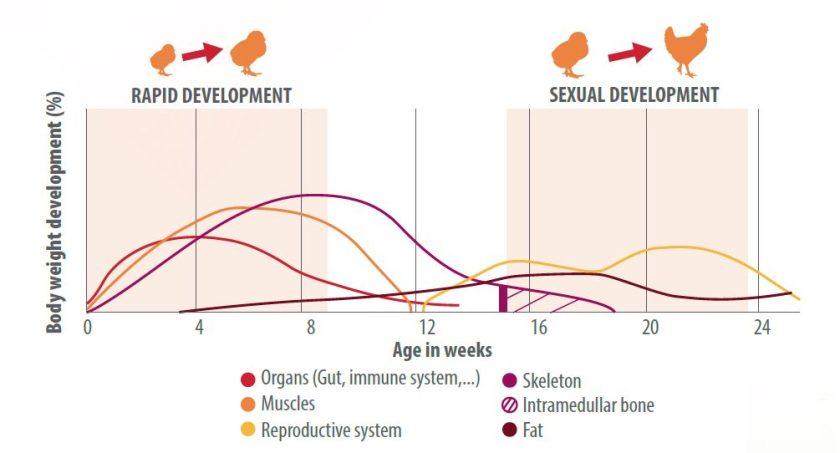
If the growth calculation is performed using the Gompertz equation and we obtain the derivative at the point of maximum growth, we will observe that the Gompertz value is the same as described in this infographic, with 8 weeks being the period of maximum growth for the bird (exponential growth). See description in Figure 1.
Therefore, a model such as the one previously described helps us understand that from week 1 to week 8, the bird is in a protein-dependent requirement for development.
- The bird is in a protein-dependent metabolism for the development of organs (gastrointestinal and immune systems), muscle, and skeleton.
After 8 weeks, the bird gains weight only marginally. The reproductive system requires about 12 weeks for development; it is not a compartment that requires many nutrients, but we must still provide the appropriate nutrient configuration for its development.
As it is a developing tissue, we must not forget to include the arginine requirement for the development of this tissue and thus ensure that the egg factory develops properly.
- In terms of energy, we must remove from our minds the values of energy per kilogram. For example, ME/kg.
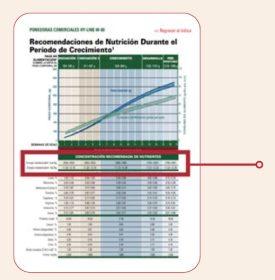
- On the left side of this infographic, in the yellow box, we see the energy requirement per kilogram of feed. Description Figure 2.
However, the correct way to describe the bird’s energy requirement is the calculation of calories per day. When we obtain the level of calories per day and divide it by the intake, what we obtain is the energy requirement per kilogram.
In the box on the right, the energy requirement of calories/bird/day is described. If we divide these values by the target intake, we will obtain the energy value of the diet. Therefore, it is essential to know the target intake of the farm in order to develop a more tailored nutrition program for the growth of a laying hen.
We must provide the appropriate energy requirement so that the bird does not compromise the development achieved; otherwise, the onset of laying will be affected.
CONCLUSIONS:
- The key to the success and persistence of laying is in the development and growth of the bird. Therefore, it is of utmost importance to evaluate a bird growth program in order to achieve productive parameters on the production farm.
- We must carry out an evaluation of each of the compartments described in allometric growth, so that we can translate that growth into nutrient requirements within the diet.
- The variable, feed intake, is the starting point for the development of a feeding program for a growing bird.