


Content available at:
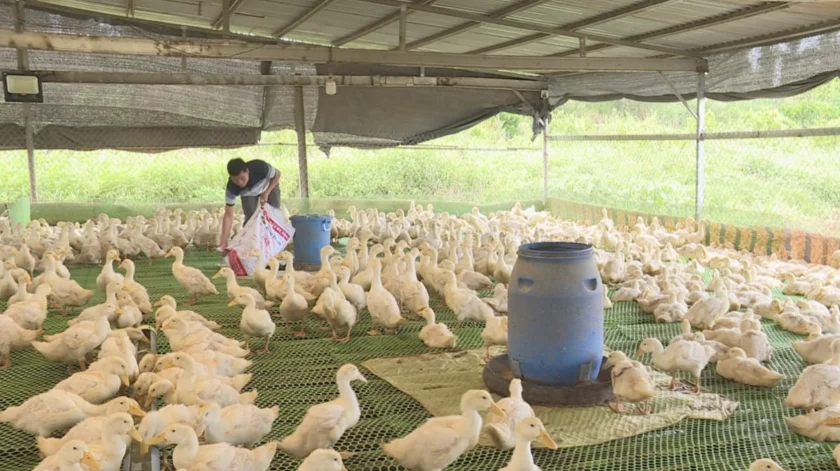
On June 9, the Quang Tri Provincial Agricultural Extension Center announced the successful implementation of a new biosecure floor-rearing model for meat ducks, combined with a product consumption linkage system.
This model not only delivers outstanding economic efficiency – yielding 1.5 times higher profit compared to traditional rearing methods, but also paves the way for a sustainable approach to duck farming, especially in the face of increasing climate change and disease risks.
The pilot model was implemented in three localities: Hai Hung Commune (Hai Lang District), Trieu Co Commune (Trieu Phong District), and Gio Hai Commune (Gio Linh District), using 1,000 imported Grimaud ducks from France at each site.

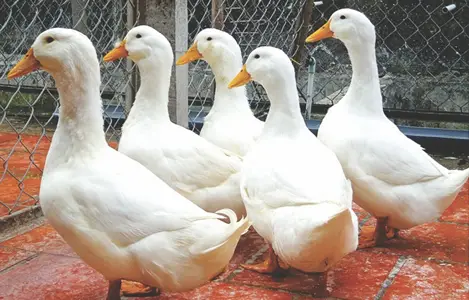
Grimaud is a meat duck breed developed by the Grimaud Group (France).
It stands out for its rapid growth rate, short rearing period, strong adaptability to tropical climates, and high meat yield, making it well-suited for industrial and semi-industrial farming in Vietnam.
A breakthrough feature of the model lies in the shift in rearing method:
- Instead of traditional pond or free-range farming, the ducks are raised on elevated slatted flooring systems (40–50 cm above ground).
- The flooring is designed with slats 1-1.5 cm apart, allowing waste to fall through. The sloped surface underneath facilitates easy collection and cleaning, ensuring better hygiene and reducing the risk of disease outbreaks.
After 1.5 months of rearing, the ducks reached an average weight of 3.2 kg per bird, with a survival rate of up to 95.7%.
At a selling price of approximately USD 1.68/kg, each model site earned around USD 748 in profit after expenses – 1.5 times higher than traditional methods.
A sustainable path for duck farming in the modern era
Beyond economic gains, the model brings multiple additional benefits:
- Shortened rearing cycle, faster flock turnover: Farmers can raise 4-5 batches per year, increasing output and improving cash flow.
- Reduced environmental pollution: Waste and wastewater are centrally collected, minimizing soil, water, and air pollution-common issues in traditional pond-based models.
- Lower disease risk and veterinary costs: Floor-rearing helps isolate ducks from environmental pathogens, reducing antibiotic use and improving the quality of duck meat-an advantage aligned with current clean and safe food consumption trends.
The adoption of this biosecure floor-rearing model is not only a technical advancement, but also a step toward modern, circular, and sustainable agriculture.
It presents an opportunity for small-scale farmers to shift toward professional practices, thereby enhancing competitiveness and ensuring food safety for both domestic and export markets