


Content available at:
Vietnam’s poultry industry is expected to maintain strong growth through early 2026, ensuring stable supply for Tet and expanding export potential.
This outlook was shared at the Vietnam Poultry Association‘s seminar ‘Enhancing the competitiveness of Vietnam’s poultry industry’, held on October 10 during Vietstock 2025 Expo & Forum in Ho Chi Minh City.
The event brought together industry leaders to assess production trends, market dynamics, and structural challenges as Vietnam’s agriculture shifts toward modernization and sustainability.
Nguyen Quy Khiem, Vice Chairman and General Secretary of the association, emphasized that poultry farming has become one of Vietnam’s most dynamic and steadily growing sub-sectors. He noted its central role in the country’s broader push for efficient, sustainable, and modernized food production.
Meanwhile, Chairman of the association, Nguyen Thanh Son forecast that poultry production and trade would sustain momentum in Q3 2025 and into Q1 2026.
This continuity ensures a stable supply of poultry meat and eggs for the Tet holiday season, when consumer demand typically peaks.
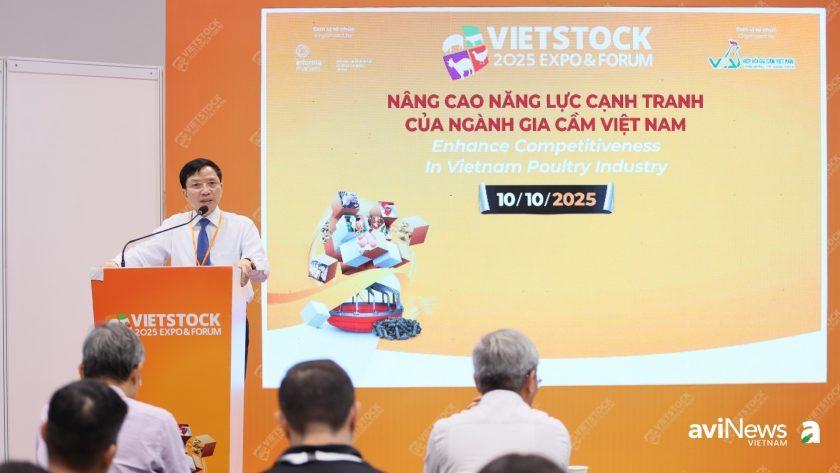
Dr Nguyen Thanh Son, Chairman of the Vietnam Poultry Association.
Vietnam’s poultry sector benefits from several advantages: a short production cycle, fast capital turnover, reasonable investment costs, and products that fit the Vietnamese dietary profile. These strengths not only meet domestic demand but also expands export potential.
Key parameters in end-2024 show:
- Total poultry flock: Over 575 million birds, up 2.8% from 2023.
- Flock composition: Chickens 72.5%; ducks and geese 27.5%
- Poultry meat output (live weight): 2.43 million tons, up 3.4% year-on-year.
- Egg production: 20.2 billion eggs, up 5.4% year-on-year
A dynamic industry still facing major challenges
Despite strong growth, Dr Khiem also pointed out several bottlenecks hindering the industry:
- Breed management remains inconsistent, with small-scale farms adjusting flock sizes based on short-term market trends, supply-demand imbalances.
- High production costs continue to pressure farmers, as over 65% of raw materials and 90% of feed additives are imported.
- Disease risks remain significant, especially among household-scale farms lacking adequate infrastructure, veterinary equipment, and effective disease control systems.
- Limited processing capacity means most poultry products is sold fresh, resulting in resource waste, low added value, and weak international competitiveness.
Strategic reforms will be key to unlocking Vietnam’s full poultry potential. These will ensure resilience, competitiveness, and growth in both domestic and global markets.