
Vietnam’s Q1 2026 meat exports rise in value despite volume drop
Vietnam’s meat industry is demonstrating two major trends: enhancing export value and diversifying export markets.

Available in other languages:
This post is also available in:
Vietnam’s meat industry recorded encouraging gains in export value and international market expansion during Q1 2026, even as shipment volumes fell.
Export performance in Q1
Data from the Vietnam Customs Department, meat and meat product exports showed a clear divergence between volume and value performance:
- Export volume: 4600 tons (down 13.7% year-on-year)
- Export value: USD 33.32 million (up 11.3%)
- Export destinations: 21 countries and territories
Market insight: The contrast between lower export volumes and higher export value indicates that Vietnamese exporters are increasingly focusing on higher value-added products or benefiting from stronger global meat prices.
Market developments and destinations
Vietnam currently maintains exports to 21 international markets, with mixed performances across destinations.
Hong Kong remained the largest market, accounting for more than half of total export value. However, shipments dropped 36.2% year‑on‑year, mainly suckling pork and frozen whole pigs..
Several traditional markets, including Canada, Malaysia, South Korea, and the Netherlands, recorded downturns.


By contrast, exports to China, France, Singapore, Japan, the United States, and Cambodia grew, underscoring Vietnam’s push to diversify and reduce reliance on traditional partners.
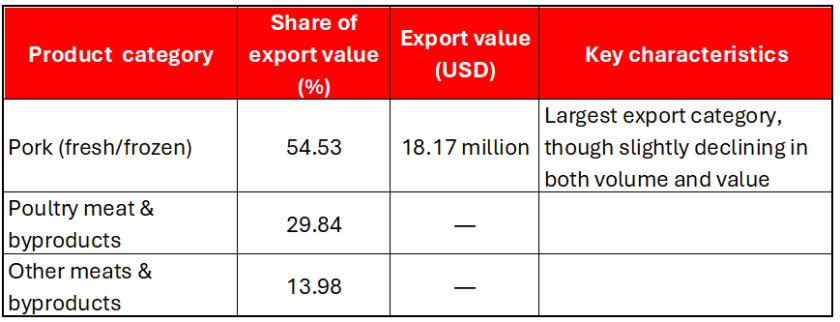
Export product structure
Industry outlook and trends
Despite global economic uncertainties, two clear trends are shaping Vietnam’s meat industry.
Exporters are prioritizing product quality and value‑added processing to sustain revenue growth despite declining shipment volumes.
At the same time, diversification into demanding markets such as the US, France, and Japan is expected to strengthen long‑term sustainability and reduce risks from overreliance.
Related to Trends

News 09 Nov


aviNews International will be covering EuroTier 2026

News 26 Oct
Brazil’s Newcastle Disease Outbreak Raises Concerns Over Global Poultry Trade

Article 25 Sep
Beyond Bedding: Turning Poultry Litter Management into a Welfare Strategy

Article 09 Sep
Multispectral AI for Early Detection of Poultry Health Problems

Article 04 Sep
World’s Poultry Congress: Global Poultry Sustainability

Article 18 Aug
Hyperspectral Imaging in Poultry Hatcheries

News 04 Aug
VETCONVERGENCE 2026 – 2nd edition of Vice chancellors meets supported by IPEMA-Poultry India Concludes Successfully

News 03 Aug
A New AI technology for Chick Sexing