


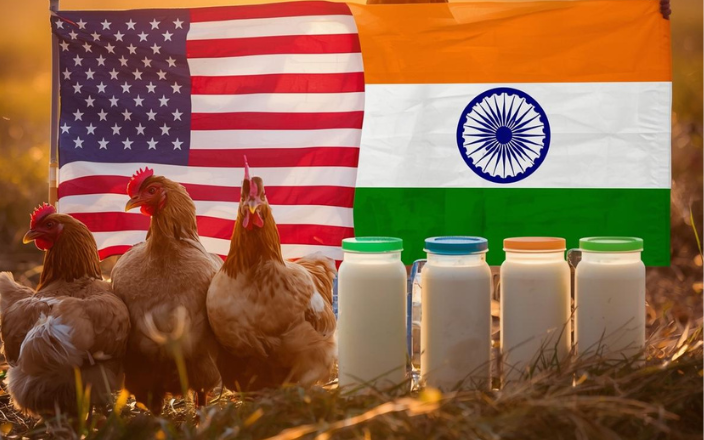
The recent announcement of a trade agreement between the United States and India has drawn attention across multiple sectors of the Indian economy. Under the agreement, the United States will reduce reciprocal tariffs on Indian goods from 25 per cent to 18 per cent, while India has agreed to eliminate tariffs and non-tariff barriers on US products.
- The announcement was made following a phone call between US President Donald Trump and Indian Prime Minister Narendra Modi.
- While the deal is being presented as a broad boost to bilateral trade, its implications for India’s poultry and dairy industries require careful examination.
- Both sectors are deeply linked to rural livelihoods and food security, and any change in trade policy tends to generate concern among farmers and processors.
Poultry: Competitive Pressure, Not a Crisis
India’s poultry industry has grown rapidly over the past two decades. It is now one of the most efficient producers of broiler meat and eggs globally, supported by integrated companies, contract farming, and a strong domestic market.
- Removal of tariffs on US poultry products could introduce some competitive pressure, particularly in the processed and frozen chicken segment.
- US exports, especially chicken leg quarters, are often priced low in international markets due to large-scale production and domestic consumption patterns that favour white meat.
However, several structural factors limit the immediate impact on Indian poultry farmers. Indian consumers overwhelmingly prefer fresh chicken over frozen imports. India maintains strict sanitary and phytosanitary regulations, including controls related to avian influenza. Cold-chain infrastructure for imported frozen poultry remains limited outside major cities.
As a result, any increase in imports is likely to be concentrated in institutional buyers such as hotels, quick-service restaurants, and airline catering, rather than the retail market.
For large poultry integrators and processors, the deal may lead to tighter margins and increased competition. For small and medium farmers supplying the domestic fresh market, the impact is expected to be limited in the short term.
Dairy: Strong Domestic Safeguards Remain
India is the world’s largest producer of milk, with the dairy sector supporting more than 80 million rural households. Unlike poultry, dairy is not just a commercial industry but a social and political pillar of the rural economy.
- Despite the commitment to remove tariffs and non-tariff barriers, significant regulatory hurdles continue to restrict US dairy imports into India.
- These include requirements related to animal feed practices, traceability, and certification, which are rooted in cultural, religious, and food safety considerations.
- Most US dairy producers currently do not meet these conditions, making large-scale imports of milk, butter, or milk powder unlikely.
Where some movement may occur is in niche segments such as whey protein, lactose, and specialised dairy ingredients used by the food processing and nutrition industries. These products do not directly compete with fresh milk sold by Indian farmers.
For the vast majority of dairy farmers, cooperatives, and milk unions, the trade deal does not pose an immediate threat.
The Longer-Term Question
While the immediate impact on poultry and dairy appears manageable, industry stakeholders remain cautious about the future. Trade agreements often evolve over time, and pressure can build to ease standards or expand market access through subsequent negotiations.
- Any dilution of sanitary regulations would affect poultry first, given its higher exposure to global trade.
- Dairy, due to its political sensitivity and scale of rural dependence, is likely to remain protected for longer.
The US–India trade deal marks a significant development in bilateral economic relations, but its effects on agriculture are uneven.
For poultry, the agreement may increase competition in specific segments, particularly processed and frozen products, without fundamentally disrupting domestic production. For dairy, strong regulatory and structural safeguards continue to protect farmers from import surges.
For now, the deal calls for vigilance rather than alarm. Much will depend not on the announcement itself, but on how its provisions are implemented on the ground.
*In 2024, the U.S. exported $5 billion in chicken products (3.25 million metric tons) and $8.2 billion in dairy products, driven by strong demand for cheese and powders, with Mexico, Canada, and China serving as top markets. U.S. chicken exports are fueled by high demand for dark meat, while dairy exports are supported by high production and competitive pricing.
U.S. Chicken Exports (2024)
- Total Value: ~$5 billion.
- Volume: 3.25 million metric tons.
- Top Markets: Mexico (largest), Canada, China, Taiwan, and the Philippines.
- Key Products: Dark meat (leg quarters, drumsticks, thighs) and, notably, chicken paws to Asia.
- Market Significance: Approximately 1 in 5 pounds of chicken produced in the U.S. is exported.
- Competition: The U.S. is the second-largest exporter, with Brazil being the top competitor.
U.S. Dairy Exports (2024)
- Total Value: $8.2 billion, representing nearly 5% of total U.S. agricultural exports.
- Top Markets: Mexico (purchasing nearly one-third), Canada, and China.
- Key Products: Nonfat dry milk (NFDM), skim milk powder (SMP), whey, cheese, and butterfat.
- Production Drivers: High milk production in late 2024/2025 and new cheese processing capacity have boosted export capacity, even amidst high domestic supply.
Key Trends
- Growth: In early 2025, U.S. dairy exports on a milk-fat basis saw significant, high-percentage increases compared to the previous year.
- Trade Relations: The top three markets (Mexico, Canada, China) are central to U.S. dairy trade, notes American Farm Bureau Federation.
- Industry Drivers: A strong, growing international demand is considered crucial for the economic health of the U.S. chicken industry, according to the National Chicken Council.
Sources: Available upon request