There is no hotter topic in the poultry industry than feed. For every farmer and integrator, feed is the lifeblood of the business.
- In many production systems, feed costs can account for more than 60-70% of total production costs.
- Therefore, every percent of efficiency gained, no matter how small, can have a significant impact on profit margins.
However, feed formulations do not mix ingredients according to a table. Variations in corn quality between regions, differences in air content, storage processes, or even the age of the chickens can make an ideal formulation on paper but suboptimal in the field.
This is where artificial intelligence (AI) is starting to attract the attention of nutritionists.
- AI is no longer just a digital trend. It is now a strategic tool for understanding nutritional complexity, processing cross-source data, and designing formulations that are truly precise – tailored to the chickens’ needs, not just averages.
From ‘nutrition tables’ to ‘live data’
For decades, traditional formulation systems have used a raw material composition table approach: a single number for each ingredient, assumed to represent its overall nutritional value.
The problem is these statistical tables, while the real world is dynamic.
Metabolizable energy content of corn can vary by up to 300 kcal/kg between batches, lysine levels of soybean can differ by 5-8%, even the same enzyme can produce varying results depending on the phytate level and calcium-phosphorus ratio in the ration.
- AI can bridge this gap by combining thousands of data sets—from laboratory test results, in-vivo digestibility tests, farm performance data, to omics (microbiome and metabolomics).
- Through machine learning algorithms, AI systems learn patterns of relationships between feed composition, chicken response and economic outcome.
- Thus, formulations are no longer based on ‘assumptions’, but on live, continuously updated data.

Three pillars of AI in modern feed formulation
[1] Metadata synthesis & meta-analysis
AI begins its work by collecting metadata. Data from raw material test results, digestion results, journal publications, and farm data.
- Through meta-analysis and machine learning regression, the system can reflect the effects of various factors (e.g., enzyme type, phytate level, or processing temperature) on nutrient digestibility.
- For example, if there are 100 studies on the effects of phytase, AI can calculate the average digestible phosphorus release contextually. So, nutritionists know how realistic matrix values to use.
[2] Nutrient matrix modeling
Nutrient matrices have become a key concept in modern feed optimization.
- Additives such as enzymes, probiotics, or organic acids are now considered not just ‘supplements’, but rather as nutrient sources that can predict decline.
AI, using a hybrid Bayesian-empirical model, can calculate conditional matrix values. For example, how much phosphorus digestibility can be restored by phytase in a high-phytate corn diet, or how much energy can be saved by using the NSP enzyme in 28-day-old broilers.
- As a result, formulation becomes much more accurate and efficient. Nutrition is no longer excessive but remains safe and optimal.
[3] Precision formulation & adaptive feeding
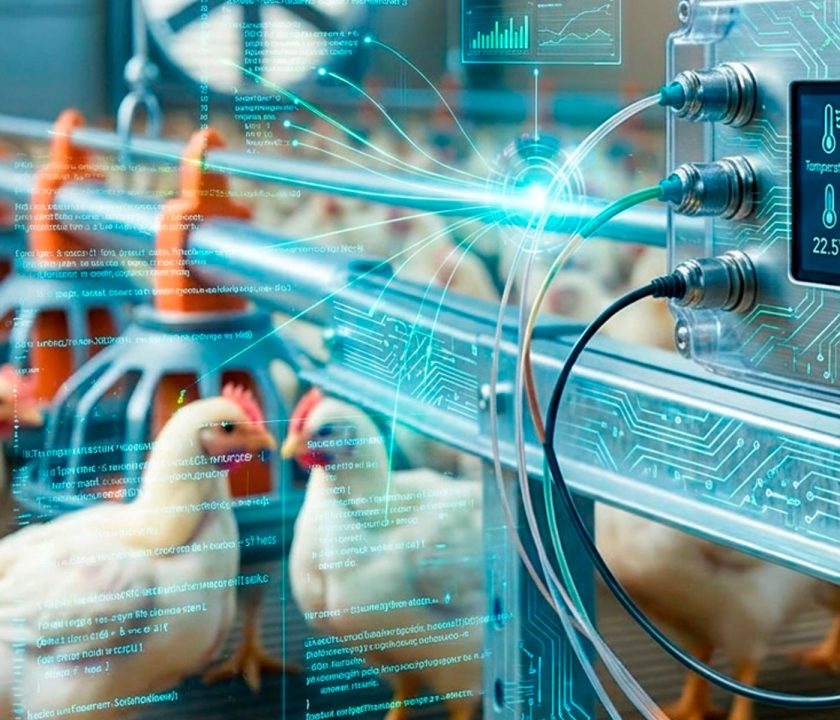
The highest level is precision formulation system, where AI adjusts the formula based on real-time data from the barn.
- IoT sensors record temperature, humidity, feed consumption, and weight gain; the system then provides automatic recommendations for changing energy density, amino acid content, and even feed phase.
- For example, when environmental temperature rises and feed intake falls, the system will recommend increasing the energy per kg of feed to maintain growth targets without overfeeding.
This is what is called ‘AI coming to the barn’, making nutrition adaptive to real-world conditions.
Concrete benefits for industry
Improved feed efficiency and performance
- Meta-analyses have shown that when matrix values and field conditions are incorporated into the model, chicken performance improves significantly.
- Feed conversion ratio (FCR) can increase by 2-3 points simply due to more precise formulation.
Cost savings and raw material prediction
AI can predict raw material variability based on supplier data and previous batches.
- This allows formulators to reduce the safety margin that has historically been a source of over-formulation.
- Furthermore, AI systems are capable of procurement forecasting: when to purchase certain ingredients or when to substitute alternatives based on predicted price and quality.
Environmental impact and sustainability
- With more precise nutrition, nitrogen and phosphorus excretion decreases. This means less waste pollution, cleaner air, and reduced regulatory pressure on livestock emissions.
- Several global companies, such as Adisseo (with Adict/Nestor) and DSM (with the PNE system), are already using this approach to support low-carbon feed strategies.
Between hopes and challenges
Despite its tremendous potential, implementing AI in feed formulation is not as simple as pressing the ‘run model’ button. There are several real challenges, including:
- Data quality: AI is only as strong as the data we input. Laboratory data must be standardized, sensors must be calibrated, and farm records must be consistent.
- Transparency and trust: Overly complex (black box) AI models are sometimes difficult for nutritionists to trust. The solution is a hybrid model that combines biological logic with algorithmic predictions.
- Initial investment: Implementing AI requires expensive infrastructure (software, sensors, human resources). However, long-term ROI typically recovers the initial costs within 1-2 years.
- Field validation: Each model needs to be tested in real-world settings. Controlled trials and commercial validation are key to the acceptance of this technology by regulators and industry.

Collaboration: When nutritionists and data scientists work together
AI does not replace humans but rather expands their capacity.
- Experienced formulators remain the ‘navigators’, while AI acts as a ‘co-pilot’, providing rapid analyses and simulations.
- Collaboration between nutritionists, data scientists, and feed technologists will determine the direction of this industry’s progress.
- In fact, in some large companies, new positions have emerged, such as Feed Data Engineer or Digital Nutrition Manager, indicating that the future of feed formulation will become increasingly digital.
Research and future directions
Several research priorities are being pursued, such as standardization of raw material databases. A global metadata format is needed to enable data transfer between laboratories and feed mills.
- Microbiome and metabolomics integration: The relationship between nutrition, microbiome, metabolites, and chicken performance will be a new frontier in precision nutrition.
- Causal AI & explainable models: Developing AI models that can explain why and how recommendations are made, not just the result.
- Field validation and economic simulation: Measuring the real impact of AI on FCR, mortality, uniformity, and margin over feed cost at the commercial level.
Reflection: Precision nutrition as the future
The application of AI in poultry feed formulation is no longer a futuristic concept. It is already happening today in various feed mills and integrators worldwide.
Amidst volatile raw material prices, margin pressures, and sustainability demands, AI is a strategic solution that offers efficiency, accuracy, and sustainability all at once.
- However, success does not come from technology alone. A new mindset is needed that feed formulation is not simply the art of mixing ingredients, but the art of managing data – data that ‘speak’ to the chickens, ingredients, and housing conditions.
As algorithms begin to penetrate the cage, the future of poultry nutrition will no longer be determined by static tables, but by data that continuously learn.
- AI is ushering in a new era where every gram of feed can be calculated, predicted, and optimized to deliver optimal performance with minimal environmental impact.
- AI is not a replacement for nutritionists. It is a new partner that helps them understand chickens better than ever before.
“Precision formulation is not just about calculating nutrients but reading the language of data. So, chickens grow optimally, businesses are efficient, and the planet remains sustainable.”